
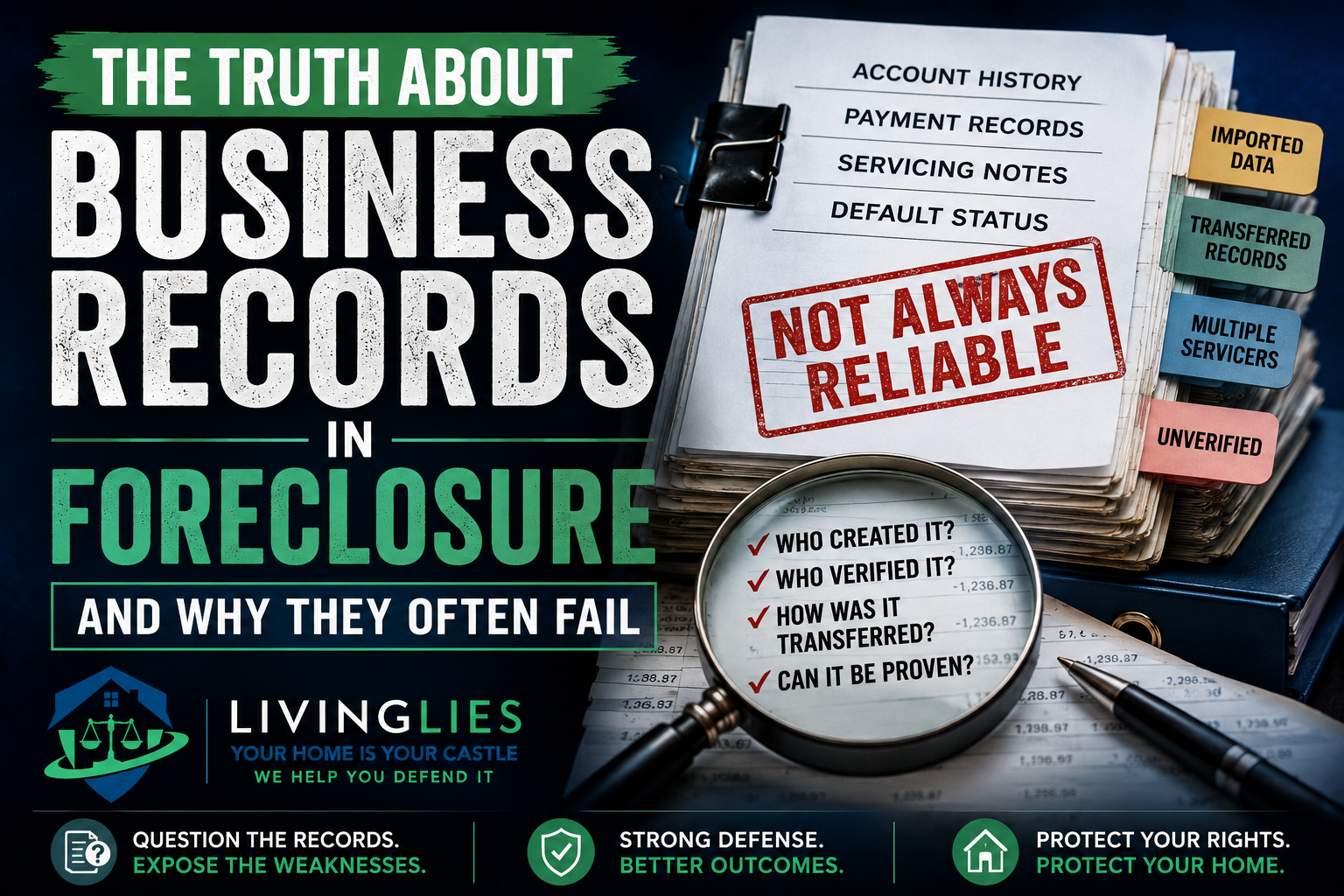
Most foreclosure cases appear overwhelming because they come wrapped in business records.
Payment histories. Affidavits. Default letters. Computer printouts. Servicing notes.
And all of it is usually presented to the homeowner—and often to the court—as if it automatically proves the case.
But here is the problem:
Most foreclosure cases are built on what are called “business records,” and many of those records are far weaker than they appear.
This is one of the biggest misunderstandings in foreclosure litigation concerns these business records in foreclosure. Homeowners often assume:
If it is in the file, it must be true.
That is not how evidence works.
The issue is not whether records exist.
The issue is whether the records are admissible, reliable, and supported by a proper legal foundation.
And in foreclosure cases, that foundation is often weak.
What Are “Business Records”?
Business records are documents allegedly created and maintained in the ordinary course of business.
In foreclosure litigation, they are usually offered to prove:
- payment history,
- default status,
- amounts due,
- ownership claims,
- and servicing activity.
The foreclosure industry depends heavily on these records.
Without them, many cases would collapse.
That is why the issue matters so much.
The Illusion of Reliability
Courts are often told that business records are inherently reliable because companies depend on them for daily operations.
But foreclosure records are different from ordinary business records in one important way:
They are frequently transferred, summarized, imported, merged, and recreated across multiple servicing systems.
That changes everything.
A payment history may look official.
But where did the data come from?
Who entered it?
Who verified it?
Was it ever audited?
Those questions are often unanswered.
The Servicing Transfer Problem
Most loans pass through multiple servicers over time.
One company services the loan for several years.
Then another takes over.
Then another.
Each transfer involves massive data migration.
And that creates serious reliability concerns.
Because when data is transferred from one system to another, errors can occur:
- missing transactions,
- incorrect balances,
- misapplied payments,
- duplicate fees,
- or corrupted records.
Yet foreclosure witnesses often testify about those records as if they personally know the entire history.
Usually, they do not.
The Witness Problem
This is where many foreclosure cases become vulnerable.
The witness testifying about the records is often:
- an employee of the current servicer,
- who did not create the original records,
- did not work for prior servicers,
- and has no personal knowledge of earlier servicing activity.
Instead, the witness relies on computer screens and imported data.
That creates a major evidentiary issue.
How can somebody testify reliably about records they did not create and events they never observed?
The Foundation Requirement
Business records are not automatically admissible.
A proper legal foundation must be established.
That foundation usually requires testimony showing:
- how the records were created,
- who created them,
- how they were maintained,
- how they were transferred,
- and why they are reliable.
In many foreclosure cases, this foundation is weak or incomplete.
The witness may simply state:
“These are business records maintained in the ordinary course of business.”
But that statement alone does not prove reliability.
The Boarding Process Myth
Servicers often claim they “boarded” prior records into their own system.
That means they imported data from a prior servicer.
Then they argue that because the records were incorporated into their own system, the records are automatically reliable.
But this raises obvious questions:
- Did anyone verify the records?
- Was the data audited?
- Were payment histories confirmed independently?
- Or did the servicer simply accept the data blindly?
Many witnesses cannot answer those questions clearly.
The Real Problem With Foreclosure Evidence
Foreclosure litigation often creates the illusion that computer records equal truth.
But computers only store information entered by people.
If the underlying information is flawed, the records are flawed.
And if the witness cannot explain how the records were created and verified, reliability becomes questionable.
Why Homeowners Lose This Argument
Many homeowners know the records are wrong.
But they make a critical mistake.
They argue emotionally instead of evidentially.
Saying:
“The records are fake.”
is not enough.
The better approach is to challenge:
- foundation,
- personal knowledge,
- verification procedures,
- transfer reliability,
- and admissibility.
That is how evidence-based foreclosure defense works.
The Hearsay Problem
Business records are often admitted as an exception to hearsay rules.
But the exception still requires reliability.
If the witness cannot establish reliability properly, the records may not qualify.
This becomes especially important when records originate from multiple prior servicers.
Why This Changes Cases
If the records are weak, then the entire foreclosure case weakens.
Because the records are used to prove:
- default,
- amount due,
- ownership claims,
- and payment history.
Those are core elements of the case.
If the evidence supporting those elements becomes unreliable, the case itself becomes vulnerable.
The LivingLies Approach
The goal is not to argue conspiracy theories.
The goal is to force proof.
That means:
- challenging weak foundations,
- forcing explanation of transferred data,
- questioning witness knowledge,
- and exposing assumptions hidden inside servicing records.
- and most importantly, challenge the legal standing of the “pretend lender” to foreclose a lien that is no longer associated with the claimed debt. (ask us how we do this at livinglies. Many of our wins are based on the fact that the debt in question is actually now unsecured and cannot be used to foreclose)
Learn more here: Who really owns your loan?
Foreclosure cases are often built on routine assumptions.
Once those assumptions are challenged properly, the appearance of certainty begins to collapse.
Why Courts Sometimes Miss This
Foreclosure cases move quickly.
Judges see large volumes of similar affidavits and records.
Over time, the process becomes routine.
But routine does not equal reliability.
And when the issue is presented carefully and professionally, courts sometimes take a much closer look at the records than the servicers expect.
What Homeowners Should Be Asking
- Who created these records?
- When were they created?
- How were they transferred?
- Who verified them?
- Does the witness actually know the answers?
Those questions matter far more than emotional arguments.
Homeowner Call To Action
Do Not Assume the Records Are Correct
Most homeowners lose foreclosure cases because they assume the servicer’s records are automatically accurate.
They are not.
At LivingLies, we help homeowners and lawyers analyze:
- servicing records,
- payment histories,
- business record affidavits,
- boarding process defects,
- and evidentiary weaknesses.
Before you accept the servicer’s version of events, force the records to be examined carefully.
Click here to request help analyzing your foreclosure case.
Internal LivingLies Resources
- Servicer Authority Problems
- Chain of Title Defects
- Standing in Foreclosure Cases
- How to Read a Foreclosure Complaint
Frequently Asked Questions
Are business records automatically admissible in foreclosure cases?
No. A proper foundation and proof of reliability are still required.
What is the boarding process in mortgage servicing?
The boarding process refers to importing records from a prior servicer into a new servicing system.
Why are transferred servicing records a problem?
Because the current witness may lack personal knowledge about how prior records were created or verified.
Can foreclosure records contain errors?
Yes. Servicing transfers and imported data can create inaccuracies and reliability concerns.
Search Our Blog
Categories
Contact Our National Headquarters Phone: 844-583-5339
Connect with us


Contact Our National Headquarters
- 844-583-5339
- Available 24/7
-
200 S. Andrews Ave. Ste. 604
Ft. Lauderdale, FL 33301