
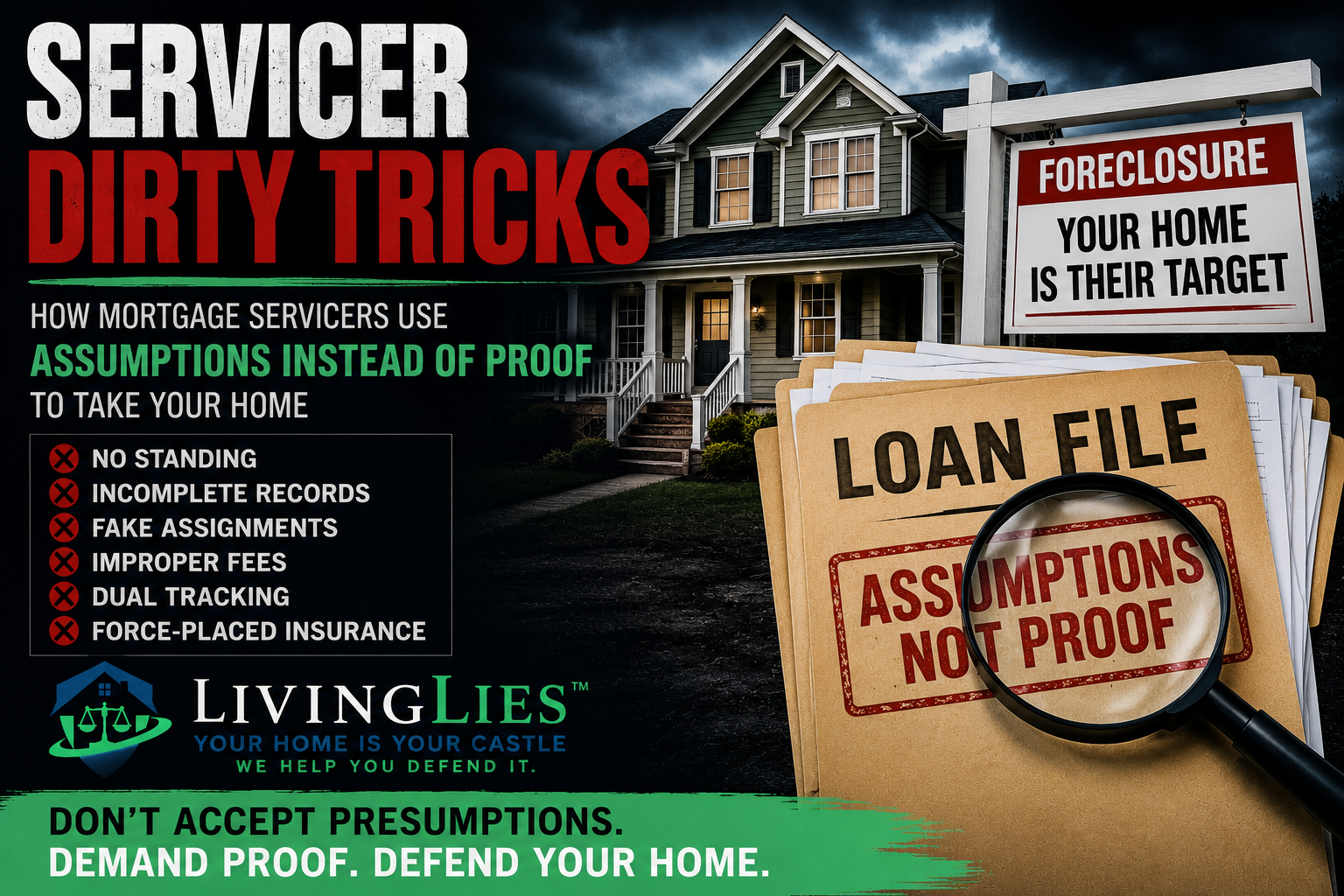
Because of some mortgage servicer dirty tricks the foreclosure process is not clean, fair, or based entirely on verified evidence. Let’s stop pretending mortgage servicer’s are above dirty tricks in foreclosure.
In many foreclosure cases, the real battle is not between a homeowner and a true lender. The battle is between a homeowner and a mortgage servicer that may not own the debt, may not have suffered any financial loss, and may not even possess admissible evidence proving the right to enforce the loan.
Companies like Shellpoint, Wells Fargo, JPMorgan Chase, and Mr. Cooper frequently appear in foreclosure litigation across the country. And while every case is different, homeowners and attorneys repeatedly report similar patterns:
- missing paperwork
- conflicting loan histories
- questionable fees
- “boarding” records created by third parties
- dual tracking during loan modifications
- affidavits signed by people with no personal knowledge
- claims based on assumptions instead of proof
The foreclosure system often operates on presumptions. If the homeowner does not challenge those presumptions with proper discovery and evidence objections, the servicer usually wins by default.
That is why foreclosure defense must focus on evidence — not emotion.
This is one of the core principles taught for years at LivingLies.
The Biggest Foreclosure Myth: The Servicer Must Be Right
One of the most dangerous assumptions in foreclosure litigation is that the servicer’s records are automatically accurate.
They are not.
In many cases, the records being introduced in court were not created by the company presenting them. Instead, they were imported from prior servicers, third-party vendors, or data platforms.
That means the witness testifying often has no firsthand knowledge of:
- who created the records
- whether the records are accurate
- whether payments were properly credited
- whether fees were properly added
- whether the alleged default calculations are correct
Yet courts often allow these records into evidence unless the homeowner aggressively challenges them.
This is where many homeowners lose their cases.
They assume the servicer must be telling the truth because the paperwork “looks official.”
But foreclosure cases are supposed to be decided on admissible evidence — not appearances.
How Shellpoint, Mr. Cooper, Wells Fargo, and JPMorgan Chase Commonly Appear in Litigation
Homeowners across the country frequently report similar servicing problems involving large companies such as:
- Shellpoint Mortgage Servicing
- Mr. Cooper
- Wells Fargo
- JPMorgan Chase
These cases often involve:
- loan transfer confusion
- payment disputes
- sudden fee increases
- force-placed insurance charges
- contradictory default notices
- questionable ownership claims
- modification review while foreclosure continues
The issue is not whether every employee acted improperly.
The issue is whether the foreclosure claimant can actually prove its case using competent admissible evidence.
That distinction matters.
Dirty Trick #1: Misapplication of Payments
One of the oldest servicing tricks involves how payments are applied.
Homeowners often believe their monthly payment is reducing principal and interest. But in many cases, servicers apply payments to:
- inspection fees
- corporate advances
- escrow shortages
- suspense accounts
- late fees
This can create the appearance of delinquency even when the homeowner made substantial payments.
Some homeowners later discover they were pushed into default because the servicer manipulated payment application rules.
And once the servicer declares default, the foreclosure machine begins moving quickly.
Dirty Trick #2: Dual Tracking
Dual tracking is one of the most abusive practices homeowners face.
This occurs when:
- the servicer tells the homeowner to apply for a loan modification
- the homeowner submits financial documents
- the servicer claims the application is under review
- meanwhile, foreclosure continues in the background
Many homeowners believe they are negotiating in good faith while the foreclosure sale is already being scheduled.
Some homeowners dealing with Shellpoint, Mr. Cooper, Wells Fargo, or JPMorgan Chase report repeated document requests, “missing paperwork,” and constantly changing representatives.
This confusion benefits the servicer because delays often increase fees and penalties.
See also:
Dirty Trick #3: The “Business Records” Illusion
Many foreclosure cases are won or lost based on “business records.”
But here is the problem:
The witness presenting the records frequently did not create them.
In many foreclosure trials, the servicer witness:
- never handled the loan personally
- never reviewed the original accounting entries
- never worked for prior servicers
- cannot explain how the data was verified
- relies entirely on computer screens
Yet courts often accept this testimony unless the homeowner objects properly.
This is why discovery matters so much.
You must force the claimant to prove:
- who created the records
- when they were created
- how they were verified
- whether they were independently audited
- whether the witness has personal knowledge
Without that challenge, assumptions become “facts.”
Dirty Trick #4: The Servicer Pretends to Speak for the Creditor
Another major issue is authority.
Servicers often act as if they automatically have authority to enforce the debt.
But legally, that authority must be proven.
The servicer must show:
- who owns the debt
- who authorized enforcement
- whether the authority existed at filing
- whether the authority still exists now
In many securitized loan cases, this chain becomes extremely difficult to prove.
That is especially true where:
- multiple servicer transfers occurred
- the alleged trust closed years earlier
- endorsements are undated
- assignments appear years after default
- the records conflict with investor reporting data
Homeowners should never assume the servicer actually represents a real creditor with a valid unpaid loan account receivable.
That issue must be proven with evidence.
Dirty Trick #5: Force-Placed Insurance
Force-placed insurance has become another major source of abuse.
If the servicer claims your insurance lapsed — even temporarily — they may purchase insurance on your behalf and charge the homeowner.
But these policies are often:
- far more expensive
- beneficial primarily to the servicer
- added without proper notice
- used to inflate the alleged default amount
Many homeowners later discover that force-placed insurance dramatically increased monthly payments and pushed the loan deeper into alleged default.
Dirty Trick #6: Servicer Transfers That Create Chaos
One common pattern involves repeated servicing transfers.
A loan may move from:
- Wells Fargo
- to Shellpoint
- to Mr. Cooper
- to another servicer entirely
Each transfer creates opportunities for:
- missing payment histories
- lost documents
- new fees
- conflicting balances
- incorrect escrow calculations
Then the newest servicer appears in court claiming its records are accurate — even though the data came from multiple prior entities.
This is one reason foreclosure discovery should focus heavily on:
- boarding procedures
- data verification methods
- payment reconciliation
- third-party vendors
- audit trails
The Real Problem: Courts Often Presume Everything Is Valid
The foreclosure system frequently begins with assumptions:
- the servicer is authorized
- the records are accurate
- the debt exists exactly as claimed
- the payment history is correct
- the witness is credible
- the trust owns the loan
But presumptions are not evidence.
And when homeowners properly challenge those presumptions, many foreclosure cases become far weaker than they first appeared.
That is why LivingLies has always emphasized:
Do not argue fairness. Force proof.
Why So Many Homeowners Lose Anyway
Many homeowners lose because they focus on the wrong issues.
They argue:
- hardship
- unfairness
- bank greed
- politics
- internet theories
Meanwhile, the servicer quietly wins on procedure and presumptions.
Winning foreclosure cases requires:
- discovery
- evidence objections
- timeline analysis
- standing challenges
- payment reconciliation
- careful pleading
This is litigation.
Not protest.
What Homeowners Should Do Immediately
1. Demand the Payment History
Do not accept summaries.
Demand the complete life-of-loan history.
2. Challenge Standing
Require proof of authority and ownership.
3. Analyze the Transfers
Look carefully at servicing transfers and assignment dates.
4. Preserve All Communications
Keep every letter, email, statement, and modification submission.
5. Use Discovery Aggressively
Most foreclosure defenses fail because discovery was never properly pursued.
See also:
Conclusion
Servicers like Shellpoint, Wells Fargo, JPMorgan Chase, and Mr. Cooper often appear in foreclosure cases where the real issues are hidden behind paperwork, assumptions, and procedural shortcuts.
The key issue is not whether a servicer says the loan is in default.
The key issue is whether they can actually prove:
- the existence of the debt
- the amount due
- their authority
- their standing
- their records
That proof is often far weaker than homeowners realize.
And when homeowners stop assuming the servicer’s paperwork is automatically true, the entire foreclosure case can change. Ask us how. Submit your free Case Statement here and find out how we can help you too. Or just call us at 866.216.4126
At LivingLies, we have spent decades helping homeowners and attorneys challenge foreclosure claims using evidence-based strategies that focus on proof instead of presumptions.
Remember:
Your home is your castle. We help you defend it.
FAQ
Can a mortgage servicer foreclose if it does not own the loan?
A servicer may attempt to enforce the loan on behalf of another party, but it must prove authority and standing with admissible evidence.
What is dual tracking in foreclosure?
Dual tracking occurs when a servicer continues foreclosure activity while simultaneously discussing loan modification options with the homeowner.
Why are servicing records important in foreclosure cases?
Servicing records are often the primary evidence used to prove default and the amount allegedly owed.
Can foreclosure records contain mistakes?
Yes. Payment histories, fees, escrow calculations, and transferred servicing data can contain significant errors.
What should homeowners demand during foreclosure litigation?
Homeowners should demand proof of standing, authority, payment histories, and admissible evidence supporting the foreclosure claim.
Can discovery help stop a foreclosure?
Yes. Proper discovery can expose weaknesses in standing, ownership claims, servicing records, and witness testimony.
Search Our Blog
Categories
Contact Our National Headquarters Phone: 844-583-5339
Connect with us


Contact Our National Headquarters
- 844-583-5339
- Available 24/7
-
200 S. Andrews Ave. Ste. 604
Ft. Lauderdale, FL 33301