
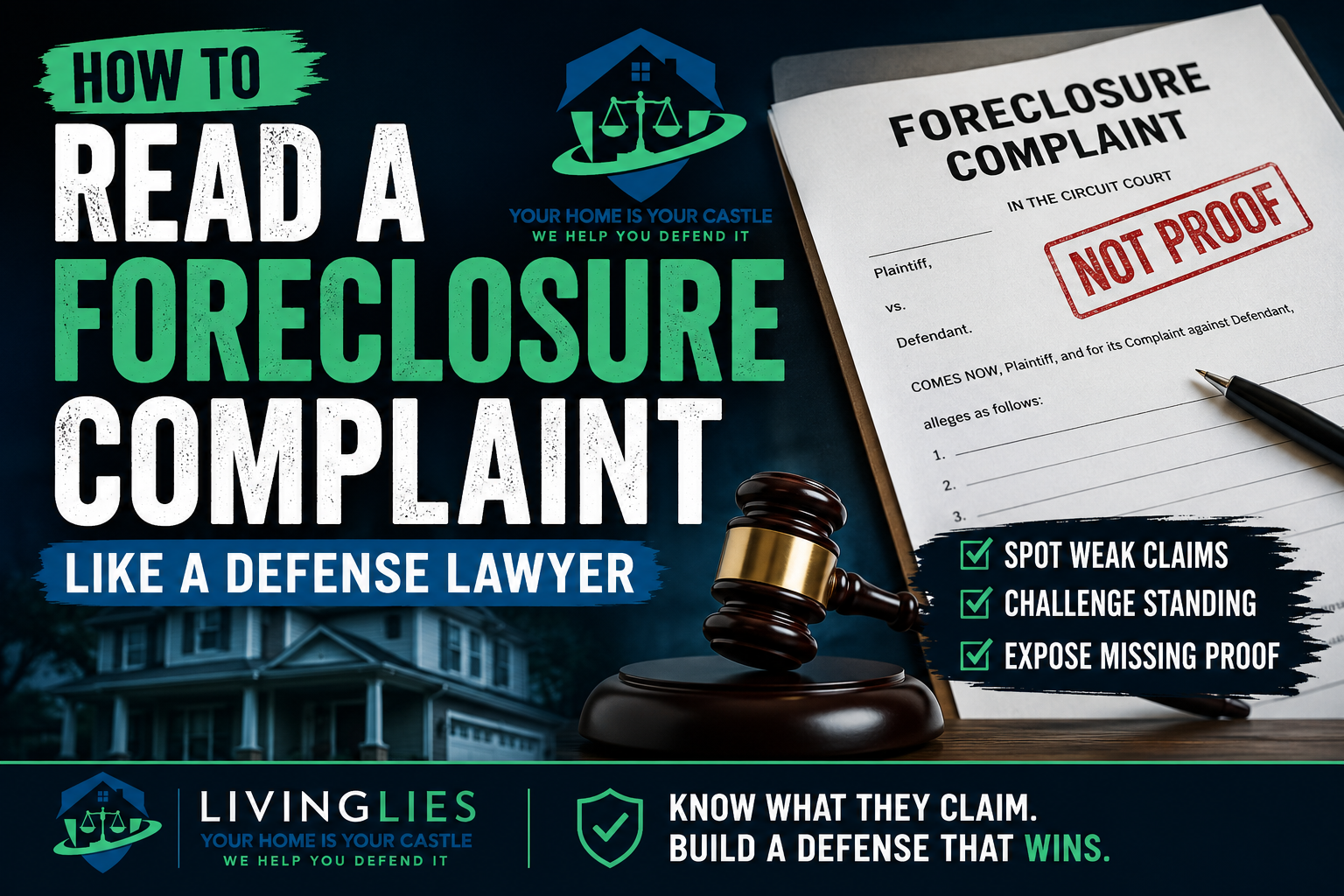
Most homeowners react to a judicial foreclosure complaint the same way.
They panic.
That reaction is understandable. A foreclosure complaint is intimidating. It looks official. It is filled with legal language, exhibits, signatures, and accusations.
But here is the first thing you need to understand:
A foreclosure complaint is not proof.
It is a set of allegations.
And those allegations must be proven with admissible evidence.
That changes the way you should read the document.
Most homeowners read a foreclosure complaint emotionally. Defense lawyers read it strategically.
That is the difference between reacting and building a defense.
Remember, if you are in a non judicial foreclosure state like California, Texas or Georgia the strategy is slightly different and we go into this near the bottom of this post.
What a Foreclosure Complaint Really Is
A foreclosure complaint is simply the opening statement of the foreclosing party’s case.
It tells a story.
That story usually goes something like this:
- the borrower signed a note and mortgage,
- the borrower defaulted,
- the plaintiff owns or enforces the loan, and
- the plaintiff has the right to foreclose.
But those are claims.
Not evidence.
The biggest mistake homeowners make is assuming the complaint has already proven the case.
It has not.
The First Question: Who Is the Plaintiff?
Start with the name of the plaintiff.
Who is claiming the right to foreclose?
Is it:
- a bank,
- a trust,
- a servicer,
- or a company you have never heard of?
This matters because the identity of the plaintiff is supposed to establish who has the right to enforce the debt.
But in many cases, the plaintiff’s role is unclear.
Sometimes the named plaintiff is a trustee for a securitized trust.
Sometimes the servicer appears to be running the entire case.
Sometimes the complaint never clearly explains who actually owns the debt.
That is where the analysis begins.
Look for Assumptions About Standing
Most foreclosure complaints assume standing instead of proving it.
Standing means the legal right to enforce the note and mortgage.
The complaint may simply state:
“Plaintiff is the holder of the note and mortgage.”
But where is the proof?
Is there:
- a complete chain of endorsements,
- a valid assignment,
- proof of possession,
- or evidence showing when the plaintiff acquired rights?
In many cases, these issues are vague or unsupported.
That is important because standing is one of the weakest points in many foreclosure cases.
Learn more about Legal Standing
Read the Allegations Carefully
Every numbered paragraph matters.
Look closely at:
- dates,
- amounts,
- default allegations,
- ownership claims,
- and references to documents.
Do not assume the statements are accurate just because they are written confidently.
Compare the allegations to the attached exhibits.
Many times, the documents do not fully support the story being told.
The Attachments Matter
Most foreclosure complaints include exhibits.
Usually:
- the note,
- the mortgage or deed of trust,
- assignments,
- and sometimes payment records.
This is where many problems appear.
Look for Missing Endorsements
Does the note contain endorsements?
Are they complete?
Are they dated?
Are they consistent with the timeline alleged in the complaint?
Undated endorsements create serious questions.
Look for Assignment Problems
Assignments are often attached to show transfer of the mortgage.
But assignments do not automatically prove ownership of the debt.
Pay attention to:
- the dates,
- the signer,
- the authority of the signer,
- and whether the assignment appears to have been created long after the alleged transfer.
Learn more here: Who really owns my loan?
Watch for MERS Issues
If Mortgage Electronic Registration Systems (MERS) appears in the chain, examine the documents carefully.
MERS assignments are often treated as automatic proof even when critical authority questions remain unanswered.
Learn how to Challenge a Mers Assignment
The Complaint Often Reveals the Weaknesses
Most homeowners believe the complaint is dangerous because it is strong.
Often, it is dangerous because homeowners never examine it carefully.
The complaint tells you:
- what the plaintiff believes it can prove,
- what assumptions it expects the court to accept,
- and what issues it hopes nobody challenges.
That is valuable information.
Watch for Statute of Limitations Problems
Timing issues are frequently hidden inside the complaint.
Pay attention to:
- the alleged default date,
- prior foreclosure filings,
- acceleration allegations,
- and modification references.
A prior foreclosure action may have already accelerated the debt.
If enough time passed, the statute of limitations may become a major issue.
This is why chronology matters so much in foreclosure defense.
A living lies win based upon statute of limitations
The Servicer Problem
Many foreclosure complaints are effectively driven by servicers.
But servicers are not automatically entitled to enforce the debt.
The complaint may refer to servicing rights or servicing activity without proving authority.
That is not enough.
The servicer’s authority must be proven with evidence.
Do Not Confuse Volume With Strength
Some foreclosure complaints are extremely long.
That does not make them strong.
Large amounts of paperwork often create the illusion of legitimacy.
But the real issues remain simple:
- Who owns the debt?
- Who has authority?
- What evidence proves standing?
- Are the records admissible?
Those are the questions that matter.
Additional reading: Evidence in Foreclosure Defense Cases
The Purpose of Your Answer
When you respond to the complaint, your goal is not to tell your life story.
Your goal is to:
- deny unsupported allegations,
- preserve defenses,
- and force proof.
Many homeowners accidentally admit key allegations because they misunderstand the complaint.
That can damage the defense before the case even begins.
Additional reading: How to Stop Foreclosure
What Defense Lawyers Look For Immediately
A defense lawyer reading the complaint usually focuses on:
- standing,
- timing,
- authority,
- document defects,
- and evidentiary weaknesses.
Not hardship.
Not fairness.
Not broad accusations.
Evidence wins foreclosure cases.
The Discovery Opportunity
The complaint also helps shape discovery.
Once you know what the plaintiff claims, you can begin demanding proof.
This may include requests for:
- servicing agreements,
- payment histories,
- loan-level data,
- transfer records,
- and communications relating to ownership.
This is where many foreclosure cases begin to weaken.
Learn more here: How to use Discovery in Foreclosure Defense
The LivingLies Approach
The goal is not to argue everything.
The goal is to force the foreclosing party to prove the case instead of accepting assumptions.
That begins with reading the complaint correctly.
The complaint is not the end of the analysis.
It is the beginning.
additional reading: Don’t overreach with weak claims
What If You Live in a Non-Judicial Foreclosure State?
In non-judicial states, homeowners usually do not receive a foreclosure complaint at the beginning of the process. Instead, the foreclosure moves forward through notices, recorded documents, and trustee procedures. But the core issues remain the same.
The homeowner should still examine:
- who is claiming the right to foreclose,
- whether the servicer has authority,
- whether the chain of title is intact,
- and whether the documents actually prove the right to enforce the debt.
The difference is procedural. In a judicial state, the homeowner responds to a lawsuit. In a non-judicial state, the homeowner often must file an action proactively to stop the sale and force the foreclosing parties to prove their claims.
Homeowner Call to Action!
Do Not Fight Blind
Most homeowners lose foreclosure cases because they never identify the weaknesses in the complaint.
They react emotionally instead of strategically.
At LivingLies, we help homeowners and lawyers analyze:
- standing problems,
- servicer authority issues,
- chain of title defects,
- statute of limitations defenses,
- and evidentiary weaknesses.
Before you assume the complaint is valid, have it analyzed properly.
Click here to request help analyzing your foreclosure case. or call us at 866.216.4126
and remember Your Home is your Castle We help you Defend it.
Search Our Blog
Categories
Contact Our National Headquarters Phone: 844-583-5339
Connect with us


Contact Our National Headquarters
- 844-583-5339
- Available 24/7
-
200 S. Andrews Ave. Ste. 604
Ft. Lauderdale, FL 33301