
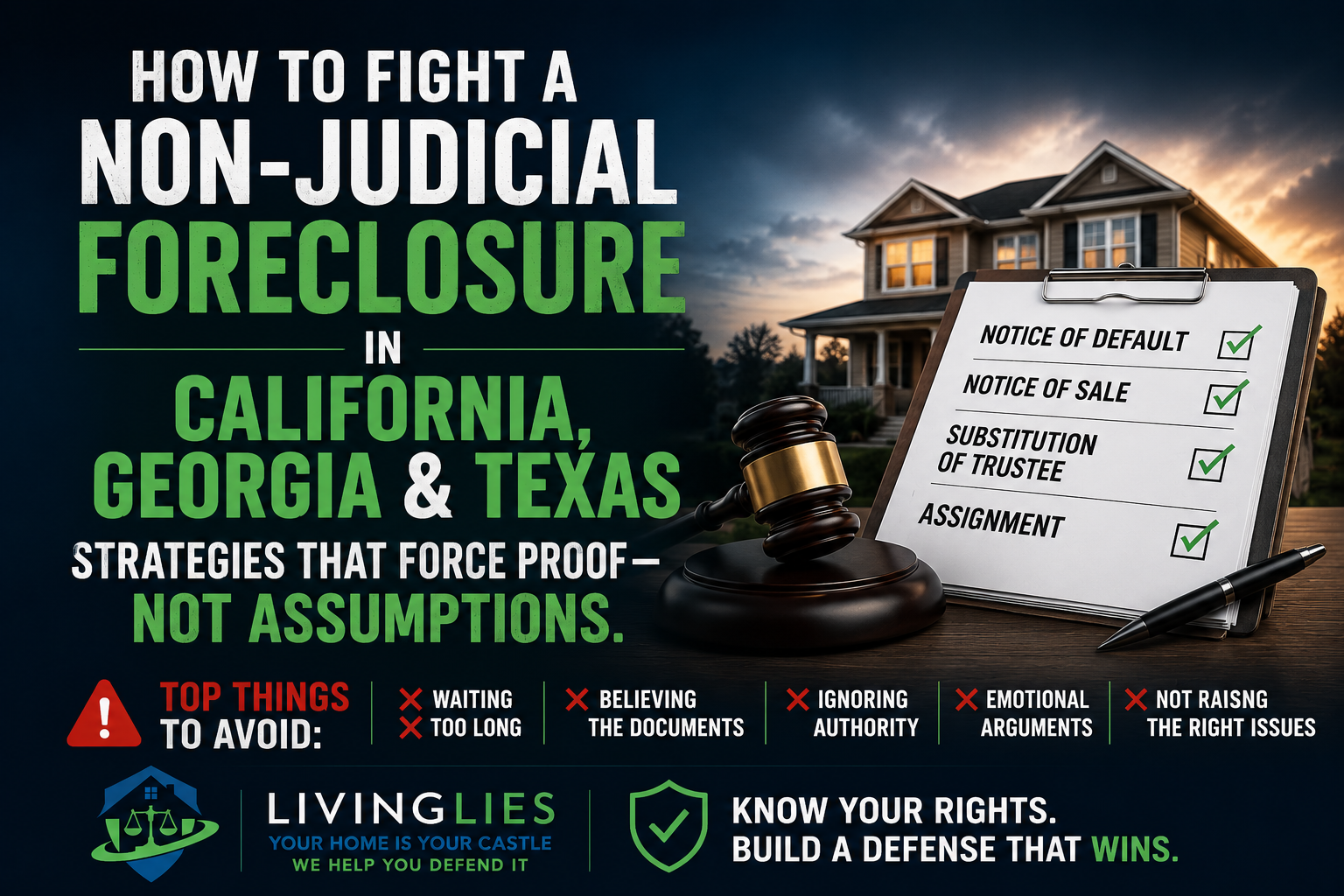
Non-judicial foreclosure fight is one of the most misunderstood processes in the country.
Many homeowners believe that because there is no lawsuit at the beginning, there is no non-judicial foreclosure fight.
That belief costs people their homes.
Non-judicial foreclosure does not mean the foreclosure is automatically valid.
It simply means the process moves forward without immediate court supervision unless the homeowner takes action.
That distinction matters.
In states like California, Georgia, and Texas, the foreclosure process can move very quickly. Notices are recorded, sale dates are scheduled, and homeowners are often pushed into panic mode before they fully understand what is happening.
But speed is not proof.
And recorded documents are not automatically evidence of a valid claim.
The key to fighting a non-judicial foreclosure is understanding what the process assumes—and forcing the parties involved to prove what they claim.
What Is a Non-Judicial Foreclosure?
In a judicial foreclosure state, the lender usually files a lawsuit before taking the property.
In a non-judicial foreclosure state, the process usually begins outside of court through notices and trustee procedures.
That often includes:
- Notice of Default
- Notice of Sale
- Substitution of Trustee
- Assignments
- Trustee Sale
The system is designed to move quickly unless challenged.
That is why homeowners must become proactive early.
The Biggest Misunderstanding About Non-Judicial Foreclosure
Many homeowners think:
“If there is no lawsuit, the bank must already have proven its case.”
That is false.
Non-judicial foreclosure is built largely on presumptions.
The system assumes:
- the foreclosing party has authority,
- the documents are valid,
- the servicer has the right to act,
- and the chain of title is intact.
But assumptions are not evidence.
And once the dispute enters court, those assumptions can be challenged.
The Most Important Principle: Force Proof
The strongest foreclosure defenses are not based on emotion.
They are based on evidence.
The core questions remain the same in every state:
- Who owns the debt?
- Who has authority to enforce it?
- Who authorized the servicer?
- Is the chain of title complete?
- Are the records reliable?
Most non-judicial foreclosures move forward because nobody forces those questions into court.
Here’s where we at livinglies can help you stop the sale. A defendant can legally stop the non-judicial process and force a judge to intervene by pursuing specific legal actions. These typically include filing a Temporary Restraining order or TRO or a Preliminary injunction to show the following:
-you will suffer irreparable harm and you have evidence to show likelihood of winning your case
-lender violated state laws
-dual tracking of a loan modification while proceeding to foreclose (bad faith conduct)
see also Bankruptcy as Foreclosure Defense Using Adversarial Actions
California: Fast Process, Early Action Required
California is one of the best examples of how quickly a non-judicial foreclosure can move.
Once the Notice of Default is recorded, the timeline begins moving toward sale.
The biggest mistake California homeowners make is waiting too long.
Many people assume they can challenge everything after the trustee sale.
Sometimes they can.
But leverage is usually much stronger before the sale occurs.
Key California Issues
- Substitution of Trustee defects
- Servicer authority issues
- Chain of title problems
- Late assignments
- Dual tracking violations
California homeowners should pay close attention to who recorded the documents and whether the timing of those documents makes sense.
Many assignments appear years after the alleged transfer.
That matters.
Georgia: One of the Fastest Foreclosure States
Georgia moves extremely fast.
Foreclosures can proceed with limited notice and very little court involvement.
This creates a dangerous environment for homeowners who wait too long to seek help.
Georgia homeowners should immediately analyze:
- who claims authority to foreclose,
- whether proper notices were sent,
- whether the security deed chain is complete,
- and whether the servicer actually has authority.
Georgia courts have often focused heavily on compliance with statutory procedures.
That means details matter.
Incorrect notices, defective transfers, or authority problems can become extremely important. But you must have evidence to prove this.
Texas: Speed and Procedure Dominate
Texas also moves quickly.
Many homeowners in Texas believe there is no way to stop a non-judicial foreclosure once the notices arrive.
That is not true.
But timing is critical.
Texas homeowners often need to move quickly to seek:
- temporary restraining orders (TROs),
- injunctions,
- or wrongful foreclosure claims.
Texas cases frequently involve disputes over:
- servicer authority,
- notice compliance,
- assignments,
- and legal standing.
The key is forcing the dispute into a forum where proof matters.
The Top Mistakes Homeowners Make
1. Waiting Too Long
This is the biggest mistake.
Many homeowners freeze after receiving notices.
By the time they act, the sale is days away.
Early action creates leverage.
2. Believing the Documents Automatically
Recorded documents are not automatically proof of ownership or authority.
Assignments, notices, and trustee documents should be analyzed carefully.
3. Relying Entirely on Loan Modification Promises
Many homeowners are told:
“Don’t worry, we’re reviewing your modification.”
Meanwhile, the foreclosure continues.
Never assume review activity automatically stops the sale.
4. Making Emotional Arguments Instead of Evidentiary Arguments
Courts respond to evidence.
Not anger.
Not conspiracy theories.
Not broad accusations.
The strongest defenses focus on:
- standing,
- authority,
- timing,
- and evidence.
5. Ignoring the Servicer Problem
Many foreclosure actions are effectively controlled by servicers.
But servicers are not automatically creditors.
Authority must still be proven.
6. Failing to Analyze Prior Foreclosure Activity
Prior foreclosure filings may affect:
- statute of limitations issues,
- acceleration,
- and standing.
The timeline matters.
What Homeowners Should Be Doing Immediately
- Collect every foreclosure notice
- Build a timeline
- Identify all parties involved
- Analyze assignments and transfers
- Review servicing history
- Determine whether litigation is necessary
The earlier this happens, the better.
The LivingLies Approach
The LivingLies strategy has never been about making noise.
It is about forcing proof.
That means identifying the assumptions hidden inside the foreclosure process and forcing the other side to support those assumptions with admissible evidence.
Non-judicial foreclosure systems move quickly because they depend on homeowners failing to challenge those assumptions.
Once the dispute reaches court, the same problems often appear:
- weak business records,
- authority problems,
- chain of title defects,
- and standing issues.
That is where cases begin to change direction. Ask for our help in providing the kind of Case Analysis and evidence that can save your home from foreclosure.
Strong Homeowner CTA Section
Do Not Wait Until the Sale Is Days Away
Most homeowners lose leverage in non-judicial foreclosure because they wait too long to act.
At LivingLies, we help homeowners and lawyers analyze:
- trustee sale notices,
- servicer authority,
- chain of title defects,
- standing problems,
- and evidentiary weaknesses.
The earlier you force proof, the stronger your position becomes.
Ask us how we have been saving homes for over 20 years in non-judicial foreclosure states. and remember YOUR HOME IS YOUR CASTLE WE HELP YOU DEFEND IT
Click here to request help analyzing your foreclosure case. OR CALL US TODAY AT 866.216.4126
Internal LivingLies Resources
- Servicer Authority in Foreclosure
- Business Records in Foreclosure Cases
- Chain of Title Defects
- How to Read Foreclosure Notices
Frequently Asked Questions
Can you stop a non-judicial foreclosure?
Yes. Homeowners may seek injunctions, TROs, or file actions challenging the foreclosure process and authority claims.
What is the biggest mistake in non-judicial foreclosure cases?
Waiting too long to act is one of the biggest mistakes homeowners make.
Does non-judicial foreclosure mean the bank already proved its case?
No. The process moves on presumptions unless the homeowner challenges those assumptions in court.
Can assignments and trustee documents be challenged?
Yes. Authority, timing, and chain of title issues may create significant defenses.
Search Our Blog
Categories
Contact Our National Headquarters Phone: 844-583-5339
Connect with us


Contact Our National Headquarters
- 844-583-5339
- Available 24/7
-
200 S. Andrews Ave. Ste. 604
Ft. Lauderdale, FL 33301