
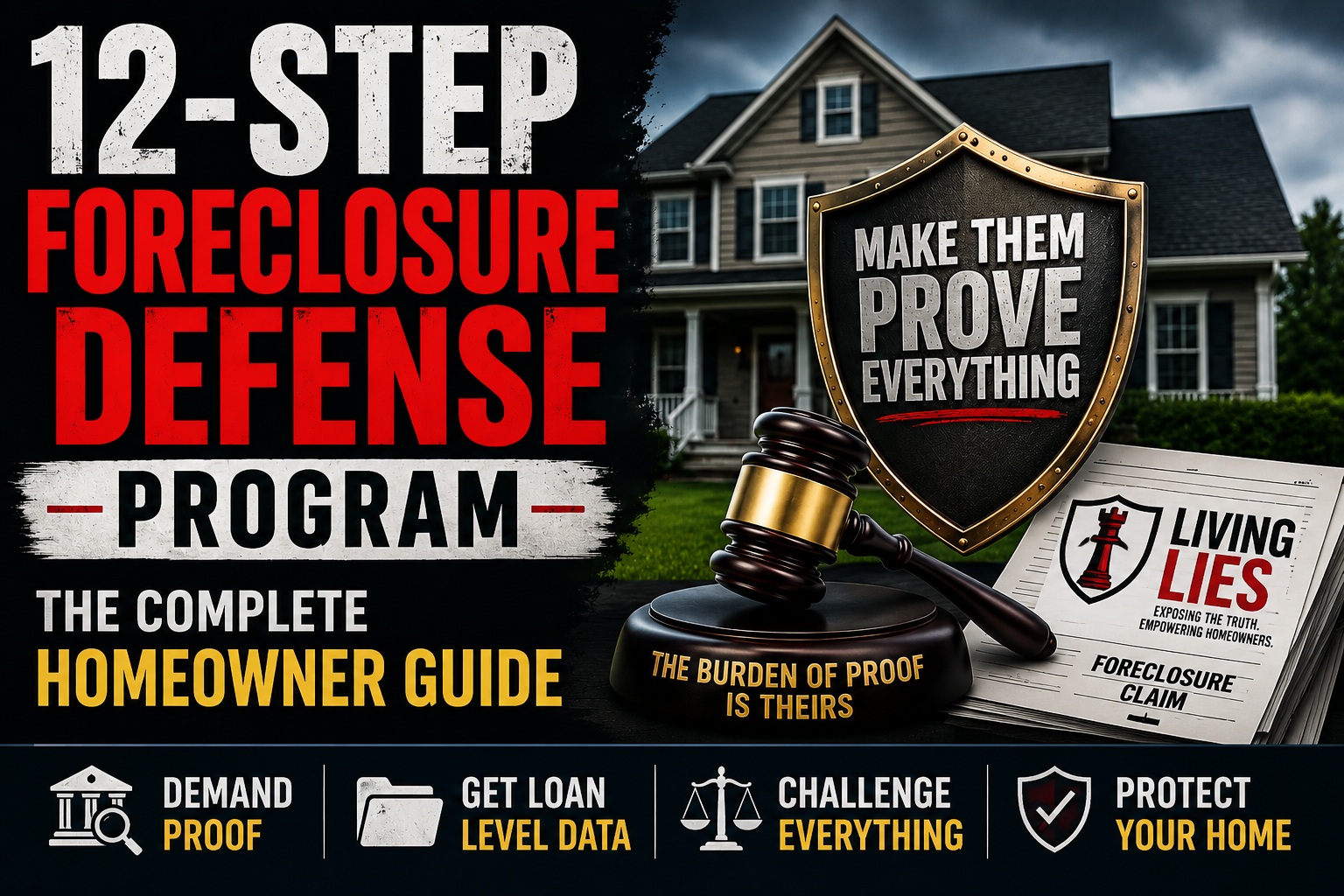
Read this 12 step Foreclosure Defense guide carefully because most homeowners lose before they ever walk into court.
Not because the bank proved its case.
Not because the servicer proved ownership of the debt.
Not because a judge carefully reviewed every transaction involving the loan.
They lose because they assume the foreclosure paperwork must be true. That assumption will cost you your home.
The foreclosure industry depends upon assumptions. It depends upon homeowners believing that because a company appears in court claiming to be a lender, trustee, servicer, beneficiary, creditor, or note holder, that company must automatically possess the legal right to foreclose.
But that is not how litigation is supposed to work.
In every other civil lawsuit, the party making a claim must prove it. They must prove standing. They must prove damages. They must prove authority. They must prove facts.
Foreclosure should be no different.
Yet millions of homeowners have been conditioned to believe that once payments stop, the case is over.
That belief is wrong.
A missed payment does not automatically establish:
- Who owns the debt.
- Who paid value for the debt.
- Who has authority to enforce the debt.
- Whether the debt was transferred.
- Whether the balance is accurate.
- Whether the named claimant suffered a financial loss.
Those issues still require proof.
That is why successful foreclosure defense starts with a change in mindset.
The goal is not to prove a giant conspiracy.
The goal is not to convince the judge that securitization is evil.
The goal is much simpler.
Force the party seeking foreclosure to prove every element of its claim using admissible evidence.
This Foreclosure Defense Guide for Homeowners is the product of over 20 years of Foreclosure litigation expertise and explains the 12-step foreclosure defense program. It has been developed by Neil Garfield and his successors at the Livinglies/DefendtheForeclosure team through decades of litigation involving securitized mortgages, mortgage servicers, trustees, and foreclosure mills.
Why Most Homeowners Approach Foreclosure the Wrong Way
Many homeowners focus on issues that feel important but often fail to move the case forward.
They spend months researching robo-signing scandals, MERS assignments, SEC filings, pooling and servicing agreements, and trust documents without first forcing the foreclosure claimant to prove the basics.
The better approach is to focus on evidence.
Who owns the debt?
Who paid value?
Who authorized enforcement?
Who would actually lose money if the note was not paid?
What evidence proves those facts?
Those questions place the burden where it belongs.
The foreclosure mill wants the homeowner defending. The homeowner should instead force the claimant to prove its case.
How Modern Foreclosure Actually Works
Most homeowners still believe their loan works the same way mortgages worked fifty years ago.
They believe a bank loaned money, kept the loan, and is now seeking repayment.
That is often not what happened.
Today, many residential loans were securitized.
Securitization means loans were pooled with thousands of other loans and sold into complex investment structures. Investors purchased certificates. Servicers collected payments. Trustees appeared on documents. Data processors maintained records.
The result is that the party named in foreclosure litigation is often not the same party that originally appeared at closing.
This creates a fundamental question:
Who actually owns the debt today?
The foreclosure claimant must answer that question with evidence, not assumptions.
The Role of Mortgage Servicers
One of the biggest sources of confusion in foreclosure litigation is the role of mortgage servicers.
Companies such as Shellpoint, Mr. Cooper, Wells Fargo, JPMorgan Chase, and numerous others frequently appear as servicers or agents in foreclosure cases.
A servicer may collect payments.
A servicer may maintain records.
A servicer may send monthly statements.
A servicer may administer modifications.
But none of those facts automatically establish ownership of the debt.
Servicing rights and ownership rights are two different things.
That distinction is frequently overlooked.
Many foreclosure cases are built almost entirely upon servicer records and servicer testimony.
The homeowner should ask a simple question:
Does the servicer possess personal knowledge of the creditor’s records, or only the servicer’s own records?
That question becomes especially important when the witness relies upon information imported from prior servicers or outside databases.
The Black Knight / ICE Mortgage Technology Problem
Another issue rarely discussed in court involves the technology systems used throughout the mortgage servicing industry.
Many servicers rely upon servicing platforms that were originally associated with Black Knight and are now part of ICE Mortgage Technology.
These systems process enormous amounts of loan information.
The existence of a database entry does not automatically prove ownership of a debt.
Nor does it automatically establish the accuracy of every transaction reflected within the system.
Homeowners should understand the difference between a computer-generated record and evidence proving the legal right to enforce a debt.
A servicing platform may record transactions. It does not create ownership.
Judicial vs. Non-Judicial Foreclosure States
The strategy discussed in this article applies in both judicial and non-judicial foreclosure states, although the procedures differ.
In judicial states such as Florida, New York, New Jersey, Illinois, and others, the claimant generally files a lawsuit seeking a foreclosure judgment.
In non-judicial states such as California, Texas, and Georgia, the process may occur without an initial court action.
Many homeowners mistakenly assume they have fewer rights in non-judicial states.
That is not necessarily true.
The fundamental issues remain the same:
- Who owns the debt?
- Who has authority?
- Who suffered a loss?
- What evidence proves those claims?
The difference is often procedural rather than substantive.
Step 1: Set a Goal — Know What You Want
The first step is surprisingly simple.
Know what you want.
Many homeowners enter litigation without a defined objective.
Do you want to save the property?
Do you want additional time?
Do you want a modification?
Do you want leverage for settlement?
Do you want damages after a wrongful foreclosure?
Every strategy begins with identifying the desired result.
Without a goal, every motion becomes random.
With a goal, every action serves a purpose.
Step 2: Learn the Rules and Play by Them
One of the hardest lessons homeowners learn is that being right is not enough.
Courts operate according to rules.
Deadlines matter.
Evidentiary objections matter.
Discovery rules matter.
Pleading requirements matter.
The foreclosure mills understand this very well.
The homeowner who understands procedure becomes far more dangerous than the homeowner who merely believes fraud occurred.
Winning often depends upon forcing the claimant to comply with the rules they routinely expect homeowners to ignore.
Step 3: Delay, Dispute, Challenge, and Attack the Debt
Delay by itself is not a defense.
But strategic delay can create the time needed to obtain evidence.
The purpose is not to postpone the inevitable.
The purpose is to create an opportunity to investigate the claim.
Challenge the amount due.
Challenge the default.
Challenge fees.
Challenge escrow charges.
Challenge advances.
Challenge payment histories.
Most importantly, challenge the assumption that the debt is exactly what the servicer claims it is.
Step 4: Find a Resource That Gets It
Not every attorney understands securitized mortgage litigation.
Many still approach foreclosure as a simple collection action.
Modern foreclosure cases are often far more complicated.
Servicers may be involved.
Trusts may be involved.
Investors may be involved.
Third-party vendors may be involved.
You need resources that understand the differences between evidence and assumptions.
The right advisor asks:
- Who paid value?
- Who owns the debt?
- Who authorized enforcement?
- What evidence supports those claims?
Learn more at DefendtheForeclosure
Step 5: Get Loan-Level Data
Loan-level data is one of the most powerful tools available to homeowners.
It often reveals facts that never appear in foreclosure pleadings.
Loan-level data may show:
- Servicing history.
- Investor reporting.
- Payment activity.
- Transfer activity.
- Corporate advances.
- Charge-offs.
- Trust reporting data.
- Prior payments from third parties.
In many cases, loan-level data tells a story very different from the one presented in court.
That is why obtaining it should be a priority. Learn more about loan level data and how LivingLies can provide evidence HERE.
Step 6: Keep the Burden on Them
This may be the most important rule in foreclosure defense.
The burden of proof belongs to the claimant.
Do not take that burden away from them.
Do not admit they own the debt.
Do not admit they have authority.
Do not admit the trust acquired the loan.
Do not admit the assignment transferred ownership.
Do not admit the balance is correct.
Make them prove it.
The central question remains:
Who paid value for the debt and who would actually lose money if the debt were not paid?
If the claimant cannot answer that question with admissible evidence, the homeowner should continue demanding proof.
Step 7: Get Expert Evidence When Necessary
Many homeowners mistakenly believe that simply pointing out defects in foreclosure documents is enough.
Sometimes it is.
Often it is not.
Courts are accustomed to hearing lawyers make arguments. What frequently makes a difference is evidence.
An expert report or affidavit can help explain issues involving:
- Chain of title defects.
- Securitization failures.
- Trust acquisition problems.
- Loan-level data analysis.
- Business records deficiencies.
- Servicing transfer irregularities.
- Standing defects.
- Payment history inconsistencies.
The purpose of expert evidence is not to replace legal arguments. The purpose is to support those arguments with facts that judges can understand and evaluate.
Many foreclosure cases are won or lost because one side presented evidence while the other side presented opinions.
Step 8: Ignore Intimidation
Foreclosure litigation is designed to create pressure.
Homeowners receive threatening letters.
They receive notices of default.
They receive notices of sale.
They receive affidavits claiming everything has already been proven.
Many servicers create the impression that foreclosure is inevitable.
It is not.
What matters is evidence.
Many homeowners abandon valid defenses because they assume the servicer must know something they do not.
Never confuse confidence with proof.
Never confuse threats with evidence.
Never assume a witness is telling the truth simply because that witness works for a large institution.
The courtroom is supposed to be a place where claims are proven, not merely repeated.
Step 9: Challenge Loan Modification Offers Carefully
Loan modifications can help homeowners.
They can also create serious legal problems.
Many modification agreements contain language that:
- Confirms ownership claims.
- Waives defenses.
- Acknowledges balances.
- Restarts limitation periods.
- Ratifies prior conduct.
This does not mean homeowners should reject every modification offer.
It means homeowners should review every modification offer with the same scrutiny applied to a foreclosure complaint.
Ask:
- Who is offering the modification?
- What authority do they have?
- Who approved the modification?
- Who receives future payments?
- What rights are being waived?
Many homeowners discover too late that they unknowingly admitted facts that were never actually proven.
Step 10: Use Debt Validation and Qualified Written Requests
Federal law gives homeowners tools that are often underutilized.
Debt validation requests and Qualified Written Requests can force servicers to address specific issues.
Proper requests may seek:
- The identity of the creditor.
- The identity of the owner of the debt.
- Payment histories.
- Transfer histories.
- Servicing records.
- Escrow records.
- Corporate advance records.
- Authority documents.
Many responses reveal something important.
They often answer questions about servicing.
But they frequently fail to answer questions about ownership.
That distinction can become critical later in litigation. (Ask us how to help you craft these demands to get results!)
Step 11: Make Them Prove Everything
This rule cannot be overstated.
Make them prove everything.
Not part of it.
Everything.
Make them prove:
- The note.
- The mortgage.
- The chain of transfers.
- The default.
- The amount due.
- The authority of the servicer.
- The authority of the trustee.
- The authority of the witness.
- The existence of a real creditor.
- The existence of a real loss.
One of the biggest mistakes homeowners make is assuming that because a document exists, it proves what the foreclosure claimant says it proves.
Documents do not authenticate themselves.
Assignments do not automatically transfer debt.
Endorsements do not automatically establish ownership.
Affidavits do not automatically establish truth.
Evidence must be tested.
Step 12: Keep the Court Focused on the Real Creditor
This is the most important issue in many foreclosure cases.
Who is the actual creditor?
Not the servicer.
Not the document custodian.
Not the foreclosure attorney.
Not the trustee appearing in the caption.
The creditor.
Who would actually lose money if the debt were not paid?
That question often receives surprisingly little attention.
Yet it should be central to every foreclosure action.
Courts routinely focus on documents.
Homeowners should focus on economic reality.
Who funded the transaction?
Who acquired the debt?
Who paid value?
Who currently owns the claim?
Those questions frequently expose weaknesses that the foreclosure paperwork attempts to conceal.
The Business Records Problem
Many foreclosure cases rely almost entirely upon business records affidavits.
The witness often claims familiarity with records generated by multiple servicers over many years.
This creates a serious evidentiary issue.
How does the witness know the prior records were accurate?
How does the witness know the information imported from another servicer was correct?
How does the witness know the data was not altered, corrected, supplemented, or reconstructed?
These questions become especially important when records originate from multiple entities.
The homeowner should challenge assumptions regarding boarding processes, record adoption, and inherited data.
A business records affidavit should not become a shortcut around foundational requirements.
Why Standing Matters More Than Most Lawyers Realize
Many foreclosure cases are decided without meaningful discussion of standing.
That is a mistake.
Standing is not a technicality.
Standing is the foundation of the entire case.
If the claimant cannot demonstrate the right to enforce the debt, the remaining issues become irrelevant.
This is particularly important in securitized loan cases.
Many trusts named in foreclosure actions are described as owners of thousands of loans.
Yet homeowners are often asked to accept that claim without evidence showing how their specific loan entered the trust.
The question is not whether a trust exists.
The question is whether the trust acquired the debt.
Those are two very different things.
Common Mistakes Homeowners Make
- Assuming missed payments automatically end the case.
- Focusing on emotion instead of evidence.
- Admitting facts that have not been proven.
- Ignoring deadlines.
- Failing to conduct discovery.
- Accepting servicer representations without verification.
- Signing modification agreements without review.
- Failing to challenge business records.
- Ignoring loan-level data.
- Treating assignments as proof of ownership.
Most foreclosure losses are not caused by lack of defenses.
They are caused by failure to assert defenses effectively.
What Discovery Should Look Like
Discovery should focus on evidence, not theories.
Ask for:
- Loan-level data.
- Transaction histories.
- General ledger entries.
- Authority agreements.
- Servicing agreements.
- Trust acquisition records.
- Payment records.
- Wire transfer records.
- Purchase documents.
- Corporate advance records.
The goal is not to create paper.
The goal is to identify the actual creditor and determine whether the claimant can prove ownership and authority.
The Real Question: Who Would Lose Money?
At LivingLies, we have repeatedly emphasized a simple concept.
Foreclosure should not be based upon possession of paperwork.
Foreclosure should be based upon the existence of an unpaid debt owed to an identifiable creditor.
The most important question may also be the simplest:
Who would actually lose money if the note were not paid?
If the foreclosure claimant cannot answer that question with competent evidence, the homeowner should continue demanding proof.
Action Plan Checklist
- Set your objective.
- Learn procedural rules.
- Dispute unsupported claims.
- Investigate the debt.
- Obtain loan-level data.
- Demand proof of ownership.
- Demand proof of authority.
- Challenge business records.
- Review modification offers carefully.
- Use discovery aggressively.
- Seek expert analysis when needed.
- Keep the focus on the actual creditor.
Conclusion
Foreclosure defense is not about denying reality.
It is about demanding proof.
The foreclosure industry depends upon assumptions.
Homeowners should challenge assumptions.
The foreclosure industry depends upon paperwork.
Homeowners should demand evidence.
The foreclosure industry wants courts to assume ownership, authority, balance, and loss.
Homeowners should require those elements to be proven.
Do not confuse paperwork with proof.
Do not surrender because a large institution claims authority.
Make them prove every element of their case.
Need Help Evaluating Your Case?
If you are facing foreclosure, the most important thing you can do is determine whether the party pursuing foreclosure can actually prove ownership, authority, standing, and loss. Call us today at 866.216.4126 or at Contact US
For more foreclosure analysis, litigation support, and homeowner education, visit LivingLies.me.
Frequently Asked Questions
Can I challenge foreclosure if I missed payments?
Yes. Missing payments does not eliminate the claimant’s burden of proof.
What is standing in foreclosure?
Standing refers to the legal right to enforce the debt and pursue foreclosure.
What is loan-level data?
Loan-level data contains detailed information regarding servicing, transfers, reporting, and payment activity associated with a specific loan.
Do servicers own loans?
Not necessarily. Servicing rights and ownership rights are different.
Can assignments be challenged?
Yes. The existence of an assignment does not automatically establish ownership of the debt.
What is securitization?
Securitization is the process through which loans are pooled and sold into investment structures.
Should I accept a modification offer?
Not without understanding the legal consequences.
Why are business records important?
Many foreclosure cases depend upon business records to establish ownership, balances, and defaults.
What is the most important question in foreclosure?
Who would actually lose money if the debt were not paid?
Can a trust foreclose without owning my loan?
The claimant must prove authority and standing under applicable law.
Can foreclosure records contain errors?
Yes. Errors occur in servicing transfers, payment histories, and other records.
What discovery should I request?
Focus on ownership, authority, payment histories, transfer records, and loan-level data.
Why do homeowners lose foreclosure cases?
Often because they fail to challenge assumptions and demand proof.
What is a Qualified Written Request?
A federal request for information relating to servicing and loan administration.
What is the purpose of foreclosure defense?
To require the claimant to prove every required element before taking a homeowner’s property.
Search Our Blog
Categories
Contact Our National Headquarters Phone: 844-583-5339
Connect with us


Contact Our National Headquarters
- 844-583-5339
- Available 24/7
-
200 S. Andrews Ave. Ste. 604
Ft. Lauderdale, FL 33301