
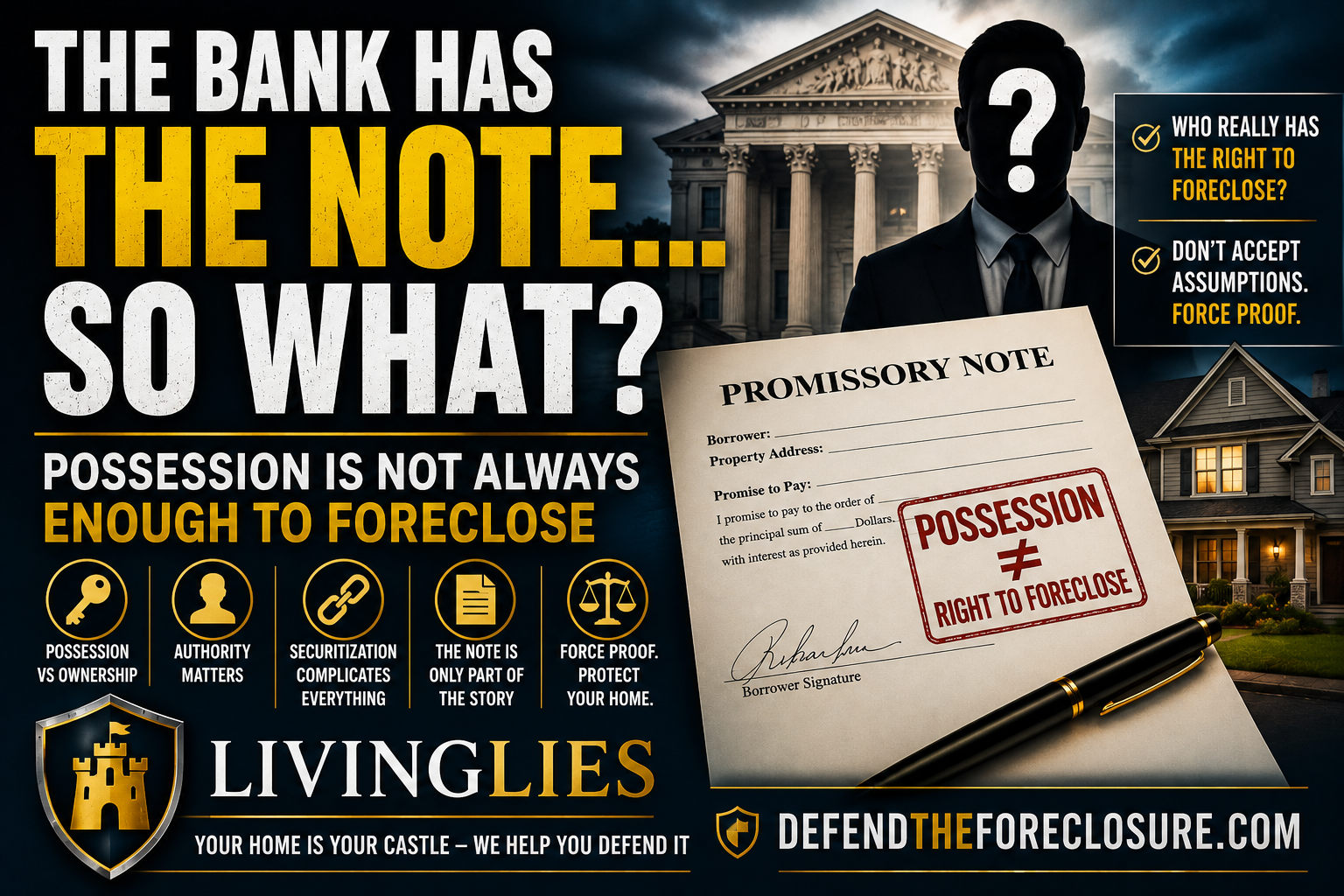
One of the most common statements heard in foreclosure courtrooms across America is:
“We have possession of the note.”
For many judges, lawyers, and homeowners, that statement ends the discussion.
The assumption is simple:
If the foreclosing party has possession of the original note, it automatically has the right to foreclose.
But that assumption is often wrong.
Possession of a note may be important. In some states it may create presumptions. In certain circumstances it may establish a right to enforce.
But possession alone does not always answer the most important question in foreclosure litigation:
Does this party actually have the legal right to foreclose?
That distinction has become increasingly important in the modern era of mortgage securitization, servicing transfers, investor ownership claims, and complex trust structures.
Understanding the difference between possession, ownership, authority, and enforcement rights can completely change how a homeowner views a foreclosure case.
The Myth of “Show Me the Note”
During the foreclosure crisis, many homeowners heard about a defense known as “show me the note.”
Some people believed that if the plaintiff could not produce the original note, the foreclosure automatically failed.
Others believed the opposite—that producing the note automatically ended the case.
Neither position is entirely correct.
The note matters.
But the note is only one piece of a much larger evidentiary puzzle.
The real question is not merely whether someone possesses the note.
The real question is whether the party possessing the note has the legal right to enforce it.
What Is a Promissory Note?
The promissory note is the borrower’s promise to repay a debt.
It is generally considered a negotiable instrument under Article 3 of the Uniform Commercial Code.
The mortgage or deed of trust secures the note by placing a lien against the property.
The note and mortgage are related.
But they are not the same thing.
This distinction becomes critically important when analyzing foreclosure standing.
Possession Does Not Automatically Mean Ownership
One of the biggest misconceptions in foreclosure litigation is the belief that possession equals ownership.
It does not.
Possession simply means someone physically controls the document.
Ownership concerns who actually owns the debt.
Those are two very different concepts.
Consider a simple example.
If you hand your car keys to a valet, the valet possesses your car.
But the valet does not own the car.
The same principle can apply in mortgage lending.
A party may possess the note while another party claims ownership of the debt.
That creates questions that cannot be answered simply by producing paper.
Possession Does Not Automatically Mean Authority
Even if possession creates certain rights under the Uniform Commercial Code, authority remains a separate issue.
The foreclosing party may claim to possess the note.
But who authorized the foreclosure?
Who authorized the servicer?
Who authorized the law firm?
Who authorized the trustee?
Those questions are often overlooked.
Yet they are essential.
Authority must come from somewhere.
And authority should be supported by evidence.
The Difference Between Ownership and Enforcement
This is where many foreclosure cases become complicated.
Ownership and enforcement are not necessarily identical concepts.
One party may claim ownership of the debt.
Another party may claim possession of the note.
A third party may claim servicing rights.
A fourth party may be acting as trustee.
The homeowner is often expected to assume all of these parties are acting together properly.
But assumptions are not evidence.
The question remains:
Who has the legal right to enforce the obligation?
How Securitization Changed the Analysis
Years ago, the lender made the loan and generally kept the loan.
Standing questions were often simpler.
Modern mortgage lending changed that structure completely.
Loans are sold into pools.
Trusts are created.
Servicing rights are transferred.
Investors purchase interests in mortgage-backed securities.
Custodians store documents.
Subservicers handle collections.
Trustees oversee trust administration.
As the number of participants increases, identifying the actual party entitled to enforce becomes more difficult.
This is why possession alone often fails to answer the entire standing question.
The Servicer Possession Problem
In many foreclosure cases, the servicer effectively controls the litigation.
The servicer sends notices.
The servicer maintains records.
The servicer provides witnesses.
The servicer hires counsel.
Yet the servicer often does not claim ownership of the debt.
Instead, it claims authority from another entity.
That authority should be examined carefully.
Possession of a note does not automatically prove the servicer’s authority to act.
The Trustee Possession Problem
Securitized trust cases create another layer of complexity.
The plaintiff may be a trustee acting for a trust.
The trustee may claim possession.
But possession does not answer questions such as:
- When was the note transferred?
- Was the transfer completed properly?
- Was it consistent with trust requirements?
- Who currently claims ownership?
These issues often become central to foreclosure litigation involving securitized trusts.
Possession and Business Records
Many foreclosure plaintiffs attempt to connect possession with business records.
But business records raise separate evidentiary concerns.
Who created the records?
Who maintained them?
Were they transferred between servicers?
Were they independently verified?
If the records are weak, the standing argument may also weaken.
This is why business records and possession issues frequently overlap.
Why Courts Sometimes Accept Possession Too Easily
Foreclosure litigation often becomes routine.
Courts see similar allegations every day.
As a result, possession may be treated as if it automatically resolves every issue.
But possession should not eliminate questions regarding:
- ownership,
- authority,
- standing,
- trust compliance,
- or evidentiary reliability.
The legal analysis should go further.
What Homeowners Should Be Asking
When a plaintiff claims possession of the note, homeowners should ask:
- Who owns the debt?
- Who authorized the foreclosure?
- Who authorized the servicer?
- When was possession acquired?
- What evidence supports the claimed transfer?
- Do the business records support the story being told?
Those questions often reveal weaknesses that are not visible on the surface.
Judicial vs Non-Judicial States
The importance of possession exists in both judicial and non-judicial states.
The difference is procedural.
In judicial states, the issue is usually litigated inside the foreclosure lawsuit.
In non-judicial states, homeowners often must bring the dispute into court themselves.
But once litigation begins, the same questions remain:
Does possession alone establish the right to foreclose?
Or is additional proof required?
How Loan-Level Data Can Help
Loan-level data frequently reveals information that is missing from foreclosure pleadings.
It may identify:
- servicing transfers,
- investor designations,
- trust references,
- ownership indicators,
- and transaction histories.
When compared against foreclosure allegations, loan-level data may expose inconsistencies that deserve further investigation.
The LivingLies practice of obtaining, analyzing and providing expert affidavit’s on loan-level data is a key reason we win cases.
The LivingLies Approach
The LivingLies approach is simple.
Do not confuse possession with proof.
The foreclosure process often relies on assumptions.
Possession may create an assumption.
But assumptions are not evidence.
The goal is not to argue technicalities.
The goal is to force proof.
Who owns the debt?
Who has authority?
Who has the right to enforce?
Those questions should never be ignored simply because someone claims possession of a document.
Homeowner Call to Action
Possession Is Not the End of the Analysis
Many homeowners assume the case is over when the plaintiff produces a note.
Often, the most important questions have not even been asked yet.
At LivingLies, we help homeowners and lawyers analyze:
- standing issues,
- servicer authority,
- ownership claims,
- business records,
- loan-level data,
- and securitized trust issue
Before you assume possession proves everything, make the foreclosing party prove its entire case. ASK US HOW
YOUR HOME IS YOUR CASTLE WE HELP YOU DEFEND IT
Click here to request help analyzing your foreclosure case. OR CALL US AT 866.216.4126
LIVINGLIES/ DEFENDTHEFORECLOSURE
Frequently Asked Questions
Does possession of the note automatically allow foreclosure?
No. Possession may be important, but it does not automatically resolve issues of authority, ownership, standing, and enforcement rights.
Is ownership the same as possession?
No. A party may possess a note without actually owning the underlying debt.
Why does securitization make possession issues more complicated?
Because multiple parties may claim different rights relating to ownership, servicing, trust administration, and enforcement.
Can servicers foreclose simply because they possess records?
No. Servicers must establish authority to act on behalf of the party entitled to enforce the debt.
What is the most important question?
Who has the legal right to enforce the debt, and what evidence proves that right?
Search Our Blog
Categories
Contact Our National Headquarters Phone: 844-583-5339
Connect with us


Contact Our National Headquarters
- 844-583-5339
- Available 24/7
-
200 S. Andrews Ave. Ste. 604
Ft. Lauderdale, FL 33301