
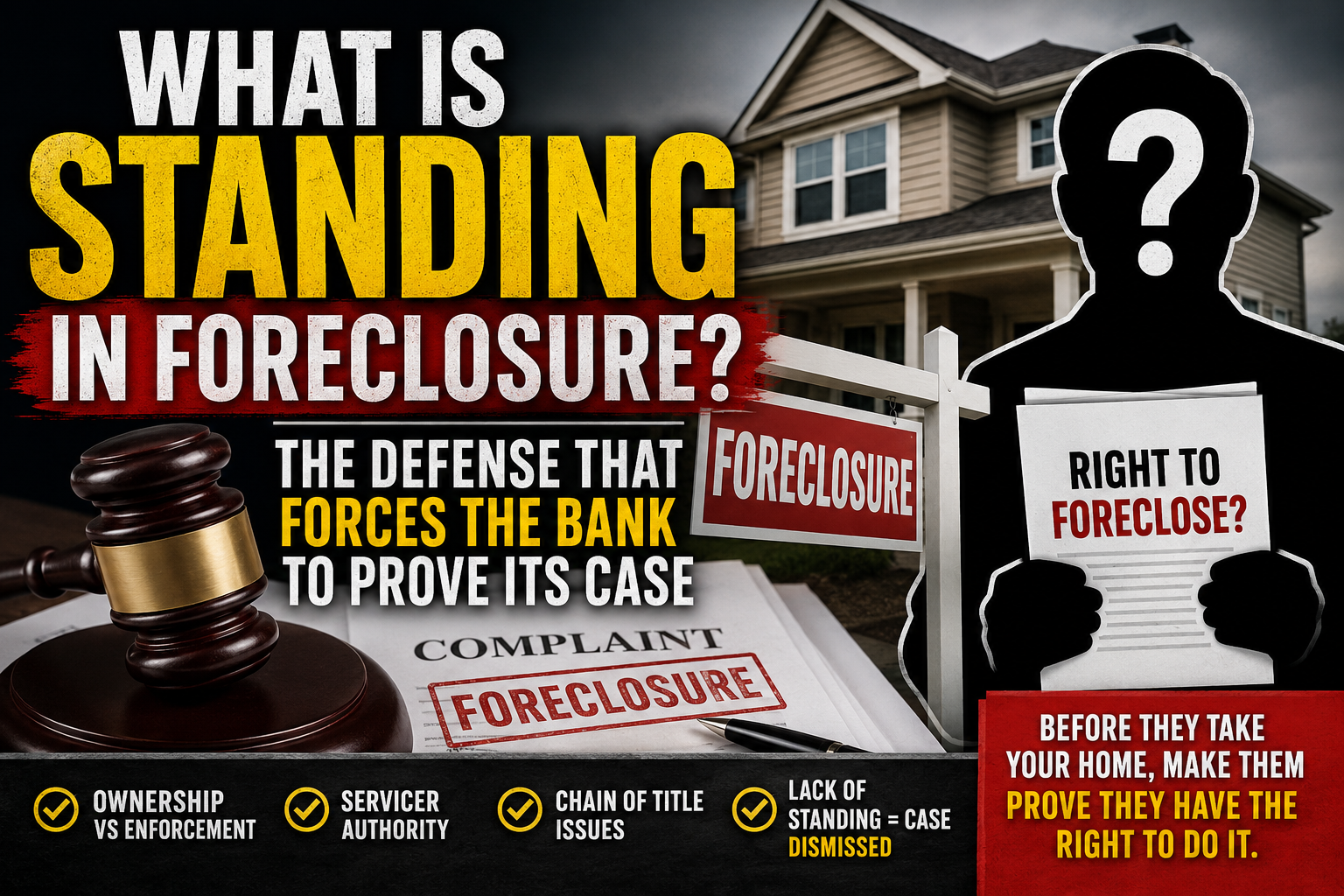
If there is one issue that can change the direction of a foreclosure case, it is standing. It is a defense we help homeowners use the most and it works. Here at LivingLies we talk about it a lot but realize not everyone understands what are Legal Standing foreclosure defenses.
Most homeowners never hear the word “standing” until they are already in trouble. By then, the foreclosure papers have been filed, the notices have arrived, or the sale date is getting close.
But standing is not a technical trick. It is not a loophole. It is one of the most basic requirements in any lawsuit.
Standing means the party trying to foreclose must prove it has the legal right to enforce the debt.
That sounds simple. But in modern foreclosure cases, it often is not simple at all.
Loans are sold. Servicing rights are transferred. Trusts are named. Assignments appear years later. Different companies claim different roles. By the time foreclosure begins, the homeowner may be facing a party that was never involved in the original loan transaction.
That is why standing matters.
What Is Standing in Foreclosure?
Standing is the legal right to bring a case in court.
In foreclosure, standing means the plaintiff must show it has the right to enforce the note and mortgage, or deed of trust, depending on the state.
The court should not allow just anyone to walk in and claim the right to take a home. The claimant must prove its legal connection to the debt and the right to enforce it.
That proof usually involves more than saying, “We are the lender” or “We are the trustee” or “We are the servicer.”
Those are labels.
Labels are not proof.
Why Standing Matters
Standing matters because foreclosure is one of the most serious remedies in law. It can result in the loss of a home.
Before that happens, the foreclosing party should be required to prove:
- who owns the debt,
- who has the right to enforce it,
- who authorized the foreclosure,
- and whether the evidence supports those claims.
If the foreclosing party cannot prove standing, the case should not proceed.
That is not a homeowner “getting away with something.” That is the law doing what it is supposed to do.
Ownership and Enforcement Are Not Always the Same
One of the biggest mistakes homeowners make is assuming that ownership and enforcement are the same thing.
They are not always the same.
A party may claim to own the loan. Another party may claim to service the loan. Another may claim to hold the note. Another may claim to be trustee for a securitized trust.
The key question is this:
Which party has the legal right to enforce the debt and foreclose?
That is the standing question.
Standing vs. Real Party in Interest
Standing and “real party in interest” are related, but they are not always identical.
Standing asks whether the party has the legal right to bring the foreclosure case.
The real party in interest issue asks whether the party bringing the case is the proper party to receive the benefit of the judgment.
In plain English:
- Standing asks: Can this party sue?
- Real party in interest asks: Is this the party that should benefit?
This distinction matters because many foreclosure cases are brought in the name of a trustee, while the servicer does the work, and investors may be the ones with the claimed economic interest.
When the roles are blurred, the homeowner should not simply accept the caption on the complaint or the name on the notice.
The party seeking foreclosure must prove why it is the proper party.
Why Standing Became a Major Issue After Securitization
Before securitization, many foreclosure cases were simpler.
The lender made the loan. The lender held the note. The lender filed the foreclosure.
Modern mortgage finance changed that.
Loans were pooled into securitized trusts. Servicing rights were separated from ownership claims. Mortgage Electronic Registration Systems, known as MERS, appeared in many chains of title. Trustees, servicers, master servicers, subservicers, custodians, and investors all became part of the picture.
That created a serious problem:
Who actually has the right to enforce the debt?
Many foreclosure cases rely on assumptions created by documents. But assumptions are not evidence.
The Typical Standing Allegation
Most foreclosure complaints say something like this:
“Plaintiff is the holder of the note and mortgage.”
That statement is not proof.
It is an allegation.
The homeowner should ask:
- When did the plaintiff become holder?
- How did it become holder?
- Who transferred the rights?
- Was the transfer valid?
- Was the plaintiff entitled to enforce when the case was filed?
Those questions matter because standing usually must exist at the beginning of the case.
The Assignment Problem
Assignments are often used to create the appearance of a clean transfer.
But an assignment does not automatically prove standing.
A homeowner should examine:
- the date of the assignment,
- the party assigning the mortgage,
- the party receiving it,
- the signer’s authority,
- and whether the assignment reflects a real transaction.
Late assignments are especially important. If an assignment appears years after the alleged transfer, or shortly before foreclosure, that may raise serious questions.
A document may be recorded. But recording does not automatically prove the underlying transaction was real.
The Endorsement Problem
Foreclosure plaintiffs often rely on endorsements on the note.
Endorsements can matter. But they also raise questions.
Are they dated?
Were they added later?
Do they match the claimed transfer timeline?
Do they show a complete chain?
Undated endorsements are common in foreclosure litigation. They may support an argument, but they often do not answer the most important question: when did the plaintiff acquire the right to enforce?
Standing in Securitized Trust Cases
Standing becomes even more complicated when the plaintiff is a trustee for a securitized trust.
The foreclosure complaint may identify a trustee acting for a trust with a long name. That sounds official. But it does not end the inquiry.
The homeowner should ask:
- Did the trust actually acquire the debt?
- When did the trust acquire it?
- Was the transfer consistent with the trust documents?
- Was the transfer completed before the trust closing date?
- Does the servicer have authority from the trust or trustee?
These questions do not automatically defeat standing. But they often justify discovery and careful examination of the plaintiff’s evidence.
The Servicer Problem
In many foreclosure cases, the servicer is the real actor.
The servicer sends the notices. The servicer maintains the records. The servicer signs affidavits. The servicer’s lawyers often push the case forward.
But the servicer is not automatically the creditor.
A servicer must prove authority to act for the party entitled to enforce.
That means the homeowner should ask:
- Who authorized the servicer?
- Where is the servicing agreement or power of attorney?
- Was the authority in effect when foreclosure began?
- Does the servicer witness have personal knowledge?
Servicer authority and standing are closely connected.
Standing and Business Records
Business records are often used to prove standing, default, and amount due.
But those records are frequently transferred from one servicer to another.
The current witness may not have created the records. The witness may not know how prior records were prepared. The witness may rely on imported data from another company.
That matters.
If the foundation for the business records is weak, then the standing claim may also be weak.
Courts should not accept records simply because a servicer calls them “business records.” Reliability must be shown.
Standing and Loan-Level Data
Loan-level data can reveal facts that do not appear in the foreclosure complaint.
It may show:
- servicing transfers,
- investor reporting fields,
- payment histories,
- ownership designations,
- and transaction codes.
This data can help determine whether the foreclosure story matches the internal records.
If one party is identified in servicing data while another party claims enforcement rights, that may raise questions about authority and standing.
Loan-level data is not magic. But it is often one of the best ways to test the claims being made in court.
Standing After Prior Foreclosure Dismissals
Prior foreclosure cases matter.
Many homeowners assume that if an old foreclosure case was dismissed, it no longer matters.
That is often wrong.
A prior case may affect:
- standing,
- statute of limitations issues,
- acceleration,
- and the timeline of claimed ownership.
If a new foreclosure case is filed years later, compare the allegations carefully.
Has the plaintiff changed?
Has the servicer changed?
Has the trust name changed?
Has the chain of title changed?
Those changes may reveal weaknesses in standing.
Standing in Judicial Foreclosure States
In judicial foreclosure states, the plaintiff files a lawsuit. That gives the homeowner a direct opportunity to challenge standing inside the case.
Standing can be challenged through:
- the answer,
- affirmative defenses,
- motions,
- discovery,
- and evidentiary objections.
Judicial states give homeowners tools. But those tools must be used properly and on time.
Standing in Non-Judicial Foreclosure States
Standing still matters in non-judicial foreclosure states.
The difference is procedural.
In non-judicial states, there may be no lawsuit at the beginning. The foreclosure may move through notices and trustee procedures unless the homeowner takes action.
That means the homeowner often must bring the dispute into court by filing for an injunction, temporary restraining order, or wrongful foreclosure action. Once the homeowner challenges the foreclosure it automatically reverts into a judicial foreclosure.
Once the dispute is in court, the same core question returns:
Who has the right to enforce the debt?
How Standing Issues Differ Across States
Standing is important everywhere, but states analyze foreclosure differently.
New York
New York courts often focus on possession of the note and whether standing existed when the case was filed.
Florida
Florida foreclosure litigation frequently involves endorsements, assignments, business records, and proof of standing at inception and also at summary judgement.
New Jersey
New Jersey cases often examine assignments, the plaintiff’s right to enforce, and the timing of transfers.
California
California is largely non-judicial, so standing disputes often arise when the homeowner brings an action to stop the sale or challenge the process.
Texas
Texas cases often involve servicer authority, statutory notice compliance, and the right to enforce through non-judicial procedures.
The details vary by state. The core issue remains the same.
Who has the right to enforce, and what evidence proves it?
Common Homeowner Mistakes
Focusing Only on Hardship
Hardship may explain what happened. But hardship does not defeat standing.
Evidence does.
Assuming the Plaintiff Must Be Correct
Do not assume the plaintiff has standing just because a lawsuit was filed or a notice was recorded.
The claimant must prove its right to proceed.
Ignoring Discovery
Standing problems are often exposed through discovery. If you do not request the right documents, you may never see the weakness.
Arguing Too Much and Proving Too Little
Many homeowners raise ten arguments and prove none of them.
A better strategy is to focus on the issues that force proof.
The LivingLies Approach
The LivingLies approach is simple:
Do not accept assumptions. Force proof.
Standing is the issue that forces the foreclosing party to answer the most important question in the case:
What gives you the legal right to enforce this debt?
That question should not be treated as a technicality.
It is the foundation of the case.
Homeowner Call to Action
Standing Can Change Everything
Many foreclosure cases appear strong until the standing issue is examined carefully.
At LivingLies, we help homeowners and lawyers analyze:
- standing problems,
- servicer authority issues,
- chain of title defects,
- business record weaknesses,
- loan-level data,
- and ownership versus enforcement claims.
The chain of title always is the underlying “linchpin” in foreclosure cases. Such title issues reflect the transfers from the assignments, endorsements to the note, affidavits, mortgage loan schedules, and/or primary exhibits attached to the foreclosure complaint, as well as material representations made therein regarding possession of the promissory note.
Before you assume the plaintiff has the right to foreclose, make them prove it. Ask us how.
Your Home is your Castle We help you Defend it Call us today at 866.216.4126 www.livinglies.me
Click here to request free help analyzing your foreclosure case.
Internal LivingLies Resources
- Servicer Authority in Foreclosure
- The Truth About Business Records in Foreclosure
- Chain of Title Defects
- Loan-Level Data in Foreclosure
- How to Read a Foreclosure Complaint
Frequently Asked Questions
What is standing in foreclosure?
Standing is the legal right of the plaintiff or foreclosing party to enforce the debt and pursue foreclosure.
Why is standing important in foreclosure?
Without standing, the foreclosing party should not be allowed to obtain foreclosure relief because it has not proven the right to enforce the debt.
Does owning the loan automatically prove standing?
Not always. Ownership and enforcement rights can be different legal issues and must be supported by evidence.
Can a servicer have standing to foreclose?
A servicer may act only if it can prove authority from the party entitled to enforce the debt.
Does standing matter in non-judicial foreclosure states?
Yes. The issue still matters, but the homeowner often must bring the dispute into court to force proof before the sale.
Search Our Blog
Categories
Contact Our National Headquarters Phone: 844-583-5339
Connect with us


Contact Our National Headquarters
- 844-583-5339
- Available 24/7
-
200 S. Andrews Ave. Ste. 604
Ft. Lauderdale, FL 33301