
By Lance Denha esq. and Donna Steenkamp
For more than twenty years, we have been saying possession of the note is not proof of ownership. This is something that many courts are only beginning to recognize.
The foreclosure industry has successfully convinced courts to ask the wrong question.
Instead of asking:
“Who actually owns the debt?”
many foreclosure cases begin and end with this question:
“Who has the original promissory note?”
Those are not the same thing.
In fact, in today’s mortgage marketplace, they are often completely different questions with completely different answers.
That distinction has cost thousands of American families their homes.
It has also allowed mortgage servicers, document custodians, trustees, substitute trustees, and foreclosure law firms to rely on assumptions instead of proof.
LivingLies has spent more than two decades exposing that problem.
Today, our investigations go even further.
Using loan-level data, investor reporting, securitization records, trust documents, servicing agreements, and expert analysis, we identify the party that actually owns the debt—not simply the company attempting to collect it.
That difference can determine whether a foreclosure is lawful or whether someone is attempting to take a home without legal authority.
A North Carolina Case Raises Questions Every Homeowner Should Ask
A recently documented foreclosure dispute from North Carolina illustrates why homeowners, judges, and attorneys should look beyond possession of the original note.
According to materials prepared by the property owner, evidence was presented indicating that the loan had been reported as belonging to a Fannie Mae REMIC trust with a 2010 closing date, while later assignments and foreclosure filings reflected a different chain of ownership. The materials argue that these competing claims raise questions about who actually owned the debt and whether later foreclosure actions accurately reflected that ownership.
Whether those allegations are ultimately accepted by a court is not the point of this article.
The important lesson is this:
If reliable evidence suggests that one entity owns the debt while another entity is conducting the foreclosure, every homeowner deserves a full examination of that evidence before losing a home.
Unfortunately, that often does not happen.
The Wrong Question Produces the Wrong Result
Many foreclosure hearings move quickly.
The foreclosing party appears.
The lawyer presents what is described as the original promissory note.
An affidavit is submitted.
A witness claims the plaintiff is entitled to enforce the note.
In many cases, that is enough.
But modern mortgage finance is far more complicated than it was fifty years ago when loans were not securitized.
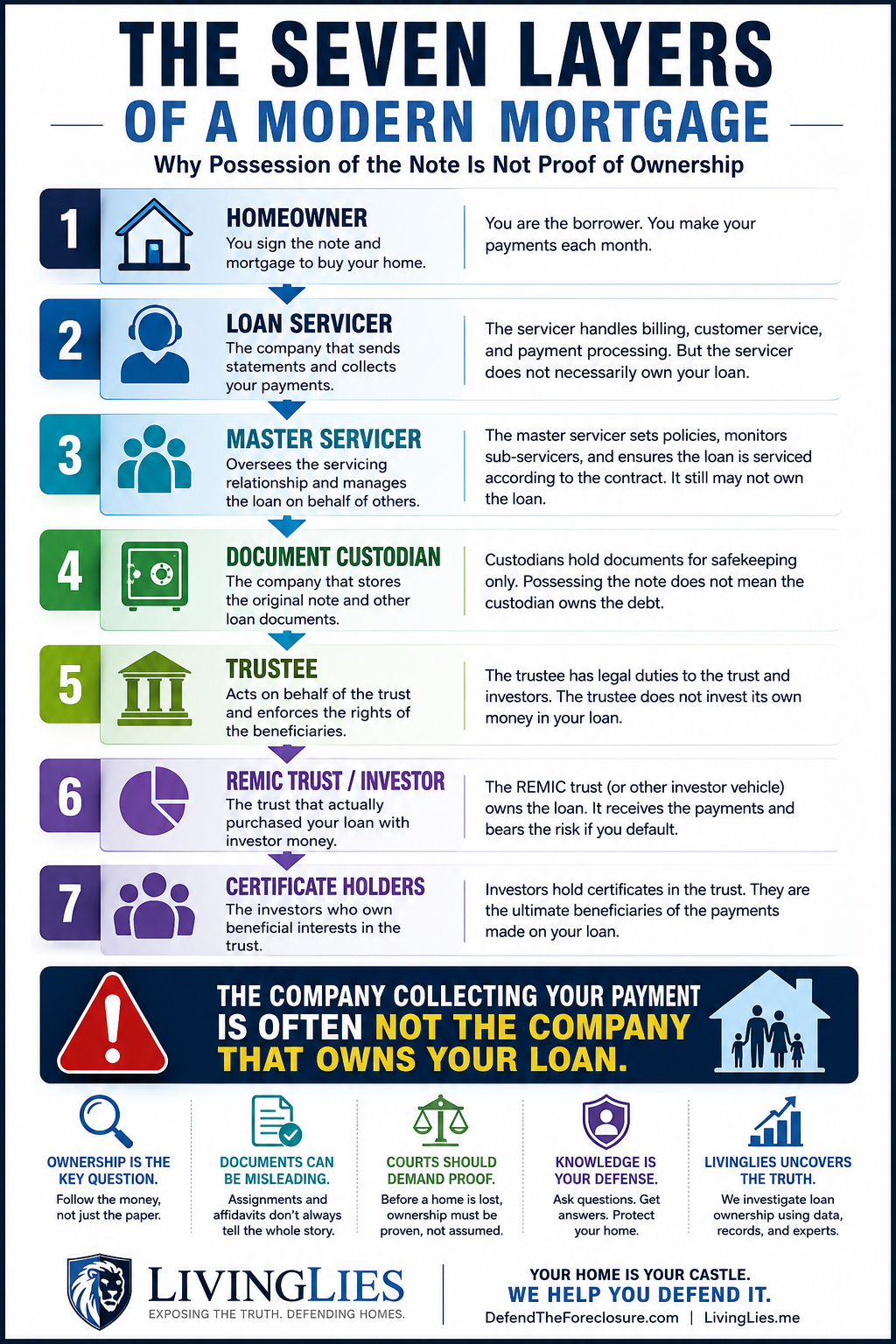
Today, the company collecting your payments likely does not own your loan.
The company sending monthly statements likely does not own your loan.
The company filing the foreclosure likely does not have legal standing to foreclose.
The company storing the original loan documents as custodian likely does not own your loan.
Those roles are frequently divided among different entities.
That is especially true after securitization.
Ownership Changed. Court Procedures Often Did Not.
When millions of mortgages were sold into mortgage-backed securities, ownership of the debt changed.
The paperwork changed.
The accounting changed.
The servicing relationships changed.
The investors changed.
But many courtroom procedures remained rooted in an earlier era, when the local bank that made the loan also kept the note, collected the payments, and owned the debt.
That is no longer how the mortgage industry operates.
Today, a loan may involve:
- an investor,
- a document custodian
- several different trustees at various levels,
- a securities administrator,
- and several law firms.
Yet many foreclosure cases still begin with one narrow question:
“Who has the original note?”
That question alone does not establish ownership and a lot of bad case precedent has been set because of it.
Possession Does Not Automatically Create Ownership
This is one of the most misunderstood concepts in foreclosure law.
A party may possess the original note for many legitimate reasons.
It may serve as:
- document custodian,
- servicer,
- sub-servicer,
- collection agent,
- or authorized representative.
None of those roles automatically make that company the owner of the debt.
Think about a storage company.
A warehouse may hold thousands of automobiles.
The warehouse possesses the cars.
It does not own them.
The same principle can apply to mortgage documents.
The custodian may physically possess the note while the beneficial ownership belongs to someone else.
That distinction becomes critically important when the party seeking to foreclose claims the right to submit a credit bid or represent itself as the creditor. (this is most important if Fannie Mae, Freddie Mac or Ginnie Mae are involved)
Credit Bids Are Reserved for Creditors
One of the least understood aspects of foreclosure sales involves the use of a credit bid.
Unlike an ordinary auction bidder, a creditor generally does not bring cash to the foreclosure sale.
Instead, the creditor offsets the debt against the purchase price.
That is called a credit bid.
But this raises an obvious question.
If the bidder is not actually the creditor, what debt is being credited?
Why Loan-Level Data Changes Everything
This is where LivingLies has fundamentally changed the conversation.
For years, homeowners were told to focus only on recorded assignments.
Those assignments often tell only part of the story.
The real evidence frequently exists somewhere else.
Loan-level data.
Investor reporting.
REMIC trust records.
Pooling and Servicing Agreements.
Servicer reporting.
Accounting records.
Custodial records.
Mortgage schedules.
Investor disclosures.
IRS Tax Code reporting
These records often reveal information that never appears in county land records.
More importantly, they may reveal who has claimed ownership of the loan for accounting, tax, and investor reporting purposes.
That information can dramatically change the issues in a foreclosure case.
Why We Follow the Money Instead of the Paper Trail
Many foreclosure defenses spend enormous amounts of time debating signatures.
Was the endorsement valid?
Was the assignment notarized?
Was the allonge attached?
Those issues can matter.
But they often distract everyone from the larger question.
Who suffered an economic loss?
If no economic loss exists, who is the real creditor?
If the debt has already been sold into a securitized trust, who receives the financial benefit of borrower payments?
If a servicer collects payments for someone else, does the servicer become the creditor?
These questions cannot be answered simply by holding up a piece of paper in court.
They require investigation.
They require accounting.
They require evidence.
Most importantly, they require asking the right question.
Who owns the debt?
The Nationstar Settlement Shows Why Oversight Matters
Concerns about mortgage servicing are not new.
In 2020, North Carolina Attorney General Josh Stein announced an $86.3 million settlement with Nationstar Mortgage (doing business as Mr. Cooper). According to the Attorney General’s announcement, investigators alleged problems involving mortgage servicing transfers, payment processing, borrower communications, complaint handling, and foreclosure-related practices. The settlement required changes to servicing standards and oversight going forward.
That settlement does not determine the outcome of any individual foreclosure case.
Nor does it establish that every foreclosure handled by Nationstar was improper.
But it does demonstrate that regulators considered servicing practices important enough to warrant nationwide corrective action.
That history reinforces why homeowners, attorneys, and courts should carefully examine evidence regarding loan ownership and servicing authority rather than relying solely on assumptions.
Why Courts Continue to Confuse the Right to Enforce a Note with Ownership of the Debt
One of the biggest problems in foreclosure litigation is that two completely different legal concepts have been blended together.
The first is the right to enforce a negotiable instrument.
The second is legal ownership of the underlying debt.
Those concepts overlap in some cases, but they are not identical.
Unfortunately, many foreclosure proceedings treat them as though they are.
That misunderstanding has become one of the most expensive legal shortcuts in American history.
Under Article 3 of the Uniform Commercial Code, a person may, under certain circumstances, qualify as a “person entitled to enforce” a negotiable instrument as a “bearer” instrument. That status concerns enforcement of the instrument itself. It does not necessarily answer the separate question of who owns the economic interest in the debt.
Ownership is a different issue.
Ownership concerns who paid value for the loan.
Ownership concerns who bears the financial risk.
Ownership concerns who receives the economic benefit when the borrower makes payments.
Those questions often fall under different legal principles, including Article 9 of the UCC and the actual contracts governing securitized mortgage transactions.
Article 3 Was Never Designed to Decide Modern Securitized Mortgage Ownership
Most homeowners have never heard of the Uniform Commercial Code.
Even many attorneys never encounter Article 3 until they begin defending foreclosure cases.
The foreclosure industry has become very good at simplifying an extremely complicated area of law into one sentence:
“We have the note.”
But that statement leaves out several critical questions.
- How did you obtain possession?
- Are you holding it for someone else?
- Who purchased the debt?
- Who reports ownership to investors?
- Who reports ownership to the IRS?
- Who receives the cash flow from borrower payments?
- Who suffers the loss if the borrower defaults?
Those questions cannot be answered simply by producing an endorsed note.
They require evidence of ownership.
The Mortgage Industry Quietly Changed the Rules
Before securitization became common, the process was simple.
A local bank made the loan.
The bank kept the note.
The bank collected the payments.
The bank owned the debt.
If foreclosure became necessary, the bank was unquestionably the creditor.
Today’s mortgage market looks nothing like that.
Instead, the loan may pass through multiple financial institutions before it is sold into a mortgage-backed security.
The beneficial owner may be an investment trust.
The monthly payments may be collected by a completely different company.
The original note may remain in the custody of the originating lender or another institution entirely-that does not mean they still own it!
Foreclosure counsel may represent yet another entity.
None of those relationships automatically establish ownership.
Loan-Level Data Frequently Reveals the Real Story
This is why LivingLies places so much emphasis on obtaining loan-level information.
Loan-level data often reveals facts that never appear in the county recorder’s office.
Among other things, our investigations can identify:
- the investor claiming ownership;
- the securitized trust reporting the asset;
- the trust closing date;
- the reported acquisition date;
- the servicing history;
- investor reporting inconsistencies;
- possible conflicts between recorded assignments and investor records;
- possible defects affecting claimed ownership.
That information often changes the entire direction of litigation.
Instead of debating signatures on assignments, the case becomes about something much more important:
Who is the true legal creditor and IF it can be established at all?
Following the Money Trail Instead of the Paper Trail
Many foreclosure defenses focus almost exclusively on recorded documents.
Assignments.
Endorsements.
Allonges.
Notarial acknowledgements.
Those documents certainly deserve scrutiny.
But experienced investigators know something even more important.
Money leaves footprints.
If an investment trust purchased the loan, there should be evidence.
Governing Trust documents map out exactly how loans are to be handled.
If investors received income from that loan, there should be accounting records.
If a REMIC trust reported ownership to investors, there should be supporting documentation.
If another entity claims ownership years later, that claim should be supported by competent evidence and a clear chain of title transfer—not merely by reciting conclusions in an affidavit.
Why Qualified Written Requests Can Change a Case
One of the most underused tools available to homeowners is the Qualified Written Request.
A carefully drafted request requires the servicer to present current information under RESPA that routine discovery often overlooks.
When properly prepared, a QWR may seek information regarding:
- the identity of the owner of the loan;
- the master servicer;
- the sub-servicer;
- document custodians;
- payment history;
- investor identification;
- servicing transfers;
- default calculations;
- corporate advances;
- credit bid authority;
- custodial agreements.
- Most importantly, provide a cop of the original Note with ALL endorsements (something that is not recorded in county land records)
LivingLies has spent years refining these requests because generic internet forms rarely ask the questions that matter.
Expert Witnesses Make Complex Evidence Understandable
Judges decide cases based upon admissible evidence.
Complex financial transactions frequently require expert testimony.
Few homeowners have the resources to explain securitization structures, custodial relationships, investor reporting systems, REMIC requirements, servicing agreements, or loan accounting.
That is where qualified expert testimony becomes invaluable.
LivingLies works with attorneys by providing:
- expert affidavits;
- expert declarations;
- litigation consulting;
- trial preparation;
- cross-examination strategy;
- analysis of business records;
- loan ownership investigations;
- expert witness testimony where appropriate.
The purpose is not to create confusion.
The purpose is to simplify complicated financial evidence so that judges understand what the documents actually establish—and what they do not. Ask to join our private facebook group here to see redacted copies of our expert affidavits.
The Goal Is Not Delay. The Goal Is Accuracy.
Critics sometimes argue that borrowers simply want to delay foreclosure.
That misses the point.
Every legitimate creditor has the right to enforce a lawful obligation.
What homeowners deserve is confidence that the party asking the court to take their home is, in fact, legally entitled to do so.
Accuracy protects everyone.
It protects homeowners.
It protects legitimate investors.
It protects the integrity of the courts.
It protects the public’s confidence in the judicial process.
LivingLies Has Been Asking the Right Question for More Than Twenty Years
For decades, foreclosure litigation has been dominated by paperwork.
LivingLies has focused on evidence.
We ask questions many foreclosure cases never ask.
- Who actually funded the loan?
- Who owns the receivable today?
- Who receives the economic benefit?
- Who claims ownership in investor reporting?
- Who possesses authority to submit a credit bid?
- Who can actually execute a satisfaction of mortgage?
- Who can deliver clear title after payoff?
Those questions expose weaknesses that frequently remain hidden when everyone concentrates only on endorsements and assignments.
Our Investigative Services
LivingLies offers investigative and litigation-support services that few organizations in the country provide.
- Comprehensive loan-level ownership investigations
- Securitization audits
- REMIC trust analysis
- Pooling and Servicing Agreement review
- Chain-of-title investigations
- Business record analysis
- Expert affidavits
- Expert witness services
- Trial consulting
- Qualified Written Requests tailored to each case
- Discovery strategy
- False creditor investigations
- Support for foreclosure defense attorneys nationwide
- Strategic assistance for homeowners representing themselves where permitted by law
These services have one objective.
Determine who actually owns the debt.
The Bottom Line
Every foreclosure case should begin with one simple question.
Who owns the debt?
Not who services it.
Not who stores the original note.
Not who hired foreclosure counsel.
Not who signed the latest assignment.
Ownership.
If courts insist upon reliable evidence answering that question before a home is taken, confidence in the judicial system will be restored.
If they do not, wrongful foreclosures will continue to occur, legitimate investors may be overlooked, and homeowners may lose their property without the true creditor ever appearing before the court.
That is why LivingLies continues to follow the money rather than simply accepting the paperwork.
Because evidence—not assumptions—should determine who has the extraordinary power to foreclose.
Take Action Before It Is Too Late
If you are facing foreclosure, do not assume the company sending monthly statements owns your loan. In most cases they do not.
Do not assume the plaintiff named in the lawsuit is the true creditor.
Do not assume possession of the original note answers every legal question and is all that matters.
Have the loan investigated.
Have the ownership analyzed.
Follow the money.
LivingLies can help homeowners and attorneys uncover the evidence necessary to determine who really owns the debt through loan-level data investigations, securitization analysis, Qualified Written Requests, expert affidavits, expert witness services, and litigation consulting.
Your Home Is Your Castle. We Help You Defend It.
Learn the Truth at DefendTheForeclosure.com and LivingLies.me or call us at 866.216.4126
Ten Questions Every Judge Should Ask Before Authorizing a Foreclosure
Foreclosure is one of the most powerful remedies available under American law. It allows one party to take another person’s home through the judicial process. Because the consequences are so severe, courts should insist upon reliable evidence before authorizing a foreclosure sale.
Unfortunately, many foreclosure hearings focus on only one issue—whether the foreclosing party possesses the original promissory note. While that may be relevant, it rarely answers the larger question of whether the party before the court actually owns the debt.
These are ten questions every judge should ask before entering a foreclosure judgment.
1. Who Paid Value for the Loan?
The first question should not be who possesses the note.
The first question should be who actually purchased the debt and from whom.
Ownership is established by paying value for an asset—not simply by possessing paperwork.
2. Who Bears the Financial Risk?
If the borrower never makes another payment, who actually loses money?
The answer to that question often identifies the real creditor IF that creditor can even still be identified.
3. Who Receives the Borrower’s Payments?
Servicers collect payments every day.
But collecting payments is not the same thing as owning the loan.
Where does the money ultimately go?
Follow the money—not simply the paperwork.
4. Who Reports Ownership to Investors?
Securitized loans generate investor reports every month.
If an investment trust reports ownership of the loan while another company claims ownership in court using documents falsely recorded in county land record, that conflict deserves careful examination.
5. Who Reports Ownership for Accounting and Tax Purposes?
Ownership claimed in litigation should be consistent with ownership reported in accounting records, SEC filings, IRS reporting, trust records, and investor disclosures. Although a homeowner is not party to these issues, it still affects a valid claim made against their title that must be legally resolved.
When those records conflict, courts should ask why.
6. Does the Foreclosing Party Have the Right to Submit a Credit Bid?
A credit bid belongs to the creditor.
If the bidder does not own the debt, where does the authority to submit a credit bid originate?
That question deserves an evidence-based answer.
7. Can the Plaintiff Deliver Clear Title?
If the borrower paid the loan in full tomorrow, who could execute a valid satisfaction of mortgage? A title company will not catch this issue, relying on falsely recorded documentation.
If the answer is uncertain, ownership deserves closer examination.
8. Does the Claimed Ownership Match the Securitization Documents?
Pooling and Servicing Agreements, Prospectuses, mortgage schedules, trust documents, and loan-level reporting frequently identify ownership interests that never appear in county land records.
Ignoring those records may result in incomplete findings and an unmarketable title.
9. Has Anyone Independently Verified the Ownership Chain?
Courts should not rely exclusively on affidavits prepared by interested parties or the current servicer who cannot attest to a previous servicer’s records that were boarded into their system.
Independent evidence should support every critical ownership claim.
10. Is the Court Determining Who May Enforce the Note—or Who Owns the Debt?
These are different legal questions.
One concerns enforcement.
The other concerns ownership.
Justice requires understanding the difference before someone’s home is permanently taken.
When courts consistently ask these ten questions, confidence in foreclosure judgments will increase because decisions will rest on evidence rather than assumptions.
The LivingLies Investigation Process: How We Discover the Real Creditor
Many homeowners contact us after spending months arguing about signatures, notarizations, endorsements, or recorded assignments.
While those issues may matter, they are often symptoms—not the disease.
Our investigation begins somewhere entirely different.
We start with one question.
Who actually owns this debt?
Everything we do is designed to answer that question with objective evidence.
Step One: Qualified Written Request and Discovery Strategy
Generic internet forms rarely obtain the information homeowners actually need. The LivingLies Qualified Written Request system under our Administrative strategy, and governed by RESPA, are designed to uncover:
The actual owner of the loan
document custodians
master servicers
sub-servicers
payment histories
corporate advance
credit bid authority
business records supporting ownership claims
currently active original documentation
When litigation hs already begun, we assist our clients and attorneys with discovery strategies focused on obtaining admissible evidence-not simply more paperwork.
Step Two: Complete Loan-Level Ownership Investigation
We begin by gathering every available source of ownership information.
That includes investor reporting, securitization data, servicing records, trust information, public filings, and available loan-level data, just to start!
Our goal is to determine whether the ownership claimed in court matches the ownership reflected elsewhere and whether an entity has “Legal Standing” to foreclose.
Step Three: Securitization Analysis
If the loan was sold into a mortgage-backed security, we reconstruct that transaction.
Among other issues, we examine:
- the trust claiming ownership;
- the trust closing date;
- reported acquisition dates;
- pooling and servicing agreements;
- custodial relationships;
- servicing transfers;
- reported investor information that includes alleged balances.
This often reveals facts that never appear in county land records.
Step Four: Chain-of-Ownership Reconstruction
Instead of accepting the chain presented by the foreclosing party, we independently reconstruct ownership from available evidence.
Where conflicts appear, we identify them and document them.
That information frequently becomes central to litigation.
Step Four: Qualified Written Requests and Discovery Strategy
Generic internet forms rarely obtain the information homeowners actually need.
Our Qualified Written Requests are designed to uncover:
- the actual owner of the loan;
- document custodians;
- master servicers;
- sub-servicers;
- payment histories;
- corporate advances;
- credit bid authority;
- business records supporting ownership claims.
When litigation has already begun, we assist attorneys with discovery strategies focused on obtaining admissible evidence—not simply more paperwork.
Step Five: Business Record Analysis
Servicers frequently rely upon business-record affidavits.
Those records deserve careful examination.
We analyze whether the witness actually possesses personal knowledge, whether the records satisfy evidentiary requirements, and whether they support the conclusions being offered.
Step Six: Expert Reports and Affidavits
Complex financial issues require clear explanations.
Our experts prepare reports and affidavits explaining:
- loan ownership issues;
- servicing relationships;
- REMIC trust analysis;
- investor reporting;
- credit bid authority;
- chain-of-title defects;
- business record deficiencies;
- industry customs and practices.
Our objective is not to overwhelm the court with technical language.
Our objective is to make complicated evidence understandable.
Step Seven: Trial Support
Cases are won because evidence is presented clearly.
We work with foreclosure defense attorneys throughout the country by assisting with:
- case strategy;
- cross-examination planning;
- exhibit preparation;
- trial notebooks;
- expert witness testimony where appropriate;
- analysis of newly produced documents.
Every case is different.
Every loan has its own history.
Every foreclosure deserves an independent investigation.
Why Our Approach Is Different
Most foreclosure investigations begin with the paperwork created by the foreclosing party.
We begin with the financial transaction itself.
We ask who paid for the loan.
We identify who reports ownership.
We determine who receives the economic benefit.
We examine whether the evidence supports the legal claims being made.
That approach has helped homeowners and attorneys identify issues that would otherwise remain hidden.
Simply put, we do not assume the plaintiff is the creditor.
We prove—or disprove—that claim with evidence.
Our Promise to Homeowners
We cannot promise that every foreclosure can be stopped.
No honest professional can make that promise.
What we do promise is this:
We will investigate the facts.
We will follow the money.
We will identify the evidence.
We will explain what the documents actually show.
And if the evidence demonstrates that the party attempting to foreclose cannot establish its claimed authority, we will help homeowners and their attorneys present those facts clearly and effectively.
Because justice begins with asking the right question.
Who really owns the debt?
Until that question is answered with competent evidence, no family should lose its home based solely on assumptions or appearances.
REFERENCES
- Uniform Commercial Code, Articles 3 and 9.
- CFPB Mortgage Servicing Rules (12 C.F.R. Part 1024).
- North Carolina Attorney General, 2020 settlement with Nationstar Mortgage regarding servicing practices.
FAQ
Does having the original promissory note prove ownership of my loan?
Not necessarily. A party may possess the note as a custodian, servicer, or authorized agent without owning the underlying debt. Determining ownership often requires examining loan-level data, investor reporting, servicing agreements, and other evidence.
What is loan-level data?
Loan-level data consists of records that identify information about a specific mortgage loan, including servicing history, investor reporting, securitization details, and ownership information that may not appear in county land records.
Why is ownership important in foreclosure?
The party seeking to foreclose should have the legal authority to do so. Questions about ownership may become significant when different records appear to identify different entities as holding interests related to the loan.
What is a credit bid?
A credit bid allows an eligible creditor to bid at a foreclosure sale by offsetting the debt rather than paying cash. Whether a particular party is entitled to use a credit bid depends on the applicable law and the facts of the case.
How can LivingLies help?
LivingLies provides litigation consulting, loan-level investigations, securitization analysis, Qualified Written Requests, expert affidavits, expert witness services, business-record analysis, and trial support to help homeowners and attorneys better understand the evidence in foreclosure cases.
Search Our Blog
Categories
Contact Our National Headquarters Phone: 844-583-5339
Connect with us


Contact Our National Headquarters
- 844-583-5339
- Available 24/7
-
200 S. Andrews Ave. Ste. 604
Ft. Lauderdale, FL 33301