
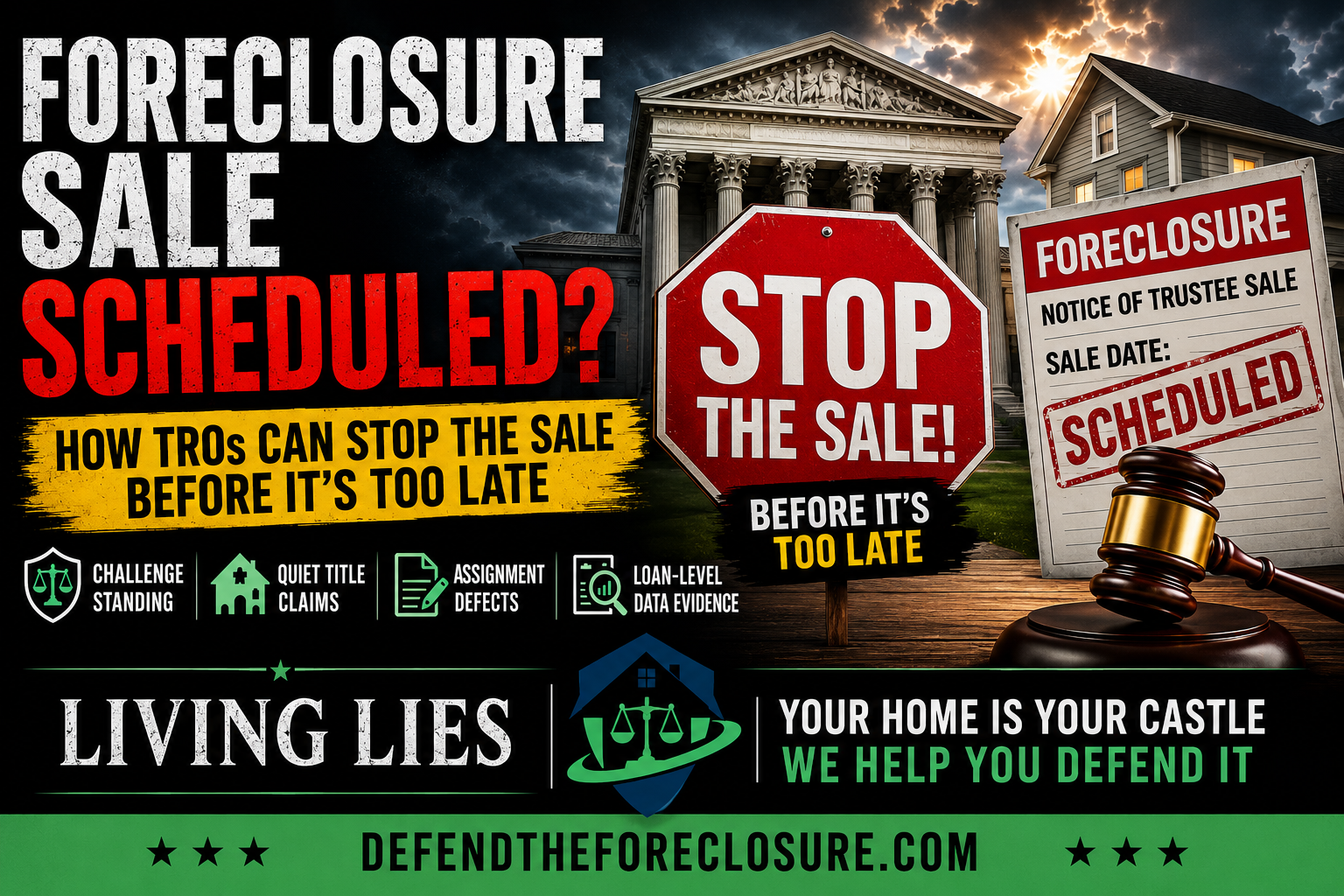
One of the most common statements heard from homeowners facing foreclosure is:
“I wish I had acted sooner.”
Unfortunately, many homeowners do not realize how quickly foreclosure timelines can move until a sale date has already been scheduled.
The notices arrive. The servicer refuses to answer meaningful questions.
The foreclosure attorneys continue moving forward.
And suddenly the homeowner is staring at a trustee sale date that may be only days away.
At that moment, many people assume there is nothing left to do.
That assumption is often incorrect.
In many situations, courts possess the authority to temporarily stop a foreclosure sale through emergency relief known as a Temporary Restraining Order (TRO).
A TRO in foreclosure is not a magic solution.
It is not granted automatically.
And it is not designed simply to delay foreclosure.
Its purpose is far more important.
A TRO in Foreclosure allows a court to prevent irreversible harm while serious legal issues are examined.
For homeowners facing an imminent foreclosure sale, understanding TROs can mean the difference between preserving rights and losing opportunities that may never return.
What Is a Temporary Restraining Order?
A Temporary Restraining Order is an emergency court order intended to preserve the status quo until a judge can determine whether further relief is appropriate.
In foreclosure litigation, TROs are frequently used to stop:
- trustee sales,
- foreclosure auctions,
- non-judicial foreclosure sales,
- evictions following foreclosure,
- property transfers,
- or other actions that may cause immediate harm.
The key concept is simple.
Once a foreclosure sale occurs, rights may change dramatically.
The law recognizes that some events cannot easily be undone.
That is why courts sometimes intervene before the sale occurs.
Why Timing Matters So Much
Many homeowners wait too long.
They continue negotiating with the servicer.
They submit modification packages repeatedly.
They make phone calls.
They send emails.
Meanwhile, the foreclosure process continues.
By the time legal help is sought, the sale may be only days away.
Emergency relief is still possible in some cases.
But the strongest TRO requests are generally filed before the crisis becomes immediate.
The earlier legal issues are identified, the greater the opportunity to present evidence and obtain meaningful review.
How a TRO Differs From a Preliminary Injunction
Many people use these terms interchangeably.
They are related but different.
Temporary Restraining Order
A TRO is emergency relief.
It is designed to stop immediate harm.
It is often short-term.
Its purpose is to maintain the status quo until a hearing can occur.
Preliminary Injunction
A preliminary injunction usually follows a TRO.
It generally lasts longer.
The court typically has an opportunity to review more evidence and hear from both sides.
In many foreclosure cases, the TRO serves as the bridge that allows the homeowner to reach a preliminary injunction hearing.
The Four Things Judges Usually Want to See
Although the standards vary slightly from state to state, most courts examine similar factors.
1. Likelihood of Success on the Merits
The homeowner must generally show that legitimate legal issues exist.
This does not mean proving the entire case immediately.
But it does require more than speculation.
The court wants to see real issues supported by evidence.
2. Irreparable Harm
This is often the easiest factor for homeowners to establish.
Losing a home through foreclosure frequently creates harm that cannot easily be repaired later.
Property rights may transfer.
Possession may change.
Third parties may become involved.
Those consequences can be difficult to reverse.
3. Balance of Hardships
The court compares the harm facing each side.
A short delay in a foreclosure sale may create inconvenience for the foreclosing party.
The loss of a family home creates far more severe consequences.
This comparison often favors preserving the status quo until the legal issues can be examined.
4. Public Interest
Courts generally recognize that public confidence in the legal system requires that property rights be determined fairly.
When serious questions exist regarding ownership, authority, standing, or enforcement rights, allowing additional review may serve the public interest.
Why Standing Problems Frequently Support TROs
One of the most powerful foundations for emergency relief is uncertainty regarding standing.
Standing simply means the legal right to enforce the debt and pursue foreclosure.
If the foreclosing party cannot clearly establish standing, courts may be more willing to pause the process.
Questions frequently include:
- Who owns the debt?
- Who possesses enforcement rights?
- Who authorized the foreclosure?
- Who authorized the servicer?
- Who authorized foreclosure counsel?
These are not technical questions.
They are foundational questions.
If they remain unanswered, emergency relief may be appropriate.
The Most Effective TRO Argument Is Often the Simplest
Many homeowners believe they must prove an elaborate fraud scheme to obtain relief.
That is often a mistake.
The strongest TRO arguments frequently focus on simple issues.
Who has the legal right to foreclose?
If that question cannot be answered clearly, courts may be reluctant to allow an irreversible sale to proceed.
Servicer Authority Problems
Modern foreclosure litigation is usually driven by servicers.
The servicer sends notices.
The servicer maintains records.
The servicer hires foreclosure counsel.
The servicer supplies witnesses.
But servicers are not automatically creditors.
They generally claim authority from another entity.
That authority should be proven.
When authority is unclear, significant questions arise regarding the validity of the foreclosure process.
Those questions often support requests for emergency relief.
Business Records Problems
Many foreclosure cases depend heavily on business records.
Payment histories.
Default records.
Boarding records.
Account notes.
Servicing system screenshots.
But courts should not automatically assume those records are reliable.
Questions often include:
- Who created the records?
- Were they transferred from another servicer?
- Were they independently verified?
- Who has personal knowledge of the information?
If the foundation for the records is weak, the court may determine that additional review is necessary before allowing a foreclosure sale to occur.
How Loan-Level Data Can Change a TRO Hearing
One of the most powerful tools available in modern foreclosure litigation is loan-level data.
Loan-level data often contains information that never appears in foreclosure pleadings.
It may reveal:
- investor reporting fields,
- ownership designations,
- servicing transfers,
- trust references,
- and transaction histories.
When loan-level data conflicts with the foreclosure narrative, courts may become more willing to preserve the status quo until those conflicts are resolved.
This is one reason LivingLies has consistently emphasized the importance of obtaining and analyzing loan-level information whenever possible.
California TRO Strategies
California’s non-judicial foreclosure system often creates the need for emergency relief.
Unlike judicial foreclosure states, no lawsuit is automatically filed before the sale process begins.
This means homeowners frequently must initiate litigation themselves.
Common California TRO issues include:
- standing disputes,
- trustee authority issues,
- servicer authority questions,
- defective notices,
- and conflicting ownership claims.
California homeowners should never assume that waiting until the final days before the sale is a good strategy.
The earlier the legal issues are presented, the better.
Texas TRO Strategies
Texas foreclosure timelines can move extremely quickly.
TROs are frequently used to bring foreclosure disputes into court before a scheduled sale occurs.
Texas TRO requests often focus on:
- standing issues,
- servicer authority problems,
- notice violations,
- ownership disputes,
- and wrongful foreclosure claims.
Because Texas sales often proceed rapidly, homeowners who delay may find themselves with fewer options.
Georgia TRO Strategies
Georgia is one of the fastest foreclosure states in America.
This makes emergency relief especially important.
Georgia TRO requests frequently focus on:
- authority defects,
- notice compliance issues,
- assignment problems,
- standing disputes,
- and ownership questions.
When legal issues exist, waiting can be extremely dangerous.
What To Do When the Sale Is Less Than 72 Hours Away
If the foreclosure sale is imminent, immediate action is necessary.
Critical steps often include:
- collecting all foreclosure documents,
- reviewing assignments,
- analyzing standing issues,
- reviewing servicer authority claims,
- obtaining available loan-level data,
- and preparing evidence supporting emergency relief.
The most important thing is not panic.
The most important thing is evidence.
Courts respond to evidence.
Evidence creates leverage.
Evidence creates opportunities.
TROs Based on Quiet Title Claims
One of the most overlooked grounds for emergency relief is the existence of a legitimate quiet title dispute.
Many foreclosure cases involve parties claiming rights against property without clearly establishing the source of those rights.
The foreclosure documents may identify:
- a trustee,
- a servicer,
- a trust,
- a beneficiary,
- or a bank.
But identifying a party is not the same as proving the party’s rights.
Quiet title claims focus on a simple issue:
Who actually possesses a valid claim against the property?
When multiple parties appear in the chain of title, assignments appear years after alleged transfers, or ownership claims conflict with available records, courts may conclude that the title issues should be examined before allowing a foreclosure sale to proceed.
That is where quiet title and TRO practice frequently intersect.
If serious title disputes remain unresolved, allowing a foreclosure sale to occur may create even greater confusion regarding ownership and property rights.
TROs Based on False or Questionable Assignments
Assignments often become the centerpiece of foreclosure litigation.
The foreclosing party frequently relies on assignments to establish standing, authority, ownership, or enforcement rights.
But assignments often raise important questions.
For example:
- Who signed the assignment?
- What authority did the signer possess?
- When was the assignment executed?
- Was it recorded years after the alleged transfer?
- Does it reflect an actual transaction?
The issue is not whether the homeowner can immediately prove the assignment is invalid.
The issue is whether significant unanswered questions remain.
Courts are often reluctant to allow an irreversible foreclosure sale when the documents relied upon to justify the sale are themselves under legitimate challenge.
TROs Based on Missing Creditor Issues
One of the central themes of LivingLies has always been the distinction between the party claiming enforcement rights and the party that may actually own the debt.
Many foreclosure cases identify:
- a servicer,
- a trustee,
- a trust,
- or a nominee.
But none of those labels automatically identifies the actual creditor.
This creates one of the most important questions in foreclosure litigation:
Who is the party that suffered the alleged financial loss?
If the answer remains unclear, courts may conclude that additional review is required before the foreclosure process continues.
Emergency relief is often appropriate when significant uncertainty exists concerning the identity of the creditor or the party entitled to enforce.
Why Loan-Level Data Can Become Critical Evidence
Many TRO motions fail because homeowners rely exclusively on recorded documents.
The problem is that recorded documents often tell only part of the story.
Loan-level data frequently reveals information that does not appear anywhere in county records.
It may identify:
- investor ownership fields,
- servicing transfers,
- trust designations,
- reporting histories,
- and transaction information.
When those records conflict with the foreclosure narrative, courts may determine that significant factual disputes exist.
Those disputes often strengthen requests for emergency relief.
This is one reason LivingLies has consistently emphasized obtaining loan-level data whenever possible. We support our loan level data with expert affidavits from our experts qualified to testify if needed.
Ask to join our private facebook group HERE to see redacted samples of our work and affidavits that have won cases nationally.
Learn about Loan Level Data evidence
California CCP §526 and Emergency Foreclosure Relief
California homeowners frequently encounter foreclosure sales through the state’s non-judicial foreclosure system.
One of the legal foundations for injunctive relief in California is California Code of Civil Procedure Section 526.
Although every case depends on its specific facts, Section 526 is often cited when homeowners seek temporary restraining orders and preliminary injunctions.
California courts generally focus on:
- the likelihood of prevailing,
- the balance of harms,
- irreparable injury,
- and preservation of the status quo.
When serious questions exist regarding authority, ownership, standing, or title, California courts may be willing to maintain the status quo until those issues can be examined fully.
Texas Rule 680 and Emergency Relief
Texas homeowners often rely upon Rule 680 of the Texas Rules of Civil Procedure when seeking temporary restraining orders.
Texas courts frequently examine:
- immediate harm,
- the need to preserve the status quo,
- and the legal basis supporting the requested relief.
Because Texas foreclosure timelines can move extremely quickly, Rule 680 often becomes a critical tool for bringing disputes before the court before the scheduled sale occurs.
Texas homeowners should understand that delay can be devastating.
Early action frequently creates the greatest opportunity for meaningful relief.
Georgia Emergency Foreclosure Practice
Georgia’s non-judicial foreclosure process often leaves homeowners with very little time to react.
As a result, TRO practice is especially important.
Georgia courts frequently review:
- authority disputes,
- notice issues,
- assignment defects,
- standing challenges,
- and ownership questions.
Because foreclosure sales can proceed quickly, identifying legal issues before the final days becomes critically important.
Homeowners who wait until the eve of the sale often find themselves facing unnecessary procedural obstacles.
Why Most TRO Motions Fail
One of the biggest misconceptions in foreclosure litigation is the belief that TROs are routinely granted.
They are not.
Most TRO motions fail for predictable reasons.
Waiting Too Long
Many homeowners seek emergency relief only after every deadline has passed.
Courts are generally more receptive when homeowners act promptly. DON’T WAIT TO LONG; CALL US NOW! 866.216.4126
Focusing on Hardship Instead of Legal Issues
Hardship matters.
But courts usually grant TROs because legal issues exist, not simply because foreclosure is difficult.
Making Unsupported Allegations
Courts require evidence.
Claims unsupported by documents, declarations, or testimony often fail.
Learn more about common homeowner mistakes when they represent themselves:
Why Homeowners lose cases when they represent themselves
Failing to Explain Irreparable Harm
Judges want to understand why immediate intervention is necessary.
That explanation should be clear and supported by facts.
Ignoring Standing Issues
Many homeowners focus entirely on modification disputes while ignoring standing, authority, ownership, and enforcement questions that may provide stronger grounds for relief.
Learn about Legal Standing Defenses in Foreclosure
Building an Effective TRO Evidence Package
Every case is different, but effective emergency motions are often supported by:
- foreclosure notices,
- assignments,
- payment histories,
- loan-level data,
- servicing correspondence,
- declarations,
- ownership evidence,
- and title records.
The goal is not volume.
The goal is credibility.
Strong evidence frequently carries more weight than lengthy accusations.
The LivingLies Approach
LivingLies has never advocated delay for the sake of delay.
The purpose of emergency relief is not to postpone the inevitable.
The purpose is to prevent irreversible harm while legitimate legal questions are examined.
When serious disputes exist regarding:
- standing,
- authority,
- ownership,
- servicer powers,
- chain of title,
- or the identity of the actual creditor,
courts should have the opportunity to evaluate those issues before a foreclosure sale permanently alters property rights.
The key is not delay.
The key is forcing proof before the sale occurs.
Homeowner Call To Action
Foreclosure Sale Approaching? Time Matters.
Many homeowners wait until the final days before a sale to seek help.
That may be the biggest mistake of all.
LivingLies/Defend the Foreclosure helps homeowners and attorneys analyze:
- standing challenges,
- loan-level data,
- quiet title issues,
- servicer authority,
- chain of title defects,
- business records problems,
- and emergency foreclosure strategies.
Your home is your castle. We help you Defend it.
Before anyone takes it, make them prove they have the legal right to do so. Call us today at 866.216.4126 or
Request an Emergency Foreclosure Analysis Today
Frequently Asked Questions
Can a TRO stop a foreclosure sale?
Yes. Courts may issue a Temporary Restraining Order to temporarily stop a foreclosure sale while legal issues are reviewed.
How quickly can a TRO be obtained?
Depending on the court and circumstances, emergency relief can sometimes be obtained within hours or days.
Do TROs permanently stop foreclosure?
No. TROs are temporary remedies designed to preserve the status quo until the court can examine the legal issues more fully.
What issues support a foreclosure TRO?
Standing disputes, servicer authority problems, assignment issues, ownership disputes, quiet title claims, and notice violations frequently support requests for emergency relief.
Does loan-level data help support a TRO?
It can. Loan-level data may reveal ownership, servicing, and investor information that creates questions regarding standing and enforcement rights.
Search Our Blog
Categories
Contact Our National Headquarters Phone: 844-583-5339
Connect with us


Contact Our National Headquarters
- 844-583-5339
- Available 24/7
-
200 S. Andrews Ave. Ste. 604
Ft. Lauderdale, FL 33301