
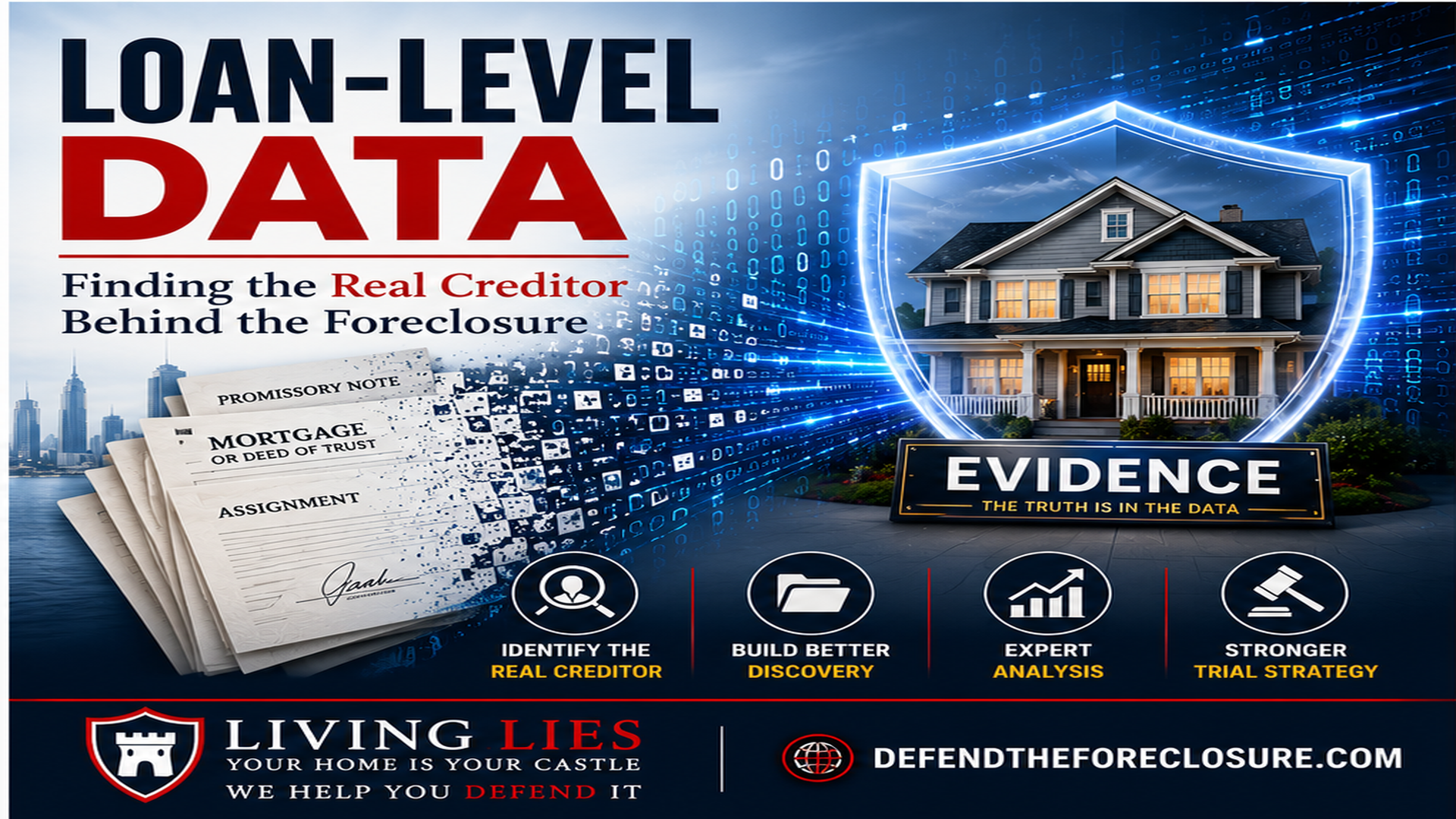
Discovering the Real Creditor Before You Lose Your Home
Here’s how loan level data in foreclosure defense can stop a sale; read on. For years, foreclosure litigation has focused on documents that appear in the public record.
The promissory note.
The mortgage or deed of trust.
Recorded assignments.
Affidavits signed by loan servicers.
Declarations stating that someone reviewed business records.
These documents are important. But they often tell only part of the story.
Behind nearly every modern residential mortgage is an enormous amount of electronic information that never appears in the county recorder’s office.
That information is commonly referred to as loan-level data.
Loan-level data in foreclosure defense may reveal details about servicing transfers, investor reporting, securitization, payment histories, ownership changes, default reporting, and other information that can be highly relevant in foreclosure litigation.
Sometimes it confirms what appears in the foreclosure complaint.
Sometimes it raises serious questions that deserve further investigation.
Those questions often become the foundation for discovery, expert analysis, and litigation strategy.
At LivingLies, we believe foreclosure cases should be decided on competent evidence—not assumptions. One of the most effective ways to evaluate the evidence is to examine the financial data behind the loan rather than relying solely on recorded paperwork.
What Is Loan-Level Data?
Loan-level data when used in foreclosure defense is the collection of electronic records generated throughout the life of a mortgage loan.
Unlike the documents recorded in county land records, loan-level data reflects activity occurring inside servicing platforms, investor reporting systems, securitization databases, and financial reporting systems.
Depending on the loan and the available sources, that data may include:
- Loan identification numbers
- Investor reporting fields
- Servicing transfer history
- Trust or pool identifiers
- Payment reporting information
- Delinquency reporting
- Loss mitigation activity
- Servicer changes
- Investor codes
- Pool and tranche references
- Master servicer information
- Custodial reporting
- Claim activity
- Default milestones
- Charge-off information
Each data point may appear insignificant by itself. Together, however, they often provide a much clearer picture of who is reporting the loan, who is servicing it, and how it has been treated throughout its history.
Why the County Records Tell Only Part of the Story
Many homeowners believe the answer to every foreclosure dispute can be found in the county recorder’s office.
Unfortunately, modern mortgage finance rarely works that way.
County records generally document interests affecting title to real property.
They do not necessarily identify every entity involved in servicing, reporting, investment, or financial administration of a mortgage loan.
Over the past two decades, residential mortgages have frequently been sold, pooled, securitized, serviced, transferred, sub-serviced, and reported through multiple entities.
Some of those activities are reflected in public records.
Many are not.
As a result, homeowners often receive foreclosure pleadings identifying one party while investor reporting and servicing records identify others performing different functions.
Understanding those distinctions is essential before drawing conclusions about ownership or enforcement rights.
The Difference Between the Note Holder and the Actual Creditor
One of the most misunderstood concepts in foreclosure litigation is the difference between possessing a promissory note and being the party entitled to receive the economic benefit of the debt.
Different legal questions may arise regarding:
- Who possesses the original note?
- Who has authority to enforce it under applicable law?
- Who receives the financial benefit of borrower payments?
- Who reports the loan to investors?
- Who bears the economic risk of loss?
- Who authorized the foreclosure?
These questions do not always produce the same answer.
Loan-level data can help identify relationships among the various participants and provide a factual basis for discovery into those issues.
Ultimately, courts decide standing and enforcement questions based on the evidence presented and the governing law. Developing a reliable factual record is therefore critical.
Securitization Added Layers of Complexity
In many residential mortgage transactions, the original lender no longer services the loan years later.
The servicing rights may have been transferred several times.
The loan may have been included in a mortgage-backed securities transaction.
Different entities may perform different roles, including:
- Master servicers
- Sub-servicers
- Document custodians
- Indenture trustees
- Administrative agents
- Investment managers
- Trustees for securitized trusts
- Investors
These arrangements can make it difficult for homeowners—and sometimes even courts—to understand who performs which function.
Loan-level data frequently provides context that recorded documents alone cannot.
When Loan-Level Data Raises Important Questions
Loan-level data is not valuable because it automatically proves wrongdoing.
Its value lies in identifying factual issues that deserve further investigation.
For example, investigators may compare loan-level reporting with:
- allegations contained in the foreclosure complaint,
- recorded assignments,
- servicer declarations,
- payment histories,
- business records,
- pooling and servicing agreements,
- or investor reports.
If material differences appear, those differences may justify additional discovery.
The purpose is not to speculate. The purpose is to determine whether the evidence supports the claims being made in court.
Standing Begins with Reliable Evidence
Standing is one of the most important issues in foreclosure litigation because it asks whether the party invoking the court’s authority has the legal right to do so.
That inquiry often requires evidence addressing several related questions.
- Who claims the right to enforce the obligation?
- What documents support that claim?
- What financial records support that claim?
- Who authorized the servicer to act?
- Who receives the economic benefit of borrower payments?
- What records establish those relationships?
Loan-level data does not answer every legal question.
But it can provide an evidentiary roadmap for discovery by identifying entities, transactions, and reporting relationships that may otherwise remain hidden.
Why Courts Need Evidence—Not Assumptions
Foreclosure litigation is ultimately decided on admissible evidence.
Courts generally expect parties to support their positions with competent testimony, authenticated documents, and reliable business records.
Loan-level data becomes especially valuable when it helps attorneys formulate targeted discovery requests, identify knowledgeable witnesses, and test the accuracy of assertions contained in affidavits or declarations.
Rather than relying on generalized arguments about securitization or servicing, a case supported by specific financial information allows the litigation to focus on verifiable facts.
What Loan-Level Data May Reveal
Although every loan is different, loan-level reporting may help identify information such as:
- Current and prior servicers
- Investor reporting identifiers
- Trust or pool references
- Reporting timelines
- Default reporting history
- Servicing transfer dates
- Master servicer relationships
- Claim and loss mitigation activity
- Payment reporting fields
- Custodial references
- Portfolio coding
- Other transaction-specific reporting information
That information can assist attorneys in preparing discovery, evaluating witness testimony, and determining what additional records should be requested from the parties involved.
Early Investigation Changes Litigation Strategy
One of the greatest advantages of obtaining loan-level data early is that it allows litigation strategy to be based on facts rather than assumptions.
Instead of waiting until trial to discover inconsistencies, attorneys can tailor Qualified Written Requests, Requests for Information, interrogatories, requests for production, subpoenas, and depositions to the specific issues suggested by the data.
Early investigation also helps determine whether expert analysis may be beneficial before emergency hearings, summary judgment proceedings, or trial.
In many cases, asking the right questions early is just as important as having the right answers later.
Using Loan-Level Data to Build a Discovery Strategy
One of the greatest advantages of obtaining loan-level data early in a foreclosure case is that it allows discovery to be focused on evidence instead of speculation.
Too often, homeowners—and even experienced attorneys—serve broad discovery requests hoping that something useful will emerge. That approach can generate objections, delay, and unnecessary expense.
Loan-level data changes that strategy.
Instead of guessing, discovery can be directed toward specific entities, specific transactions, specific reporting events, and specific periods reflected in the data.
For example, if loan-level reporting indicates that servicing transferred on a particular date, discovery can be tailored to obtain the boarding records, servicing agreements, communications, and quality-control procedures associated with that transfer.
If the data identifies investor reporting that differs from the allegations contained in the foreclosure complaint, discovery can focus on the documents supporting those differences.
Discovery becomes more efficient because the questions are grounded in objective financial information rather than assumptions.
Qualified Written Requests (QWRs) and Requests for Information (RFIs)
Before litigation begins—or while it is pending—federal servicing regulations provide borrowers with tools that may help obtain important information from the loan servicer.
Qualified Written Requests and Requests for Information should never be treated as generic form letters.
The most effective requests are carefully drafted after reviewing the available evidence.
At LivingLies, our approach is to tailor these requests to the facts suggested by the loan-level data and the foreclosure record.
Rather than asking dozens of unrelated questions, properly targeted requests can seek information regarding:
- the identity of the party claiming ownership of the debt,
- the authority under which the servicer acts,
- the existence of servicing agreements,
- boarding records following servicing transfers,
- payment histories,
- default calculations,
- investor reporting,
- and the documents relied upon in initiating foreclosure.
Well-drafted QWRs and RFIs also create a record. The responses—or the failure to provide meaningful responses—may later become relevant in discovery, motion practice, or trial.
Transforming Raw Data into Litigation Evidence
Raw electronic data does not speak for itself.
Financial reporting fields, investor codes, servicing identifiers, and transaction histories often require careful analysis before they become useful in litigation.
That is where expert review becomes valuable.
An experienced analyst can organize the information into a coherent chronology, identify relationships among the entities involved, compare the reporting with public records, and highlight areas where additional evidence should be obtained.
The goal is not to draw unsupported conclusions.
The goal is to provide attorneys and courts with a reliable factual framework that can be tested through discovery and witness testimony.
Expert Affidavits and Declarations
Many contested foreclosure matters involve technical issues that are unfamiliar to judges and juries.
Servicing systems.
Securitization reporting.
Investor accounting.
Business-record practices.
Electronic loan administration.
In appropriate cases, expert affidavits or declarations can help explain those subjects in a clear and understandable manner.
At LivingLies, we assist attorneys by preparing expert analyses that explain the financial reporting reflected in loan-level data, identify areas requiring additional investigation, and place complex servicing activity into an organized factual context.
Those reports are designed to assist the court in understanding the evidence—not to substitute for the court’s role in deciding the legal issues.
Expert Witness Testimony at Trial
Discovery is only one part of foreclosure litigation.
Ultimately, many contested cases depend upon testimony presented in court.
When technical financial issues become central to the dispute, expert testimony may help explain:
- loan servicing practices,
- servicing transfers,
- investor reporting,
- boarding procedures,
- business-record reliability,
- financial reporting systems,
- and the significance of loan-level reporting.
LivingLies provides expert witness support for attorneys nationwide by helping translate complex financial records into understandable testimony supported by documentary evidence.
The objective is to ensure that complicated financial issues are presented accurately and clearly.
Preparing for Depositions
Loan-level data frequently identifies topics that deserve careful examination during depositions.
For example, a witness may be asked:
- Who entered specific servicing information?
- What system generated particular reports?
- When were the records created?
- How were records transferred during servicing changes?
- Who verified the accuracy of boarded information?
- What documents support the witness’s conclusions?
Because these questions arise from documented financial information rather than speculation, they often lead to more meaningful testimony.
Preparing for Trial
Trial preparation begins long before the first witness is sworn.
Loan-level data allows attorneys to organize exhibits, identify missing evidence, anticipate evidentiary objections, and prepare examinations that focus on verifiable facts.
Rather than reacting to testimony presented by the foreclosing party, counsel can build an affirmative evidentiary presentation based upon documented financial information.
That preparation frequently strengthens cross-examination, motions in limine, and challenges to unsupported business-record testimony.
State-Specific Considerations
California
California’s non-judicial foreclosure process often moves quickly. Obtaining loan-level data early can assist attorneys seeking Temporary Restraining Orders, Preliminary Injunctions, expedited discovery, and other emergency relief before a trustee’s sale occurs.
Texas
Texas foreclosure timelines require early investigation. Targeted discovery supported by loan-level analysis may help identify the issues that require immediate judicial review.
Florida
Because Florida foreclosures generally proceed through judicial proceedings, loan-level data can support discovery, motions challenging standing, business-record objections, and trial preparation.
Georgia
Georgia homeowners frequently face compressed timelines under the non-judicial foreclosure process. Early financial investigation may identify issues that justify emergency court intervention.
New York and New Jersey
In judicial foreclosure states such as New York and New Jersey, loan-level data can provide valuable support for discovery, standing challenges, business-record litigation, and trial preparation.
The LivingLies Loan-Level Data Program
For more than twenty years, LivingLies has emphasized that foreclosure litigation should focus on evidence rather than assumptions.
Our loan-level data program is designed to help homeowners and attorneys obtain, organize, and understand the financial information that often lies behind a foreclosure claim.
Depending on the circumstances of the case, our services include:
- loan-level data and analysis,
- identification of the real creditor based upon proprietary loan level data access,
- review of servicing transfers and investor reporting,
- analysis of business records and payment histories,
- expert affidavits and declarations,
- expert witness testimony for hearings and trial,
- discovery planning,
- assistance with deposition preparation,
- litigation consulting for attorneys and self-represented homeowners,
- drafting targeted Requests for Information (RFIs),
- review of responses received from servicers,
- and assistance in developing an evidence-based litigation strategy.
Every foreclosure case is different.
Our role is not to promise a particular outcome.
Our role is to help ensure that important financial evidence is identified, understood, and presented effectively so that the court can evaluate the case on a complete factual record.
Discover the Evidence Behind the Foreclosure
If your home is facing foreclosure—or you represent a homeowner in foreclosure—the most important question may not be who signed the last assignment.
The more important question may be:
Who is the party that can demonstrate, through competent evidence, that it possesses the legal right to enforce the obligation?
LivingLies provides:
- Loan-level data analysis
- Real creditor investigations
- Expert reports and affidavits
- Expert witness services
- Discovery consulting
- QWR and RFI drafting
- Trial preparation support
- Litigation consulting for attorneys and pro se homeowners
Your Home Is Your Castle.
We Help You Defend It.
Schedule a Loan-Level Data Case Review Today or call us at 866.216.4126
Related LivingLies Resources
- How to Challenge Standing Successfully in Foreclosure
- Emergency Motions That Can Stop a Foreclosure Sale
- Quiet Title: Challenging Pretender Lender Claims
Frequently Asked Questions
What is loan-level data?
Loan-level data consists of financial and servicing information generated throughout the life of a mortgage loan. It may include servicing history, investor reporting, payment reporting, transfer activity, and other transaction-specific information that can assist in evaluating foreclosure claims.
Can loan-level data identify the actual creditor?
Loan-level data may provide information that helps identify the entities reporting or administering the loan and may support further investigation into who claims the economic interest in the debt. It should be evaluated together with the governing legal documents and other evidence.
Why are expert reports important?
Expert reports can organize complex financial information, explain technical servicing issues, and assist attorneys and courts in understanding evidence that may not be readily apparent from raw electronic data.
Can LivingLies assist attorneys as well as homeowners?
Yes. LivingLies provides litigation consulting, loan-level data analysis, expert reports, expert witness services, QWR and RFI drafting assistance, discovery planning, deposition preparation, and trial support for attorneys and self-represented homeowners.
Search Our Blog
Categories
Contact Our National Headquarters Phone: 844-583-5339
Connect with us


Contact Our National Headquarters
- 844-583-5339
- Available 24/7
-
200 S. Andrews Ave. Ste. 604
Ft. Lauderdale, FL 33301