
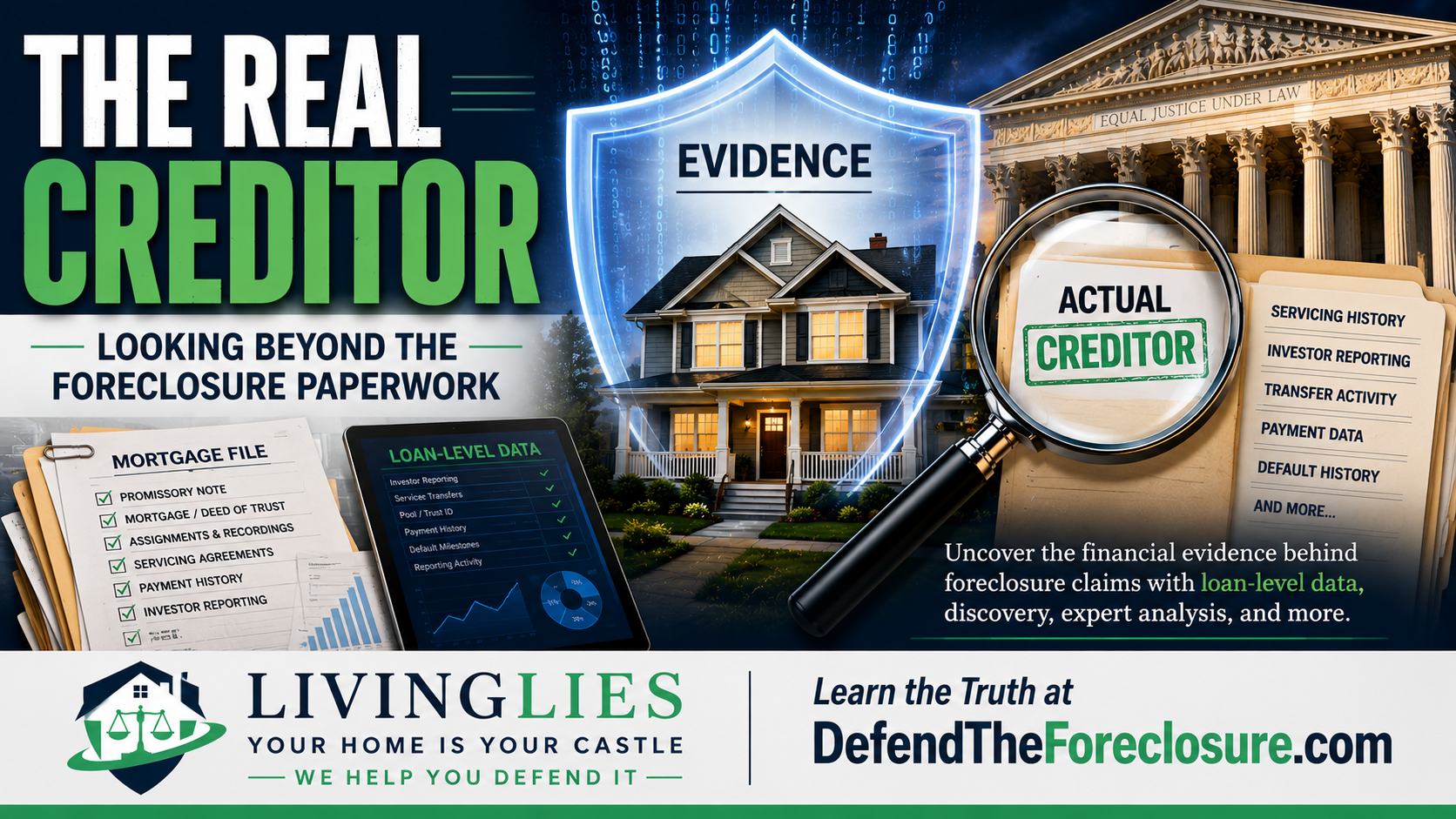
How to prove it by building an evidence based defense
One of the first questions many homeowners should ask after receiving a foreclosure complaint is surprisingly simple:
“Is the company suing me actually the company that owns my loan?”
It is an important question. That’s why making them prove they are the real creditor is critical.
The foreclosure complaint may identify one entity.
The monthly mortgage statement may identify another.
The notice of default may come from a loan servicer.
The assignment of mortgage may reference a trustee.
The original lender may no longer exist.
As a result, homeowners often encounter multiple companies connected to the same loan and understandably wonder which one, if any, has the legal right to pursue foreclosure.
Answering that question requires more than reviewing a single document.
Modern mortgage transactions often involve loan servicers, trustees, custodians, investors, document custodians, and other participants that perform different functions. Determining which party has the legal authority to enforce the obligation depends upon the applicable law and the evidence presented in the particular case.
At LivingLies, our approach of over 20 years in saving homes nationally, has always been that foreclosure litigation should be grounded in verifiable financial evidence. Rather than assuming who the “real creditor” is, we focus on identifying the documents, financial records, reporting relationships, and testimony that allow our clients, attorneys and courts to evaluate those issues on a complete factual record. It’s why we win so many cases. It’s all about the evidence from experts qualified to testify if needed.
Why the Identity of the Creditor Matters
Every foreclosure action is based upon the assertion that the plaintiff or foreclosing party possesses the legal right to enforce the obligation.
If that assertion is challenged, the court must evaluate the applicable law together with the evidence supporting the claim.
Questions commonly explored during litigation include:
- Who claims the right to enforce the debt?
- What documents support that claim?
- What financial records support that claim?
- Who authorized the foreclosure?
- Who receives the economic benefit associated with the loan?
- What witnesses can explain those relationships?
Those questions are significant because foreclosure affects one of the most important property interests a person owns. Courts generally expect the parties to support their positions with competent evidence rather than unsupported conclusions.
Common Misconceptions About Foreclosure
Foreclosure litigation is often misunderstood because several different legal concepts are treated as though they mean the same thing.
For example, homeowners frequently hear statements such as:
- “The servicer owns the loan.”
- “The trustee owns the loan.”
- “The company sending the statements is automatically the creditor.”
- “The party holding the note necessarily answers every legal question.”
Those statements may or may not be accurate in a particular case.
Different participants often perform different roles within a mortgage transaction.
Servicing the loan, maintaining payment records, communicating with borrowers, or acting as trustee are not necessarily identical to possessing the enforceable economic interest in the debt.
The governing law determines what must be proven. The evidence determines whether those legal requirements have been satisfied.
Holder, Owner, Servicer, and Creditor Are Not Always the Same Concept
Modern mortgage finance frequently separates responsibilities among several entities.
For example, different organizations may:
- service the loan,
- collect borrower payments,
- maintain business records,
- hold documents in custody,
- report information to investors,
- administer a securitized trust,
- or claim authority to enforce the obligation.
Because these roles can differ, careful factual investigation is often necessary before drawing conclusions regarding who possesses which rights.
One of the goals of discovery is to identify those relationships and determine what evidence supports them.
Why Loan Servicers Often Appear Instead of the Alleged Creditor
Many homeowners interact almost exclusively with the loan servicer.
The servicer sends monthly statements.
The servicer receives payments.
The servicer answers customer service calls.
The servicer may also initiate default notices or coordinate foreclosure proceedings.
Those responsibilities are important, but they do not by themselves answer every legal question concerning who possesses the enforceable interest in the debt.
Servicers often act pursuant to agreements entered into with other entities. Understanding those relationships frequently requires reviewing servicing agreements, business records, investor reporting, and other financial information.
Discovery is designed to develop those facts rather than assume them.
Standing Begins with the Burden of Proof
Standing is one of the most frequently litigated issues in foreclosure cases because it addresses whether the party invoking the court’s authority has demonstrated the legal right to do so.
Although the precise legal standards vary by jurisdiction, standing disputes often involve evidence addressing:
- the documents relied upon,
- the history of transfers,
- the authority under which the servicer acts,
- business records,
- witness testimony,
- and the financial relationships among the entities involved.
Courts generally decide those issues by applying the governing law to the evidence presented. That is why careful investigation before major hearings or trial is so important.
Why Loan-Level Data Changes the Investigation
One reason LivingLies has devoted significant attention to loan-level data is that modern mortgage transactions generate substantial electronic reporting that may not appear in county land records.
Depending upon the available sources, loan-level reporting may identify:
- servicing history,
- investor reporting identifiers,
- pool or trust references,
- servicing transfers,
- payment reporting activity,
- default milestones,
- portfolio coding,
- and other transaction-specific information.
That information does not automatically determine the legal issues.
However, it may identify factual questions that deserve further investigation through discovery, witness testimony, and document requests.
Instead of beginning with assumptions, attorneys can begin with objective financial information and build discovery accordingly.
Financial Evidence Is More Persuasive Than Speculation
Foreclosure litigation becomes more effective when the discussion shifts from generalized theories to specific evidence.
Rather than arguing that “something must be wrong,” attorneys can focus on identifiable documents, transaction histories, reporting relationships, servicing records, and witness testimony.
That approach helps the court evaluate concrete facts instead of broad conclusions.
It also allows discovery to become more focused because every request can be tied to information already identified through financial analysis.
For redacted samples of our expert affidavits that have won cases ask to join our private facebook group where we share copies of our work product and our legal team of experts will answer questions.
Building the Discovery Plan
Once potential issues have been identified, the next step is developing a discovery strategy designed to obtain the evidence necessary to evaluate the foreclosing party’s claims.
Discovery should be intentional.
Rather than requesting every document imaginable, counsel can develop targeted requests directed toward:
- servicing authority,
- boarding records,
- investor reporting,
- payment histories,
- business-record procedures,
- communications regarding servicing transfers,
- and the documents relied upon in authorizing foreclosure.
Targeted discovery often produces a more organized factual record while reducing disputes over overly broad requests.
The Importance of Early Investigation
One of the most common challenges in foreclosure litigation is that important evidence is often sought only after critical hearings have already occurred.
Early investigation allows attorneys to evaluate the available financial information, identify potential witnesses, draft focused discovery requests, and determine whether expert analysis may assist the court in understanding complex servicing or reporting issues.
Waiting until summary judgment—or worse, trial—to begin asking foundational questions frequently limits the opportunities available to develop the evidentiary record.
The earlier the investigation begins, the greater the opportunity to build an evidence-based foreclosure defense supported by competent documentation and testimony.
Using Qualified Written Requests (QWRs) and Requests for Information (RFIs)
One of the most effective ways to begin identifying the party claiming the right to enforce a mortgage obligation is through carefully drafted Qualified Written Requests (QWRs) and Requests for Information (RFIs).
Unfortunately, many homeowners rely on generic templates downloaded from the internet. Those form letters often ask dozens of unrelated questions and rarely produce meaningful responses.
Effective QWRs and RFIs are different.
They are drafted after reviewing the foreclosure pleadings, the recorded documents, and—when available—loan-level data.
Rather than asking broad questions, they seek specific information that can later be compared with business records, witness testimony, and other discovery.
Among the information that may be requested are:
- the identity of the entity claiming the enforceable interest in the debt,
- the agreements authorizing the servicer to act,
- servicing transfer records,
- boarding records,
- payment histories,
- investor reporting information,
- the documents relied upon in declaring a default,
- and the records supporting the decision to initiate foreclosure.
At LivingLies, we prepare customized QWRs and RFIs designed around the facts of each case. Our objective is not simply to ask questions—it is to obtain information that can later be used in discovery, motion practice, and trial.
Depositions That Test the Claimed Creditor’s Evidence
Depositions frequently provide the first opportunity to determine whether the witnesses presented by the foreclosing party possess actual knowledge of the facts they are describing.
Questions often focus on:
- the witness’s responsibilities,
- how the records were created,
- who entered the data,
- how servicing transfers occurred,
- what boarding procedures were followed,
- what documents support the witness’s testimony,
- and how the witness knows the entity identified in the complaint possesses the authority it claims.
Loan-level data often helps identify subjects that deserve careful examination during those depositions.
Rather than conducting a generalized examination, attorneys can ask questions grounded in documented financial reporting and servicing history.
Business Records and the Boarding Process
Many foreclosure cases depend upon business records maintained by loan servicers.
Those records frequently include:
- payment histories,
- account notes,
- default calculations,
- servicing comments,
- collection activity,
- and computer-generated reports.
When servicing transfers occur, those records are often incorporated into the receiving servicer’s systems through a process commonly known as “boarding.”
An important question is whether the witness can explain how that boarding occurred, what verification procedures were used, and how the reliability of transferred information was established.
These are evidentiary questions—not technicalities. Courts frequently evaluate the reliability of business records when determining the weight to give them.
Expert Reports and Expert Affidavits
Financial reporting systems, servicing platforms, investor reporting, and loan-level data often involve technical subjects that are unfamiliar to most judges and jurors.
Expert reports help organize that information into a logical chronology.
They may compare financial reporting with the foreclosure pleadings, identify servicing transfers, summarize available documentation, and explain areas where additional evidence should be obtained.
LivingLies prepares expert reports and affidavits designed to assist attorneys in presenting organized, evidence-based analyses of the financial information associated with the loan.
These reports do not determine the outcome of the case.
Instead, they help the court understand the factual issues that require judicial determination.
Expert Witness Testimony
Some foreclosure cases proceed to evidentiary hearings or trial where technical financial issues become central to the dispute.
LivingLies provides expert witness services to assist attorneys in explaining:
- loan-level data,
- servicing history,
- investor reporting,
- business-record practices,
- boarding procedures,
- servicing transfers,
- and financial reporting relationships.
Complex financial evidence is most persuasive when it can be explained clearly and supported by documentary evidence.
Our objective is to help the court understand the evidence so that legal issues may be decided on a complete factual record.
State-Specific Considerations
California
California’s non-judicial foreclosure process frequently requires early investigation. Identifying the claimed creditor before a trustee’s sale may support Temporary Restraining Orders, Preliminary Injunctions, expedited discovery, and other emergency relief.
Texas
Because Texas foreclosure timelines move quickly, targeted investigation into servicing authority and the claimed creditor often must begin immediately after default notices are received.
Florida
Florida’s judicial foreclosure system provides broader discovery opportunities. Loan-level data, business records, and expert analysis can assist counsel in evaluating standing, evidentiary issues, and trial preparation.
Georgia
Georgia homeowners benefit from prompt investigation because non-judicial foreclosure sales can occur rapidly. Early evidence gathering frequently determines whether emergency relief is available.
New York and New Jersey
Judicial foreclosure procedures in New York and New Jersey allow discovery into standing, business records, servicing authority, and the factual basis supporting the foreclosure complaint.
The LivingLies Real Creditor Investigation Program
For more than twenty years, LivingLies has focused on helping homeowners and attorneys look beyond assumptions and examine the financial evidence underlying foreclosure claims.
Our Real Creditor Investigation Program combines document review, financial analysis, and litigation support to help counsel build stronger evidence-based foreclosure defenses.
Our services include:
- Loan-level data acquisition and analysis
- Real creditor investigations based upon available financial reporting
- Review of servicing transfers
- Business-record analysis
- Expert reports
- Expert affidavits
- Expert witness testimony
- Drafting customized Qualified Written Requests (QWRs)
- Drafting Requests for Information (RFIs)
- Discovery planning
- Deposition preparation
- Litigation consulting
- Trial preparation support
Our work is designed to help attorneys and homeowners develop a complete evidentiary record. We do not assume who the real creditor is. We analyze the available financial information, identify issues requiring further investigation, and assist counsel in presenting those issues through admissible evidence.
Find the Evidence Before You Fight the Case
If you are facing foreclosure—or representing someone who is—the first question should not be:
“Who says they own the loan?”
The better question is:
“What admissible evidence supports the claim that this party has the legal right to enforce the obligation?”
LivingLies can help with:
- Real creditor investigations
- Loan-level data analysis
- Expert reports and affidavits
- Expert witness services
- QWR and RFI preparation
- Discovery consulting
- Litigation consulting
- Trial preparation
Your Home Is Your Castle. We Help You Defend It.
Request a Real Creditor Investigation Today or call us at 866.216.4126
Related LivingLies Resources
- How Loan-Level Data Can Stop a Foreclosure
- What Is Standing in Foreclosure?
- How to Challenge Standing Successfully
- Emergency Motions That Can Stop a Foreclosure Sale
- Quiet Title: Challenging Pretender Lender Claims
Frequently Asked Questions
Can a loan servicer foreclose if it is not the creditor?
Whether a servicer can legally pursue foreclosure depends on the governing law, the authority under which it acts, and the evidence presented to the court. Those issues are often explored through discovery and witness testimony to stop an illegal foreclosure.
How can loan-level data help identify the claimed creditor?
Loan-level data will identify servicing history, investor reporting, trust references, and other financial information that can assist attorneys in investigating who claims the enforceable interest and what records support that claim.
Why are expert reports important?
Expert reports organize complex financial information, explain technical servicing issues, and help attorneys present evidence in a clear and understandable manner.
Can LivingLies help attorneys as well as homeowners?
Yes. LivingLies provides litigation drafting, loan-level data analysis, real creditor investigations, expert reports, expert witness services, discovery consulting, QWR and RFI drafting, deposition preparation, expert affidavits and trial support. We have been saving homes nationally for over 20 years.
Search Our Blog
Categories
Contact Our National Headquarters Phone: 844-583-5339
Connect with us


Contact Our National Headquarters
- 844-583-5339
- Available 24/7
-
200 S. Andrews Ave. Ste. 604
Ft. Lauderdale, FL 33301