
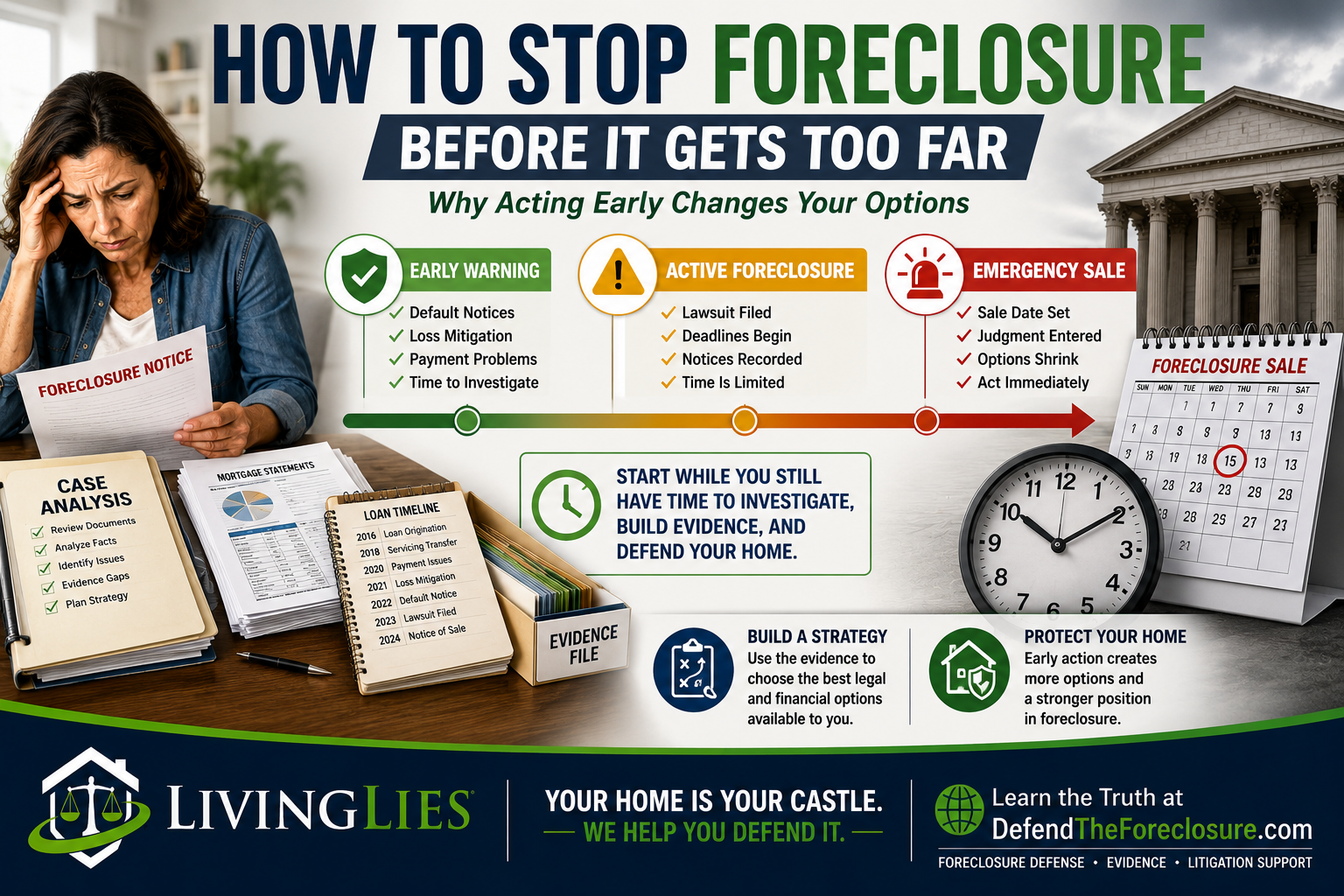
Why Acting Early Changes Your Options
If you are searching the Internet for how to stop foreclosure, there is something you need to understand before anything else:
When you act can be almost as important as what you do.
Homeowners often think of foreclosure as one event.
It isn’t.
Foreclosure is a process.
And during that process, your options can change.
The homeowner who begins investigating after receiving the first serious default or foreclosure notice may have months to gather documents, obtain information, analyze the loan, seek professional help, develop evidence, and determine what strategy makes sense.
The homeowner who waits until a foreclosure sale is days away may be trying to accomplish all of those things under emergency conditions.
That is an enormous difference.
If you want to know how to stop foreclosure, start with this: Do not wait until the foreclosure sale to start defending your home.
The earlier you understand what is happening, the more time you may have to do something meaningful about it.
Foreclosure Usually Does Not Start With the Sale
Many homeowners don’t become seriously concerned until they see the words:
FORECLOSURE SALE.
But the process usually began much earlier.
There may have been:
- missed or disputed payments,
- default notices,
- letters demanding payment,
- loss mitigation communications,
- acceleration notices,
- servicing changes,
- a foreclosure complaint,
- a notice of default,
- a notice of trustee’s sale,
- or other legally significant events.
Each stage can matter.
And each passing stage may change what can realistically be accomplished.
That is why the question should not merely be:
“How do I stop the sale?”
The better question is:
“How early can I begin understanding and responding to the foreclosure claim?”
The Three Stages of a Foreclosure Problem
For homeowners, it can help to think about foreclosure in three broad stages.
Stage One: The Warning Stage
This is when something has gone wrong, but the case may not yet have reached an advanced foreclosure stage.
You may have:
- missed payments,
- a disputed payment history,
- a notice of default,
- a notice of intent to accelerate,
- loss mitigation problems,
- or repeated communications from the servicer.
This is often the best time to begin investigating.
Why?
Because you may still have time.
Stage Two: The Active Foreclosure Stage
The foreclosure process is now moving.
In a judicial foreclosure state, you may have been served with a lawsuit.
In a non-judicial foreclosure state, notices may have been recorded, mailed, or posted as the sale process advances.
Deadlines become increasingly important.
You may still have meaningful options, but you need to use your time intelligently.
Stage Three: The Emergency Stage
Now the homeowner may be facing:
- an approaching answer deadline,
- default,
- summary judgment,
- final judgment,
- a scheduled trustee’s sale,
- or a foreclosure sale only days away.
At this point, the question may no longer be:
“What is the best strategy we could develop?”
It may become:
“What can still realistically be done with the time remaining and what are the odds of success?”
That is why early action matters.
What Does “Stopping Foreclosure” Actually Mean?
This phrase causes a great deal of confusion.
When someone searches for “how to stop foreclosure,” they may mean several different things.
They might mean:
- catching up the loan,
- obtaining a loan modification,
- entering a repayment plan,
- challenging the foreclosure,
- postponing a sale,
- seeking court intervention,
- selling the property before foreclosure,
- filing bankruptcy,
- or developing a defense to the foreclosure claim.
Those are very different paths.
There is no single magic document called a “stop foreclosure form.”
There is no single argument that works in every case.
And there is no responsible way to determine the best option without first understanding the homeowner’s actual situation.
Start With the Homeowner’s Goal
Before choosing a strategy, ask a basic question:
What are you trying to accomplish?
Do you want to keep the home?
Do you have enough income to make a sustainable payment if the loan can be resolved?
Are you disputing the amount claimed?
Do you believe payments were improperly applied?
Are you trying to obtain time to sell the property?
Are you already involved in litigation?
Are you trying to determine whether the party seeking foreclosure can establish its claim?
The answer matters.
A homeowner who wants a modification may require one strategy.
A homeowner disputing the accounting may require another.
A homeowner facing a lawsuit may need to address immediate procedural deadlines while also investigating the underlying claim.
A homeowner with a sale scheduled next week has a completely different time problem.
The strategy must fit the objective, the evidence, and the amount of time remaining.
Why Calling the Servicer Is Not a Complete Strategy
One of the first things homeowners are usually told is:
“Call your mortgage company.”
There is nothing inherently wrong with contacting the servicer.
You may need information.
You may want to discuss loss mitigation.
You may want a reinstatement figure.
You may be trying to correct an account problem.
But calling the servicer is not the same thing as developing a foreclosure strategy.
The servicer is communicating with you in connection with servicing the account and, in many cases, the foreclosure process.
The servicer is not your foreclosure defense adviser.
If you are relying entirely upon telephone conversations with the servicer, you may be leaving critical questions unanswered.
Do Not Confuse Loss Mitigation With Foreclosure Defense
Loan modification and other loss mitigation options can be extremely important.
For some homeowners, they may provide the best path to keeping the home.
But loss mitigation and foreclosure defense are not necessarily the same process.
A modification asks whether an alternative payment arrangement can be reached.
A foreclosure defense may ask whether the party seeking foreclosure can establish the legal and factual elements required for the relief it seeks.
A homeowner may therefore need to think about two tracks at the same time:
Track One: Can the loan be resolved?
Track Two: Is the foreclosure claim supported by the required evidence?
Depending upon the circumstances and applicable law, those tracks may interact.
But homeowners should not simply assume that pursuing one automatically protects them on the other.
The Dangerous Sentence: “They Told Me the Foreclosure Was On Hold”
We have heard versions of this statement many times.
A homeowner says:
“The servicer told me not to worry because they were reviewing my modification.”
Or:
“They said the foreclosure was on hold.”
Then something happens.
A deadline passes.
A motion gets filed.
A sale remains scheduled.
Or the homeowner discovers that what they thought was happening is not what the official record shows.
The lesson is not that every servicer representative is misleading homeowners.
The lesson is much simpler:
Do not rely solely upon a telephone conversation when your home is at stake.
Document communications.
Ask for important representations in writing.
And independently verify legal deadlines.
The Earlier You Start, the More Evidence You Can Develop
This is where early foreclosure defense becomes particularly important.
Evidence does not appear instantly.
Suppose you need to understand a disputed payment history.
You may need records.
Suppose you need to understand what happened when servicing transferred from one company to another.
You may need boarding information or prior-servicer records.
Suppose the foreclosure documents identify a trustee, investor, or other entity.
You may need to investigate the claimed relationships.
Suppose independent loan-level information does not appear to match the foreclosure narrative.
You may need additional records to determine why.
All of this takes time.
That is why early investigation can change the case.
Evidence Building Is Different From Finding “Something Wrong”
Many homeowners approach us believing that foreclosure defense means finding a defective document.
They search assignments.
They compare signatures.
They search trust names.
They look for dates that seem inconsistent.
Those observations may identify questions worth investigating.
But finding something unusual is not necessarily the same thing as developing evidence that matters in litigation.
A useful investigation asks:
- What fact are we trying to establish?
- Why does that fact matter?
- What evidence could prove or disprove it?
- Who has that evidence?
- How can it be obtained?
- How does it relate to the foreclosure claim?
That is evidence building.
Why LivingLies Starts With Case Analysis
This is precisely why our work begins with a Case Analysis.
We do not begin by assuming every homeowner has the same defense.
They don’t.
We begin by examining the case.
That means looking at questions such as:
- What stage has the foreclosure reached?
- What deadlines are approaching?
- Who is seeking foreclosure?
- Who is servicing the loan?
- What documents have been presented?
- What does the homeowner’s payment and servicing history show?
- What information is missing?
- What facts are disputed?
- What evidence may be available?
- And how much time remains to develop it?
Only after those questions begin to be answered can you intelligently decide what should happen next.
Case Analysis Is Not the End Product
Think of the Case Analysis as the starting map.
It may reveal that additional work is appropriate.
Depending upon the circumstances, that work might include:
- loan-level data analysis,
- payment-history analysis,
- servicing-record investigation,
- real creditor investigation,
- public-record review,
- Qualified Written Requests,
- Requests for Information,
- Notices of Error,
- discovery planning,
- litigation consulting,
- drafting assistance,
- expert analysis,
- expert affidavits,
- or expert witness support.
But notice the sequence.
We don’t start by selling the homeowner a theory.
We start by determining what the case requires.
Loan-Level Data Can Help You Ask Better Questions
One of the tools available to the LivingLies team is loan-level data analysis.
This subject can sound intimidating.
For the homeowner, it does not need to be.
Think of it this way:
The foreclosure paperwork tells a story about your loan.
The servicing records tell a story.
The payment history tells a story.
Public records tell a story.
And available loan-level information may tell another part of that story.
The objective is to compare them.
Do they agree?
If they do, that is information.
If they don’t, that is also information.
An inconsistency does not automatically win a foreclosure case.
But it may tell you where further investigation is required.
The Money Trail Can Matter More Than the Paper Trail
Homeowners naturally focus on documents because documents are what they can see.
There is an assignment.
There is an endorsement.
There is a mortgage.
There is a foreclosure complaint.
But foreclosure is ultimately based upon an alleged financial obligation.
That means the financial history matters.
Who received money?
How were payments applied?
What balance is being claimed?
What happened when servicing transferred?
What advances or adjustments appear?
What records support the claimed default?
Who claims the economic interest in the obligation?
Those questions move the investigation from paperwork toward evidence.
Why You Want to Ask Those Questions Early
Imagine two homeowners with essentially the same foreclosure problem.
The first homeowner begins investigating six months before a scheduled sale.
The second begins six days before the sale.
The first homeowner may have time to:
- organize years of records,
- obtain a Case Analysis,
- investigate loan-level information,
- request servicing records,
- analyze the payment history,
- identify discrepancies,
- develop targeted information requests,
- work with an attorney or litigation consultant,
- and prepare an evidence-based strategy.
The second homeowner may spend most of those six days trying to find somebody willing to look at the case.
That is the difference.
The underlying facts may be identical.
The available preparation time is not.
Early Action Does Not Mean Filing Everything Immediately
This distinction is important.
When we say “act early,” we do not mean:
File every motion you can find.
Send twenty form letters.
Accuse everyone of fraud.
Record documents against the property.
Or begin making arguments you do not understand.
Acting early means investigating early.
It means getting organized.
Understanding deadlines.
Understanding the parties.
Understanding the claimed debt.
Identifying the missing information.
And deciding what evidence you actually need before committing yourself to a legal theory.
What If You Are Already in Foreclosure?
Then the same principles apply, but the clock matters more.
Do not assume it is automatically too late.
But do not assume you have unlimited time either.
Find out:
- Has a lawsuit been filed?
- Have you been served?
- Has an answer been filed?
- Has a default been entered?
- Has summary judgment been requested?
- Has judgment already been entered?
- Has a sale been scheduled?
- Is the foreclosure non-judicial?
- What is the next legally significant date?
The answers tell you how urgent the situation is.
What If You Already Have a Foreclosure Sale Date?
Then you should treat the matter as urgent.
A sale date does not tell us, by itself, what remedies may or may not be available.
Those questions depend upon state law, procedural history, the facts of the case, and how much time remains.
But one thing is clear:
This is no longer the time for casual research.
If you intend to seek legal relief, you need to determine quickly what options remain and what evidence exists to support them.
The Goal Is Not Delay for the Sake of Delay
There is another misconception worth correcting.
A legitimate foreclosure defense strategy is not simply about delaying foreclosure.
Delay without purpose accomplishes very little.
Time is useful only if you use it.
If additional time allows you to obtain evidence, investigate the account, pursue loss mitigation, develop discovery, prepare a defense, or work toward another resolution, that time can be extremely valuable.
But postponing the inevitable without developing a strategy is not the objective.
The objective is to use available time to improve your position.
The Question You Should Be Asking Today
If foreclosure has started—or you believe it is about to start—do not ask only:
“How long do I have?”
Ask:
“What can I accomplish with the time I still have?”
That question changes everything.
Because now you are thinking about evidence.
Investigation.
Strategy.
And preparation.
Those are the things that become much harder to create after the case turns into an emergency.
Your Foreclosure Early-Action Plan
If you remember only one thing from this article, remember this:
The earlier you begin investigating a foreclosure, the more time you have to develop useful evidence and make informed decisions.
That does not mean filing motions immediately.
It does not mean accusing the servicer, trustee, bank, or anyone else of wrongdoing.
And it certainly does not mean downloading every foreclosure document you can find on the Internet and sending or filing it.
It means understanding the problem before deciding upon the solution.
For most homeowners, that begins with five basic questions.
Question 1: Where Are You in the Foreclosure Process?
Before deciding what to do, determine exactly where you are.
Do not settle for saying:
“I’m in foreclosure.”
That does not tell you enough.
You need to know what has actually happened.
For example:
- Have you only received collection letters?
- Have you received a notice of default?
- Has the debt allegedly been accelerated?
- Have you received a foreclosure complaint?
- Have you been formally served with court papers?
- Has a default been entered?
- Has a motion for summary judgment been filed?
- Has judgment already been entered?
- Have you received a notice of trustee’s sale?
- Has a foreclosure sale date been scheduled?
The answers matter because foreclosure procedures and deadlines vary from state to state.
They can also vary depending upon whether the foreclosure is judicial or non-judicial.
Your first job is to identify the next important event and the deadline connected with it.
Question 2: What Does the Foreclosing Party Say Happened?
Next, look at the foreclosure from the other side’s perspective.
What are they claiming?
Usually, the foreclosure claim contains some version of the following story:
- a loan was made,
- the homeowner signed a note,
- the obligation was secured by a mortgage or deed of trust,
- payments became delinquent,
- a particular amount is now due,
- the required notices were sent,
- the party seeking foreclosure has authority to enforce the obligation,
- and foreclosure is therefore permitted.
Do not begin by assuming that story is true.
But do not begin by assuming it is false either.
Begin by asking what evidence supports each important part of the story.
That is a much stronger starting point.
Question 3: What Do Your Own Records Show?
Your own records may contain information that becomes important later.
Start gathering them now.
Look for:
- your original closing documents,
- the note,
- the mortgage or deed of trust,
- loan modification agreements,
- monthly mortgage statements,
- bank records showing payments,
- cancelled checks,
- escrow statements,
- notices of servicing transfers,
- default notices,
- acceleration notices,
- loss mitigation applications,
- modification correspondence,
- letters you sent to the servicer,
- letters the servicer sent to you,
- and all foreclosure or court documents.
Do not worry if your file is incomplete.
Most homeowners do not have every document.
The missing documents themselves may help identify what needs to be requested or investigated.
Question 4: What Facts Are Actually Disputed?
This is where a foreclosure investigation starts becoming useful.
Instead of saying:
“Something is wrong with my loan,”
try to identify the specific issue.
For example:
Do you dispute the amount claimed to be due?
Do you dispute when the alleged default occurred?
Were payments made that do not appear in the servicer’s records?
Were payments placed into suspense?
Did the account balance change after a servicing transfer?
Are there fees or advances you do not understand?
Does the foreclosure identify a party whose role you do not understand?
Does the payment history appear inconsistent with other records?
Were you told something about loss mitigation that appears inconsistent with what happened afterward?
Now you are developing actual questions.
And actual questions can lead to evidence.
Question 5: What Evidence Do You Need That You Do Not Already Have?
This may be the most important question of all.
A foreclosure defense cannot be built entirely from suspicion.
You need to determine what information would help prove or disprove the important facts.
Suppose the amount claimed appears wrong.
You might need a complete payment history.
Suppose the problem appears to have started when servicing transferred.
You may need records concerning the transfer and boarding of the account.
Suppose the foreclosure identifies an entity as trustee for a particular trust.
You may need additional information concerning the claimed relationship and authority.
Suppose the servicer’s records conflict with information found elsewhere.
You may need to determine which records explain the inconsistency.
This is how an evidence-based strategy begins.
Create an Evidence Gap List
One simple tool can make an enormous difference.
Create a document called:
WHAT WE KNOW / WHAT WE NEED TO KNOW
Divide it into two columns.
On the left, write down facts supported by documents or other reliable information.
On the right, write down unanswered questions.
For example:
WHAT WE KNOW: The monthly statement identifies ABC Servicing as the current servicer.
WHAT WE NEED TO KNOW: When did ABC Servicing begin servicing the account, and what information did it receive from the prior servicer?
Another example:
WHAT WE KNOW: The foreclosure complaint alleges a default beginning January 1.
WHAT WE NEED TO KNOW: What transaction-level records establish that date and the amount allegedly unpaid?
Another:
WHAT WE KNOW: A recorded assignment identifies XYZ Bank as trustee.
WHAT WE NEED TO KNOW: What is XYZ Bank’s claimed role, and what evidence supports the authority being asserted in the foreclosure?
This exercise forces you to separate what you can prove from what you merely suspect.
That distinction is essential.
Now Decide How to Fill the Evidence Gaps
Once you know what information is missing, you can begin deciding how to obtain it.
Depending upon the case, available tools may include:
- your own records,
- public records,
- servicer correspondence,
- loan-level data,
- Qualified Written Requests,
- Requests for Information,
- Notices of Error,
- formal discovery in litigation,
- subpoenas where legally available,
- depositions,
- expert analysis,
- and other evidence-development tools.
Not every tool belongs in every case.
That is why the analysis comes first.
A QWR Is a Tool, Not a Foreclosure Defense
Qualified Written Requests are frequently discussed on foreclosure websites and social media.
So are Requests for Information and Notices of Error under federal mortgage servicing rules.
These tools can be useful.
But there is an important distinction:
Sending a QWR is not itself a foreclosure defense strategy.
The real question is:
What information are you trying to obtain, and why does it matter?
A carefully targeted request based upon identified evidence gaps can be much more useful than a generic form containing dozens of questions that have little connection to the actual dispute.
Why Generic Internet Letters Can Create Problems
Homeowners understandably search online for free help.
They find templates.
Some are useful.
Some are outdated.
Some contain questions that do not apply to the homeowner’s situation.
Some make sweeping legal accusations.
Some demand information that the recipient may have no legal obligation to provide through that particular process.
And some create hundreds of pages of correspondence without moving the homeowner any closer to useful evidence.
More paper does not necessarily mean more evidence.
A good request should have a purpose.
What are you trying to learn?
Why does it matter?
What will you do with the response?
Those questions should come before the letter.
How Loan-Level Data Fits Into the Investigation
Loan-level data can provide another source of information for investigating the history of a mortgage loan.
Depending upon the available data and the particular loan, it may provide information relating to matters such as:
- loan reporting,
- servicing activity,
- pool or trust references,
- investor-related reporting,
- loan status,
- and changes occurring during the life of the account.
The purpose is not to print a report and announce that the foreclosure is invalid.
That would miss the point.
The purpose is to compare available information.
Does the loan-level information match the story presented in the foreclosure?
Does it match the servicing history?
Does it match public records?
Does it raise questions about events that need further investigation?
Loan-level data is most useful when it helps us ask better questions and identify where additional evidence may exist.
The Difference Between Data and Evidence
This distinction is important for every homeowner to understand.
Information is not automatically admissible evidence.
A report may help you discover an issue.
A database may help identify a discrepancy.
A servicing record may point toward another record.
But litigation requires attention to how facts can actually be established under the applicable rules of evidence and procedure.
That is where professional analysis becomes increasingly important.
The objective is not simply to know something.
The objective is to determine how that information can be developed into useful evidence.
Follow the Money, Not Just the Documents
Recorded documents are important.
Assignments can be important.
Endorsements can be important.
But focusing exclusively on those documents can cause homeowners to miss the larger financial picture.
A mortgage loan involves money.
That means you may also need to examine questions such as:
- How were payments received and applied?
- What happened to payments during servicing transfers?
- How was the claimed balance calculated?
- What fees were added?
- What advances were reported?
- What corrections were made?
- What information was transferred from one servicer to another?
- What records support the claimed default?
- What party claims the economic interest in the obligation?
- And what records support the relationships being asserted?
That is why we often say:
Follow the money trail as well as the paper trail.
What Happens When One Servicer Takes Over From Another?
This is an area homeowners frequently overlook.
Suppose Servicer A handled the account for several years.
Then Servicer B took over.
Servicer B may later produce a payment history and other records in the foreclosure case.
But important questions can arise.
What information did Servicer B receive?
How was that information transferred?
How was it loaded into Servicer B’s system?
Were balances reconciled?
Were exceptions identified?
Were corrections made?
What information came from the prior servicer?
What information was created after the transfer?
Those questions may become especially important when a foreclosure depends upon records covering periods handled by multiple servicers.
Again, the point is not to assume that the records are wrong.
The point is to determine how the records were created and what they actually prove.
Why Waiting Can Make Evidence Harder to Develop
Every evidence-development tool requires time.
A records request takes time.
A response takes time.
Analyzing the response takes time.
Following up on missing information takes time.
Formal discovery takes time.
Depositions take time.
Expert analysis takes time.
Drafting pleadings takes time.
Preparing affidavits takes time.
Preparing for hearings takes time.
Now imagine trying to begin all of this when the sale is scheduled for Friday.
That is why acting early changes your options.
When Litigation Consulting Becomes Useful
Not every homeowner can afford traditional full-service foreclosure representation.
Some homeowners represent themselves.
Others have local counsel who may need assistance with complicated mortgage servicing, securitization, loan-level data, or evidentiary issues.
This is where litigation consulting can help.
The purpose is not to turn a homeowner into a lawyer.
The purpose is to help organize the case around the evidence.
Depending upon the circumstances, LivingLies litigation support may include:
- reviewing the foreclosure claim,
- identifying factual and evidentiary issues,
- loan-level data research,
- servicing analysis,
- payment-history analysis,
- real creditor investigation,
- evidence-development planning,
- QWR and RFI drafting support,
- discovery assistance,
- litigation drafting,
- expert reports,
- expert affidavits,
- expert witness services,
- and consulting support for local counsel.
Which of those services makes sense depends upon what the Case Analysis reveals.
Why Drafting Should Follow Investigation
This is another place where homeowners sometimes reverse the process.
They call and say:
“I need a motion.”
Our response begins with a different question:
What evidence supports the motion?
Good litigation drafting should be connected to the facts and evidence of the case.
The document should not create the strategy.
The strategy should determine the document.
That is why Case Analysis and evidence development should occur as early as possible.
When Your Foreclosure Has Become an Emergency
There are certain warning signs that the time for ordinary investigation is disappearing.
You should treat the situation as urgent if:
- a foreclosure sale has been scheduled,
- a trustee’s sale is approaching,
- your deadline to answer a foreclosure complaint is approaching,
- you have already missed an answer deadline,
- a default has been requested or entered,
- a motion for summary judgment has been filed,
- a final judgment hearing is approaching,
- judgment has already been entered,
- or another significant court deadline is only days away.
At that point, the first priority may become preserving whatever rights and options remain.
That can be very different from the strategy we might have developed months earlier.
What If You Think It Is Already Too Late?
Do not decide that based upon fear or something you read online.
But do not assume the opposite either.
The answer depends upon:
- your state,
- whether the foreclosure is judicial or non-judicial,
- what has already happened,
- what deadlines have passed,
- whether judgment has been entered,
- whether a sale has occurred or is merely scheduled,
- and what facts and evidence exist.
If a sale is imminent, obtain qualified legal advice quickly.
Emergency situations require emergency analysis.
But they also demonstrate why we encourage homeowners to begin much earlier.
Don’t Waste the Time You Gain
Suppose you obtain a postponement.
Or the sale is rescheduled.
Or a court gives you additional time.
Or loss mitigation temporarily slows the process.
That time is valuable.
Use it.
Do not simply wait for the next deadline.
Investigate.
Request records.
Analyze the account.
Develop the evidence.
Work on the strategy.
Time without preparation is merely delay.
Time used to build evidence can become an advantage.
The LivingLies Evidence-Based Approach
After more than two decades of research and work involving foreclosure litigation, one principle remains central to the LivingLies approach:
The defense should be built from evidence—not assumptions.
That generally means following a logical sequence.
Step 1: Case Analysis
Understand the foreclosure, the procedural stage, the parties, the documents, the homeowner’s history, and the immediate deadlines.
Step 2: Identify the Evidence Gaps
Determine what facts matter and what information is missing.
Step 3: Investigate
Use appropriate sources—including loan-level data, servicing information, payment records, public records, and targeted information requests—to investigate those questions.
Step 4: Develop the Evidence
Determine how useful information can be authenticated, supported, explained, or developed into evidence appropriate for the proceeding.
Step 5: Build the Strategy
Determine what arguments and defenses are actually supported by the evidence.
Step 6: Draft and Litigate
Prepare pleadings, discovery, affidavits, motions, or other litigation materials that fit the strategy and applicable procedure.
Notice what comes first.
Analysis.
Not accusation.
Not theory.
Not a motion downloaded from the Internet.
Analysis.
Your Foreclosure Early-Action Checklist
If foreclosure has started or appears likely, use this checklist now.
- Save every notice and envelope.
- Identify every deadline and sale date.
- Determine whether your foreclosure is judicial or non-judicial.
- Determine the current stage of the foreclosure.
- Gather your note, mortgage or deed of trust, and modifications.
- Gather mortgage statements and payment records.
- Gather servicing-transfer notices.
- Gather default and acceleration notices.
- Gather loss mitigation correspondence.
- Gather all court and foreclosure documents.
- Create a chronological loan timeline.
- Identify every servicer involved.
- Identify the party presently seeking foreclosure.
- Write down the facts you dispute.
- Create a list of missing information.
- Separate what you know from what you suspect.
- Determine what evidence could answer the important questions.
- Consider whether loan-level data or servicing analysis may help.
- Do not rely solely upon telephone conversations with the servicer.
- Do not assume loss mitigation automatically stops every foreclosure deadline.
- Do not wait for the sale date to start investigating.
- Consider obtaining a Case Analysis while there is still time to use what you learn.
Ten Mistakes That Can Cost Homeowners Valuable Time
- Ignoring the first foreclosure notice.
- Assuming the servicer will solve everything.
- Believing a modification application automatically stops foreclosure.
- Waiting for a sale date before seeking help.
- Using generic Internet forms without understanding them.
- Starting with a legal theory instead of the evidence.
- Focusing only on assignments and recorded documents.
- Failing to investigate the payment and servicing history.
- Ignoring court or statutory deadlines while investigating.
- Using additional time merely to delay instead of building the case.
The Earlier You Start, the More Questions You Can Answer
There is no guarantee that acting early will stop every foreclosure.
There is no universal foreclosure defense.
And no responsible professional should promise that a particular investigation will produce a particular result.
But there is a practical reality that should be obvious:
You can usually investigate more in six months than you can in six days.
You can request more information.
You can analyze more records.
You can identify more inconsistencies.
You can work with professionals without every decision becoming an emergency.
And you can make strategic decisions based upon evidence rather than desperation.
That is why early action matters.
Start Before Your Foreclosure Becomes an Emergency
If you have received a foreclosure notice, been served with a foreclosure complaint, received a notice of default, or learned that foreclosure may be starting, this is the time to understand your case.
Not after judgment.
Not after every discovery deadline has passed.
Not three days before the sale.
Now.
A LivingLies Case Analysis is designed to help identify:
- where you are in the foreclosure process,
- what the foreclosing party is claiming,
- what documents and evidence are presently available,
- what important information may be missing,
- whether loan-level data or additional investigation may be useful,
- what evidence-development steps deserve consideration,
- and what issues should be addressed while there is still time to address them.
The purpose is not to hand you a foreclosure theory.
The purpose is to understand your case well enough to begin building an evidence-based strategy.
Additional Reading:
The Foreclosing Party is not the real Creditor
Possession of the note is not proof of Ownership
12-Step Foreclosure Defense Program: A Complete Homeowner Guide
Submit a free Case Statement for our team to review for free or call us at 866.216.4126
Your Home Is Your Castle.
We Help You Defend It.
Frequently Asked Questions About Stopping Foreclosure Early
What is the best way to stop foreclosure?
There is no single method that applies to every homeowner. Options can include loss mitigation, reinstatement, repayment arrangements, sale of the property, bankruptcy, or challenging the foreclosure where facts and applicable law support doing so. The appropriate strategy depends upon the homeowner’s objectives, financial circumstances, procedural stage, applicable state law, and available evidence.
When should I start fighting a foreclosure?
You should begin investigating as soon as you receive a serious default or foreclosure notice. Acting early gives you more time to identify deadlines, gather records, investigate the account, obtain professional analysis, and determine what options may be available.
Can I stop foreclosure by applying for a loan modification?
A loan modification may provide a path to resolving a delinquent mortgage, but homeowners should not assume that merely submitting an application automatically stops every foreclosure action or deadline. The protections that apply depend upon the circumstances and applicable federal and state law.
Should I send a Qualified Written Request to stop foreclosure?
A Qualified Written Request can be useful in appropriate circumstances, but it is an information and dispute tool rather than a universal method of stopping foreclosure. A targeted request developed around specific account or servicing questions is generally more useful than sending a generic form without understanding what information is actually needed.
Can loan-level data stop a foreclosure?
Loan-level data does not automatically stop a foreclosure. It is an investigative resource that may provide information that can be compared with servicing records, foreclosure documents, public records, and other evidence. Discrepancies can be used to create expert affidavits as evidence to defend against an illegal foreclosure.
What if the foreclosure sale is already scheduled?
A scheduled foreclosure sale should be treated as urgent. Available remedies depend upon state law, the procedural history, the facts, and the amount of time remaining. Homeowners facing an imminent sale should promptly determine what legal options remain rather than relying upon general Internet information.
Why does LivingLies recommend a Case Analysis first?
Because the appropriate strategy depends upon the actual case. A Case Analysis helps identify the procedural stage, parties, documents, disputed facts, evidence gaps, deadlines, and areas requiring further investigation before substantial resources are committed to a particular strategy.
Can LivingLies help if I already have an attorney?
Yes. Depending upon the engagement and circumstances, LivingLies can provide litigation consulting, research, loan-level data analysis, evidence-development assistance, drafting support, expert reports, affidavits, and expert witness services to assist local counsel.
Can LivingLies help a homeowner representing themselves?
Depending upon the case and applicable rules, LivingLies litigation support may assist self-represented homeowners with Case Analysis, research, evidence development, loan-level data, servicing analysis, and drafting support. Litigation consulting is not a substitute for legal representation where representation is required or advisable. LivingLies has a network of attorneys using our work nationwide.
Is it ever too late to stop foreclosure?
The answer depends upon what has already occurred and the law of the state involved. A homeowner facing judgment or an imminent sale has a much different situation from someone who just received a default notice. That is why the procedural stage and deadlines should be determined immediately.
Search Our Blog
Categories
Contact Our National Headquarters Phone: 844-583-5339
Connect with us


Contact Our National Headquarters
- 844-583-5339
- Available 24/7
-
200 S. Andrews Ave. Ste. 604
Ft. Lauderdale, FL 33301