
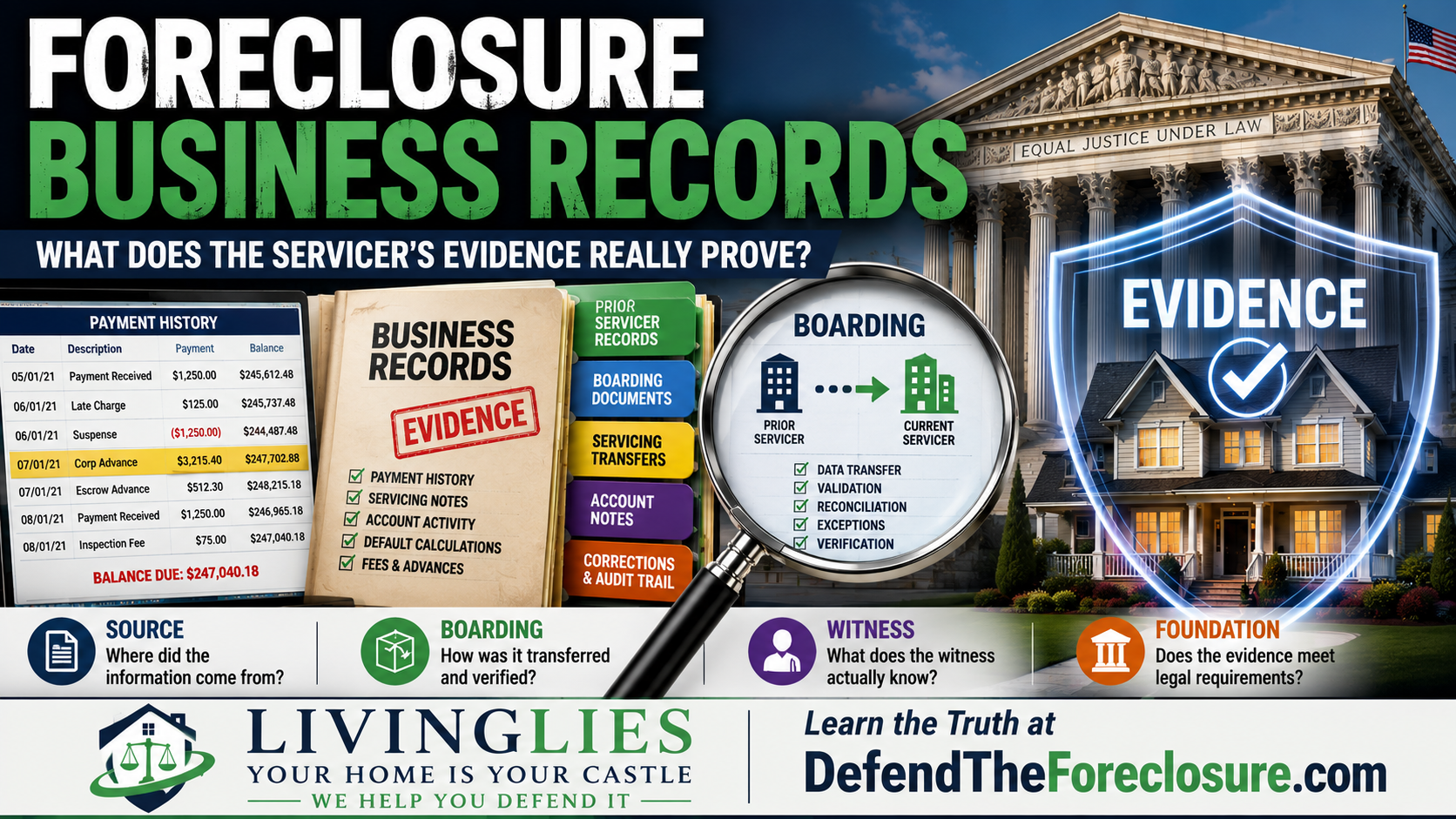
How Servicers Try to Get Computer Records Into Evidence
There is a moment in many foreclosure trials that homeowners and even some lawyers fail to recognize as one of the most important moments in the entire case. The introduction of Foreclosure Business records.
The foreclosure lawyer hands a stack of documents to a witness.
The witness identifies them as records maintained by the mortgage servicer.
The lawyer asks a series of questions about how the company keeps its records.
Then the lawyer asks the judge to admit the documents into evidence under the Foreclosure business records exception to the hearsay rule.
That stack of documents may contain the payment history, account notes, default calculations, servicing records, and other information the plaintiff needs to prove its case.
If those records are admitted without an effective challenge, the foreclosure case can suddenly become much easier for the party seeking foreclosure.
But there is an important distinction every homeowner should understand:
A document appearing on a mortgage servicer’s computer screen does not automatically establish that every statement contained in that document is accurate, admissible, or sufficient to prove the foreclosure claim.
That is where the business-record foundation becomes important.
And that is why discovery conducted before trial can be so valuable.
What Is the Business Records Exception?
Most courts have evidentiary rules limiting the use of hearsay.
Hearsay, stated simply, generally involves an out-of-court statement offered to prove the truth of what the statement asserts.
Business records are often admitted through an exception to that general rule when the requirements of the applicable evidence law are satisfied.
The precise wording differs among federal and state jurisdictions, so attorneys must work from the evidence rules and appellate decisions governing the particular case.
But the basic inquiry commonly involves questions concerning how the record was created, when it was created, whether it was maintained as part of regularly conducted business activity, and whether the witness or other permitted evidence can establish the required foundation.
That means the important question is not simply:
“Does the servicer have this record?”
The better questions include:
Where did the information come from?
When was it entered?
Who or what supplied the information?
What procedures were used to create and maintain it?
Was some of the information inherited from another company?
What does the witness actually know about those procedures?
The Foreclosure Case May Depend on Computer Records
Modern mortgage servicing is overwhelmingly electronic.
The witness appearing at trial probably did not personally receive the homeowner’s payments.
The witness probably did not personally calculate every fee.
The witness may not have worked for the company when the loan was originated.
The witness may not have been present when servicing transferred from another company.
Instead, the witness frequently relies upon information stored in servicing systems.
That does not automatically make the testimony improper.
But it does make the foundation for those records extremely important.
If the plaintiff’s proof depends upon electronic records, the homeowner’s attorney should understand where those records came from and how the witness claims to know they are reliable.
The Critical Distinction: A Record Versus the Information Inside the Record
This distinction is frequently overlooked.
A servicer may maintain a particular computer record in the ordinary course of its business.
But that does not necessarily answer every question concerning information within that record that originated somewhere else.
Suppose Servicer B takes over a loan previously serviced by Servicer A.
Servicer B may import years of payment information into its system.
Later, an employee of Servicer B appears in court and produces a payment history containing information originating during Servicer A’s servicing period.
The important inquiry becomes more specific.
What did Servicer B do when it received Servicer A’s data?
Was the information checked?
Was it reconciled?
Were exceptions identified?
Were balances independently verified?
What happens when the incoming records do not match?
Who can explain that process?
Those questions lead directly to one of the most important subjects in modern foreclosure litigation:
the boarding process.
What Is Loan Boarding?
When servicing rights are transferred, the new servicer generally needs to place information concerning the loan into its own servicing system.
This is commonly called boarding.
The information transferred may include:
- principal balances,
- payment histories,
- escrow information,
- corporate advances,
- fees and costs,
- delinquency information,
- loss mitigation information,
- account notes,
- property information,
- and other servicing data.
The receiving servicer may then rely upon that imported information for years.
That means a witness testifying today could be relying on information generated by several companies over a period of many years.
Discovery should therefore examine not merely whether boarding occurred, but how it occurred.
The Boarding Questions That Matter
Consider the questions that can arise when a servicer relies upon records inherited from another servicer:
- When was this particular loan boarded?
- Which company supplied the incoming data?
- What data fields were transferred?
- Was the transfer automated or manual?
- What reconciliation procedures were performed?
- Were payment balances compared against source records?
- Were exceptions generated?
- Were exceptions resolved?
- Who was responsible for resolving them?
- Were any corrections made after boarding?
- Are records of those corrections preserved?
- Does the witness know these procedures from training or personal involvement?
- Can the witness identify the procedures applicable at the time this particular loan was boarded?
Those questions are much more useful than simply asking:
“Do you have personal knowledge of the loan?”
The objective is not to create a trick question.
The objective is to determine whether a sufficient evidentiary foundation exists for the particular records being offered.
Why “I Am Familiar With the Records” Should Be the Beginning of the Inquiry
A common foreclosure witness may testify that he or she is familiar with the servicer’s recordkeeping practices.
That testimony may be important.
But the inquiry should not necessarily end there.
What does “familiar” mean?
Did the witness receive training?
What training?
Does the witness work with the system every day?
Has the witness ever boarded a loan?
Does the witness know how prior-servicer data is tested?
Did the witness review the records for this particular loan?
Which records?
When?
Can the witness explain the source of the specific information being offered?
A carefully prepared deposition can obtain these answers long before the witness enters the courtroom.
Why the Payment History Deserves Special Attention
The payment history is often treated as routine paperwork.
It shouldn’t be.
In many cases, it is the document used to establish the alleged default and calculate the amount claimed to be due.
That makes it worth examining carefully.
A detailed review may include:
- payments received,
- payments reversed,
- suspense balances,
- escrow transactions,
- late charges,
- property inspection fees,
- attorney fees,
- corporate advances,
- recoverable balances,
- credits,
- adjustments,
- and servicing-transfer entries.
A payment history containing hundreds or thousands of entries should not simply be accepted as an incomprehensible spreadsheet.
The entries should be understood.
What Are Corporate Advances?
One area deserving particular attention is the appearance of advances or similar accounting entries.
Mortgage servicing arrangements may involve advances for various expenses or amounts associated with loan administration.
The existence of an advance does not automatically prove that the borrower’s debt was reduced, eliminated, or transferred.
Nor should the terminology be interpreted without examining the governing agreements and accounting records.
But those entries may raise legitimate questions.
What was advanced?
By whom?
Under what agreement?
How was the amount recorded?
Was reimbursement sought?
How does the servicer distinguish an advance from a borrower payment?
Those are factual questions that may be explored through discovery where relevant to the issues in the case.
The Difference Between Authentication and What the Record Proves
This is another distinction homeowners should understand.
Getting a document admitted into evidence does not necessarily establish every conclusion the foreclosing party wants the court to draw from it.
There can be separate questions concerning:
Admissibility.
Can the document properly be considered by the court?
Reliability.
Does the evidence provide reason to trust the information contained within it?
Meaning.
What do the entries actually represent?
Weight.
How persuasive should the court find the evidence?
Sufficiency.
Does the evidence, taken together, actually prove the element for which it is offered?
Those concepts should not be collapsed into one another.
Business Records Do Not Automatically Prove Standing
One of the recurring mistakes we see in foreclosure defense is treating every evidentiary issue as a standing argument.
That can weaken an otherwise legitimate defense.
The better approach is to identify precisely what the plaintiff must prove under the applicable law and then determine what evidence is being offered for each element.
A payment history may help establish payment activity.
A servicing record may help establish servicing activity.
A document custody record may address possession of an instrument.
An agreement may address authority.
Loan-level data may identify financial reporting relationships requiring additional investigation.
But one category of evidence should not automatically be assumed to establish another proposition.
Make the foreclosing party connect the evidentiary dots.
Discovery Comes Before the Evidentiary Objection
The worst time to begin investigating a business record is when the foreclosure lawyer offers it into evidence at trial.
By then, it may be too late to discover how the record was created.
Effective preparation begins much earlier.
Discovery may seek:
- recordkeeping policies,
- boarding procedures,
- data dictionaries,
- payment histories,
- servicing notes,
- transfer records,
- exception reports,
- correction histories,
- corporate representative testimony,
- and documents relied upon by the proposed witness.
The deposition then tests the foundation.
(Note: When we see our clients get this far in the process their cases against them by the “Pretend Lender” usually get dropped or dismissed. The Foreclosing party knows the game is up and they cannot win so they bow out of the case to avoid a loss and a case precedent. If wrongful foreclosure cases they will often agree to a financial settlement under a strict non-disclosure agreement for the same reason.)
If the case does reach a summary judgment or trial, counsel should already know what the witness can—and cannot—say about the records.
Loan-Level Data Can Provide a Comparison Point
This is where Post 31 connects directly with our earlier cornerstone articles on loan-level data and real creditor investigations.
Information appearing in the servicer’s records can sometimes be compared with other available financial reporting.
If the information is consistent, that may strengthen the factual picture.
If material differences appear, those differences may identify subjects requiring additional discovery.
The important point is not to assume that a discrepancy proves wrongdoing.
The point is to investigate it.
Evidence should lead the investigation.
Stop Arguing Conclusions and Start Testing Foundations
A homeowner standing in court and declaring, “The bank has no standing,” is making a conclusion.
A lawyer demonstrating through deposition testimony that a witness cannot explain the source, transfer, verification, or meaning of material information presents the court with something very different.
That is evidence.
And evidence is where the strongest foreclosure defenses are built.
The strategy is not to claim that every servicer record is false.
The strategy is to require the party relying upon the record to establish whatever foundation and proof the governing law requires.
That is the difference between a foreclosure theory and a foreclosure defense built for the courtroom.
The Prior-Servicer Records Problem
One of the most important business-record issues in modern foreclosure litigation arises when the current servicer relies upon information created by one or more prior servicers.
Consider what may have happened to a mortgage over fifteen or twenty years.
Servicer A maintains the loan for several years.
The servicing is transferred to Servicer B.
Servicer B imports information received from Servicer A.
Years later, servicing transfers again to Servicer C.
Servicer C eventually supplies the payment history and witness used in foreclosure.
The witness standing in court may therefore be relying upon information that originated with companies for which that witness never worked.
That does not automatically make the records inadmissible.
But neither should the records automatically be treated as reliable merely because they now appear in the current servicer’s computer system.
The applicable evidence law matters.
Courts in various jurisdictions have developed rules concerning circumstances in which one business may rely upon or incorporate records received from another business. The precise foundation required varies, which is why counsel should research controlling authority in the jurisdiction where the foreclosure is pending.
The factual inquiry, however, remains extremely important.
What did the current servicer actually do before relying upon information supplied by somebody else?
Adoption of Prior-Servicer Records Should Be Examined, Not Assumed
A current servicer may contend that records received from a prior servicer were incorporated into its own records and relied upon in its ordinary business.
That assertion should lead to factual questions.
- What records were received?
- In what format were they received?
- When were they received?
- Who was responsible for the transfer?
- What validation procedures were performed?
- Were balances reconciled?
- Were exceptions generated?
- Were discrepancies found?
- How were discrepancies resolved?
- Were corrections made?
- Is there an audit trail showing those corrections?
- What records document the boarding process?
The goal is not to establish some universal rule that prior-servicer records are invalid.
There is no such universal rule.
The goal is to determine whether the foundation actually presented satisfies the law governing the particular case.
The Records Custodian Is Not Automatically an Eyewitness
Another common source of confusion concerns the role of the business-record witness.
A witness may be qualified to explain certain recordkeeping practices without having personally participated in every transaction reflected in those records.
That is an important distinction.
But it also means the scope of the witness’s knowledge should be carefully established.
Ask:
- What does this witness personally know?
- What does the witness know from company training?
- What does the witness know only because a computer screen says it?
- What records did the witness review?
- When did the witness review them?
- Did the witness work for any prior servicer?
- Did the witness participate in boarding this loan?
- Can the witness explain the procedures actually used when this loan was transferred?
The point is not that a witness must personally observe every transaction.
The point is that counsel should determine exactly what foundation the witness is competent to provide and avoid allowing the testimony to expand beyond that foundation without challenge.
Depose the Witness Before Trial Whenever Possible
If the foreclosing party intends to rely heavily upon a servicer witness, waiting until trial to learn what that witness knows can be a serious mistake.
A deposition provides an opportunity to examine the witness before the decisive hearing.
The deposition can establish the witness’s employment history, training, access to computer systems, knowledge of servicing transfers, understanding of boarding procedures, and familiarity with the particular loan.
It can also lock the witness into testimony that may become important later.
Questions for the Foreclosure Business-Records Witness
The exact questions must be tailored to the facts and applicable law, but subjects worth investigating may include:
- How long have you worked for the current servicer?
- What is your present job title?
- What are your responsibilities?
- What training have you received regarding the servicing system?
- Which computer systems did you review before testifying?
- Did you personally create any of the records you intend to authenticate?
- Which records were created by the current servicer?
- Which records originated with prior servicers?
- How do you know where those records originated?
- When was this loan boarded into the current system?
- Did you participate in that boarding?
- What procedures were used to verify incoming information?
- How do you know those procedures were used for this particular loan?
- Were exception reports generated?
- Did you review them?
- Were discrepancies identified?
- Were corrections made after boarding?
- Is there an audit trail reflecting those corrections?
- Can you identify the source of the beginning balance entered into your system?
- Can you explain each category appearing in the payment history?
- What do corporate advances represent?
- What do suspense entries represent?
- What documents establish the alleged default date?
- What documents did you rely upon to calculate the amount allegedly due?
- What records establish the authority under which your company acts?
These are not magic questions.
They are starting points for testing the factual foundation behind the evidence.
Authentication, Hearsay, Relevance and Sufficiency Are Different Issues
Attorneys should resist collapsing every evidentiary challenge into one objection.
Several different questions may arise.
Authentication
Has an adequate basis been established for identifying the document as what the offering party claims it is?
Hearsay
Does the document contain an out-of-court statement offered for its truth, and if so, does an applicable exception permit its admission?
Relevance
Does the evidence tend to prove or disprove a fact that matters to the case?
Foundation
Has the testimony or other evidence established the prerequisites necessary for the document or testimony to be considered?
Weight
Even if admitted, how persuasive should the court find the evidence?
Sufficiency
Does the evidence actually establish the proposition or legal element for which it is being offered?
Those distinctions can be crucial.
A document can be admitted and still fail to prove what the plaintiff says it proves.
Summary Judgment Is Often Where the Business-Records Fight Begins
Homeowners sometimes think evidentiary issues matter only at trial.
That can be a costly mistake.
In judicial foreclosure states, plaintiffs frequently seek summary judgment using affidavits or declarations from servicer employees.
The declaration may attempt to establish:
- the payment history,
- the default,
- the amount due,
- possession or custody of documents,
- servicing authority,
- and other facts required for judgment.
That means counsel should examine the declaration just as carefully as live testimony.
What does the declarant actually say?
What does the declarant avoid saying?
What records are attached?
What records are missing?
Does the declaration establish the foundation required under the governing rules?
Does the declarant claim personal knowledge?
If so, what is the stated basis for that knowledge?
Those questions should be investigated before the response to summary judgment is due.
Compare the Declaration With the Deposition
This is where early discovery can become especially powerful.
Suppose a declaration broadly states that the witness is familiar with the company’s recordkeeping practices.
During deposition, however, the witness admits that he or she:
- did not participate in boarding the loan,
- never worked for the prior servicer,
- does not know whether exceptions occurred during boarding,
- did not review certain source records,
- and cannot explain particular entries in the payment history.
Those facts may become important when evaluating the declaration and determining whether the evidence establishes what the plaintiff claims.
This is why discovery should occur before the decisive motion whenever procedural rules permit it.
Loan-Level Data Can Reveal What Questions to Ask
Loan-level data becomes particularly useful when compared with the records produced by the servicer.
For example, outside financial reporting may identify a servicing transfer, investor code, pool reference, reporting event, or other transaction that deserves explanation.
If the servicer’s records appear consistent with that information, the comparison may help clarify the history.
If they do not, counsel has identified something to investigate.
That investigation might involve:
- additional document requests,
- a Request for Information,
- a Qualified Written Request where applicable,
- interrogatories,
- Requests for Admission,
- a corporate representative deposition,
- or expert analysis.
The discrepancy itself should not be exaggerated.
It should be investigated.
When Expert Analysis Becomes Valuable
Mortgage servicing records can contain thousands of entries generated across multiple computer systems.
A lawyer does not necessarily need an expert merely because the records are complicated.
But expert analysis can become valuable when specialized knowledge is needed to explain financial reporting, servicing practices, data relationships, or inconsistencies among different record sets.
An expert may assist counsel in:
- organizing a servicing chronology,
- analyzing loan-level data,
- comparing different payment histories,
- identifying servicing-transfer events,
- reviewing investor reporting,
- identifying subjects for deposition,
- preparing exhibits,
- and explaining technical financial evidence.
Expert Affidavits at Summary Judgment
In appropriate cases and where permitted by applicable procedural and evidence rules, an expert affidavit or declaration may assist in explaining technical issues raised by the evidence.
A useful expert affidavit should not merely announce a legal conclusion.
It should identify the information reviewed, explain the methodology used, describe relevant observations, and clearly separate factual analysis from legal determinations reserved for the court.
The stronger expert analysis is usually the analysis that shows the court why an issue exists rather than simply telling the court what result to reach. Don’t make this mistake; judges resent it when this happens
Expert Testimony at Trial
If the dispute proceeds to trial, an expert may be useful in explaining complex financial evidence to the judge or jury.
Depending upon the expert’s qualifications and the issues presented, testimony may address:
- mortgage servicing practices,
- loan-level reporting,
- servicing transfers,
- data relationships,
- financial reporting,
- payment-history analysis,
- and other subjects requiring specialized knowledge.
Expert testimony should complement the documentary evidence.
It should not replace missing proof that the party bearing the burden is legally required to provide.
California: Business Records in a Non-Judicial Foreclosure State
California requires a somewhat different strategy because most residential foreclosures proceed without an ordinary foreclosure lawsuit.
That does not make evidence irrelevant.
It makes timing more important.
If a homeowner seeks judicial intervention through a Temporary Restraining Order, Preliminary Injunction, wrongful foreclosure action, or related proceeding, declarations and documentary evidence may become critical. (Note: The use of a evidence based counterclaim turns a non-judicial foreclosure into judicial one where you have a change to challenge the opposition.)
Investigation therefore needs to begin before the trustee’s sale whenever possible.
California attorneys should analyze the state’s evidence rules and controlling appellate authority rather than assuming that rules developed in judicial foreclosure states apply identically.
Florida: Business Records Can Decide the Foreclosure Trial
Florida’s judicial foreclosure system has generated substantial litigation concerning mortgage business records and servicer testimony.
The payment history, default evidence, prior-servicer records, and witness foundation can become central issues at trial.
Discovery should therefore establish the witness’s knowledge and the history of the records well before trial.
New York and New Jersey
Because New York and New Jersey generally use judicial foreclosure procedures, business-record evidence can become important during both summary judgment and trial.
Counsel should pay particular attention to affidavits submitted in support of dispositive motions and determine whether the factual foundation satisfies controlling state law.
Texas and Georgia
Texas and Georgia commonly use non-judicial foreclosure procedures.
As in California, this changes the procedural setting in which evidentiary issues arise.
A homeowner seeking emergency judicial relief may need to develop the factual record rapidly.
That makes early investigation, document requests, loan-level analysis, and expert review especially important.
The LivingLies Business Records & Evidence Analysis
LivingLies assists homeowners and attorneys in moving beyond the surface appearance of foreclosure documents and examining the evidence behind them.
Our work can include:
- loan-level data acquisition and analysis,
- business-record review,
- payment-history analysis,
- servicing-transfer analysis,
- boarding-process investigation,
- real creditor investigation,
- customized discovery planning,
- Qualified Written Request drafting,
- Request for Information drafting,
- deposition preparation,
- expert reports,
- expert affidavits and declarations,
- expert witness services,
- summary judgment support,
- litigation consulting,
- and trial preparation.
We do not begin with the assumption that every foreclosure record is false.
We begin with the proposition that a foreclosure case should be decided upon competent evidence.
Then we investigate the evidence.
Don’t Just Read the Foreclosure Records. Investigate Them.
If your foreclosure case depends upon a servicer’s computer records, there are questions that should be answered before those records become the foundation for taking your home.
Who created the information?
Where did it originate?
Was it transferred from another servicer?
How was it verified?
What does the witness actually know?
And what does the record actually prove?
LivingLies/DefendtheForeclosure assists self-represented litigants and the attorneys in our network with the financial and evidentiary investigation behind those questions.
Your Home Is Your Castle.
We Help You Defend It.
Request a Foreclosure Evidence & Business Records Case Review or Call us today at 866.216.4126
The Rule to Remember
There is one principle homeowners and foreclosure defense attorneys should remember from this article:
Don’t merely attack the document. Test the foundation, test the witness, and determine exactly what the document actually proves.
That approach changes the conversation.
Instead of telling the judge that the foreclosure documents are unreliable, you develop evidence showing precisely what the witness knows, where the information came from, how it was handled, and what remains unproven.
That is a courtroom strategy.
And it provides the foundation for the next articles in this series.
Related LivingLies Cornerstone Articles and Information
- How Loan-Level Data Can Stop a Foreclosure: Discovering the Real Creditor
- How to Prove the Foreclosing Party Is Not the Real Creditor
- Foreclosure Discovery Secrets: How to Obtain the Records Banks and Servicers Avoid Producing
- What Is Standing in Foreclosure?
- Qualified Written Requests in Foreclosure Defense
Frequently Asked Questions About Foreclosure Business Records
Are mortgage servicer computer records automatically admissible in foreclosure?
No. The party offering business records must satisfy the applicable evidentiary requirements. Those requirements vary by jurisdiction and should be evaluated under the law governing the particular foreclosure case.
Can a current servicer use records created by a prior servicer?
Potentially. Courts may permit incorporated or adopted records under circumstances recognized by applicable evidence law. The foundation, integration of the records, reliance upon them, and evidence of reliability may become important depending upon the jurisdiction.
Does the foreclosure witness need to have personally created the records?
Not necessarily. Business-record rules generally do not require the sponsoring witness to have personally created every record. But the witness or other qualifying evidence must establish whatever foundation the governing evidence rule requires.
What is mortgage loan boarding?
Boarding generally refers to the process through which a new servicer loads information received from a prior servicer into its servicing system. The process may involve balances, payment histories, escrow information, account notes, fees, advances, and other servicing data.
Why does the boarding process matter?
If the current servicer relies upon information supplied by a prior servicer, the procedures used to transfer, validate, reconcile, and correct that information may be relevant to evaluating the reliability and evidentiary foundation of the records.
Does admitting a payment history prove the plaintiff has standing?
Not necessarily. Admissibility and standing are separate questions. The court must determine whether the evidence presented satisfies each legal element required under the governing foreclosure law.
Can loan-level data help challenge foreclosure business records?
Loan-level data can provide additional financial information that may be compared with servicing records. Material differences may identify subjects for additional discovery, deposition testimony, or expert analysis. A discrepancy should be investigated rather than automatically treated as proof of wrongdoing.
Can an expert help analyze mortgage servicing records?
Yes. Where specialized knowledge would assist the court or counsel, qualified experts may analyze servicing records, loan-level data, payment histories, financial reporting, and related information subject to applicable evidence rules.
Can LivingLies assist my attorney?
Yes. LivingLies provides litigation consulting and technical support that may include loan-level data analysis, business-record review, discovery planning, deposition preparation, expert reports, expert affidavits, expert witness services, and trial support.
Search Our Blog
Categories
Contact Our National Headquarters Phone: 844-583-5339
Connect with us


Contact Our National Headquarters
- 844-583-5339
- Available 24/7
-
200 S. Andrews Ave. Ste. 604
Ft. Lauderdale, FL 33301