
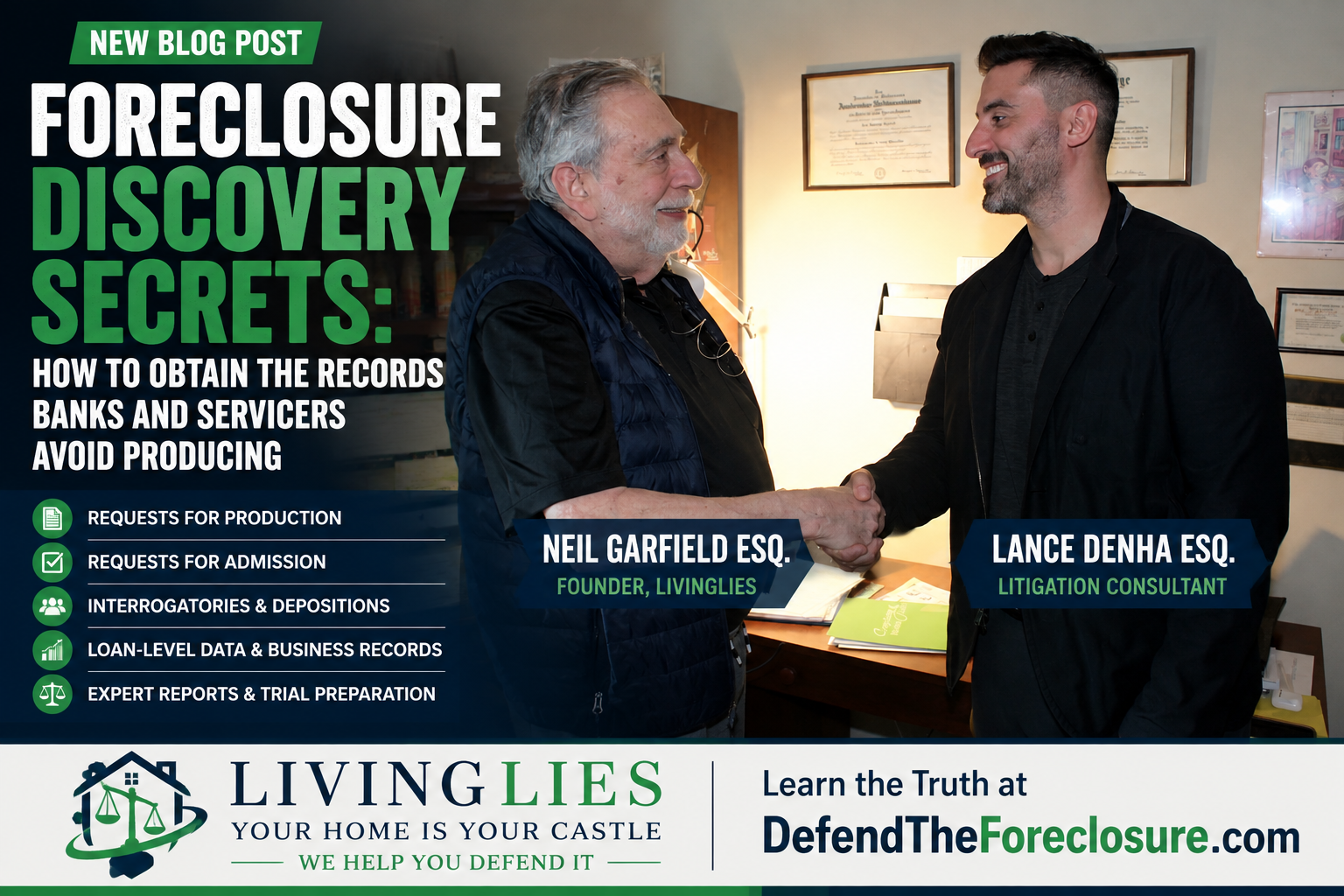
How to Obtain the Records Banks and Servicers Avoid Producing in Discovery
If you are facing foreclosure the Discovery process in Foreclosure cases is key. One of the biggest myths in foreclosure litigation is that the outcome depends entirely on the documents attached to the foreclosure complaint.
It doesn’t. Learn how to get the records the “pretend lenders” don’t want you to see.
The complaint is only the beginning of the case.
The real battle often centers on the evidence that exists behind those documents—and whether the foreclosing party can produce competent records that support its claims.
That is why discovery is one of the most powerful tools available to homeowners and their attorneys.
Properly used, discovery allows you to move beyond assumptions and require the foreclosing party to produce evidence supporting the allegations made in court.
Unfortunately, discovery is also one of the most misunderstood parts of foreclosure litigation.
Many homeowners serve generic discovery requests copied from the internet.
Many attorneys request hundreds of documents that have little connection to the actual issues in dispute.
The result is predictable.
The servicer objects.
The court limits discovery.
Months are lost.
Important evidence is never obtained.
LivingLies has long advocated a different approach.
Discovery should begin with the financial evidence already available. Loan-level data, servicing histories, recorded documents, investor reporting, and business records should be analyzed first. Discovery should then be directed toward the specific factual questions raised by that evidence.
That strategy frequently produces stronger results than broad requests seeking “everything.”
Why Foreclosure Discovery Wins Cases
Every foreclosure case begins with allegations.
The complaint alleges that the plaintiff has the legal right to enforce the obligation.
The complaint alleges that a default occurred.
The complaint alleges that required notices were provided.
The complaint alleges that business records support those assertions.
But allegations are not evidence.
Courts ultimately decide foreclosure cases based upon admissible evidence presented through documents, witness testimony, and properly authenticated business records.
Discovery is the process that allows each party to test whether those allegations are actually supported.
Without meaningful discovery, the court may never receive the complete factual record necessary to evaluate disputed issues.
The Difference Between Pleadings and Evidence
One of the most important lessons for homeowners is understanding that the foreclosure complaint is not proof.
A pleading is simply a statement of the claims a party intends to prove.
Evidence is something very different.
Evidence may include:
- authenticated business records,
- payment histories,
- servicing agreements,
- loan-level data,
- investor reporting,
- deposition testimony,
- original documents,
- and testimony from witnesses with personal knowledge.
Discovery exists to determine whether those materials support the allegations made in the pleadings.
What Foreclosure Discovery Is Designed to Accomplish
Good discovery answers specific questions.
For example:
- Who authorized the foreclosure?
- What records support the alleged default?
- How were the payment histories created?
- Who boarded the loan into the current servicing platform?
- What quality-control procedures were used during servicing transfers?
- What documents establish the servicer’s authority?
- What financial records identify the entity claiming the economic interest in the loan?
Each of those questions seeks evidence—not conclusions.
When discovery focuses on factual issues instead of speculation, it becomes far more effective.
The Most Important Records to Request in Foreclosure Discovery
Every case is different, but certain categories of records frequently become central to foreclosure litigation.
These include:
- complete payment histories,
- servicing agreements,
- boarding records,
- default calculations,
- account notes,
- servicing transfer documentation,
- investor reporting,
- loan-level data,
- business-record procedures,
- document custody records,
- communications concerning servicing transfers,
- and the records relied upon in authorizing foreclosure.
The objective is not to request every document in existence.
The objective is to obtain the documents necessary to evaluate the factual basis of the foreclosure claim.
Understanding the Servicer Boarding Process
One issue that appears repeatedly in foreclosure litigation is the transfer of servicing from one company to another.
When servicing rights change, the receiving servicer usually imports or “boards” information from the prior servicer into its own computer systems.
That process can involve payment histories, account notes, escrow information, collection records, default data, and other electronic information.
An important discovery question is how those records were transferred and verified.
Who performed the boarding?
What procedures were followed?
Were the transferred records independently verified?
Can the witness explain those procedures from personal knowledge?
These questions frequently become important when business records are offered into evidence.
Why Payment Histories Matter
Almost every foreclosure complaint alleges that the borrower failed to make required payments.
The records supporting that allegation deserve careful review.
Discovery should determine:
- how the payment history was created,
- who entered the information,
- whether prior servicing records were incorporated,
- how corrections were documented,
- whether suspense accounts existed,
- whether fees were added,
- and whether the witness can explain the records presented to the court.
Payment histories often become one of the most important exhibits at summary judgment and trial.
Servicing Notes Often Tell the Story Behind the File
Electronic servicing notes frequently contain a running history of borrower communications, collection efforts, servicing transfers, loss mitigation activity, and account administration.
Although not every note is significant, together they can provide a valuable timeline of how the loan was handled.
Discovery directed toward servicing notes may identify inconsistencies, missing information, or events requiring additional investigation.
Loan-Level Data Can Focus Foreclosure Discovery
One of the most effective ways to improve discovery is to begin with loan-level data.
Loan-level data may identify servicing transfers, investor reporting, pool identifiers, trust references, reporting timelines, and other financial information that is not reflected in county land records.
Instead of drafting discovery requests based on assumptions, attorneys can use that information to identify specific transactions and specific entities that deserve closer examination.
LivingLies has found that evidence-based discovery is generally more effective than broad requests seeking every document related to the loan.
Investor Reporting May Reveal Additional Questions
Modern residential mortgages frequently involve investor reporting that extends beyond the records maintained by the current servicer.
Depending on the circumstances of the case, investor reporting may provide additional context regarding servicing activity, reporting timelines, pool identifiers, and financial administration.
That information should not be viewed as conclusive by itself.
Instead, it should be treated as another source of factual information that may guide discovery into the relationships among the various entities involved in the mortgage transaction.
Why Generic Foreclosure Discovery Usually Fails
Courts expect discovery requests to be relevant and proportional to the issues in dispute.
Generic requests copied from internet forms often ask for hundreds of categories of documents without explaining why they matter.
Those requests invite objections.
By contrast, targeted discovery tied to specific financial evidence is more likely to withstand objections because each request can be connected to a genuine issue in the case.
The better the investigation, the better the discovery in Foreclosure cases.
Building an Evidence-Based Foreclosure Discovery Strategy
Discovery should never begin with a template.
It should begin with an investigation.
Review the recorded documents.
Analyze the foreclosure pleadings.
Examine payment histories.
Review available loan-level data.
Evaluate investor reporting.
Identify servicing transfers.
Only then should discovery requests be drafted.
When discovery follows the evidence instead of speculation, attorneys are far more likely to obtain the records and testimony needed to present a complete factual record to the court.
Requests for Production: Ask for the Records That Matter in Discovery
Requests for Production are one of the most powerful discovery tools available because they require the opposing party to produce documents supporting its claims.
The key is to request documents that address specific factual issues rather than asking for “everything related to the loan.”
For example, discovery may seek:
- the servicing agreement authorizing the servicer to act,
- boarding records created during servicing transfers,
- complete payment histories,
- account notes maintained within servicing platforms,
- investor reporting relied upon by the servicer,
- documents identifying the entity directing the foreclosure,
- custodial records relating to the original loan documents,
- quality-control procedures used during servicing transfers,
- default calculations,
- communications concerning acceleration or foreclosure approval,
- business-record policies and procedures,
- and documents identifying the witnesses expected to authenticate those records.
Well-crafted requests are tied directly to issues already identified through investigation. That makes objections more difficult to sustain and increases the likelihood of obtaining meaningful evidence.
Requests for Admission Can Narrow the Issues
Requests for Admission are frequently underused in foreclosure litigation.
Rather than seeking documents, they ask the opposing party to admit or deny specific facts.
For example, admissions may address:
- whether the servicer boarded records received from a prior servicer,
- whether the witness has personal knowledge of that boarding process,
- whether specific servicing transfers occurred,
- whether certain documents exist,
- whether identified agreements authorize the servicer to act,
- or whether particular business records were relied upon before filing suit.
Admissions can simplify litigation by identifying which issues remain genuinely disputed and which facts are no longer contested.
Interrogatories: Force the Foreclosing Party to Explain Its Position
Interrogatories require written answers under oath.
They are particularly useful for identifying:
- the factual basis supporting standing,
- the identity of persons with knowledge,
- the systems used to maintain records,
- the witnesses expected to testify,
- the documents supporting specific allegations,
- and the procedures used to calculate the alleged default.
Answers to interrogatories often become valuable during depositions because witnesses may later be questioned about those sworn responses.
Depositions: Testing the Witness Behind the Records
Many foreclosure cases ultimately depend upon testimony offered by a corporate representative or loan servicer employee.
The witness may testify regarding payment histories, default calculations, servicing transfers, or business records.
Discovery should determine whether that witness actually possesses personal knowledge of the facts described.
Important deposition topics often include:
- how records were created,
- how information was transferred during servicing changes,
- what quality-control procedures were followed,
- who entered specific information into servicing systems,
- what documents the witness reviewed before testifying,
- and whether the witness can identify the records supporting each material allegation.
Loan-level data often helps attorneys prepare focused deposition outlines because it identifies specific transactions and reporting events that deserve explanation.
Challenging Business Records
Business records frequently become the foundation of the foreclosing party’s case.
Courts generally expect those records to satisfy the applicable evidentiary rules before they are admitted.
Discovery should explore:
- who created the records,
- when they were created,
- whether they were made in the ordinary course of business,
- how transferred records were verified,
- whether corrections were documented,
- and whether the witness possesses sufficient knowledge to explain those procedures.
These questions help the court evaluate the reliability of the evidence rather than simply accepting it at face value.
Motions to Compel
Discovery disputes sometimes arise when relevant information is withheld or objections prevent meaningful responses.
When appropriate, a motion to compel may ask the court to require additional responses or production of documents.
Courts generally expect parties to make reasonable efforts to resolve discovery disputes before seeking judicial intervention.
A well-supported motion identifies:
- the discovery requested,
- the response received,
- why the information is relevant,
- and why additional responses are necessary for the fair resolution of the case.
Discovery Sanctions
Courts possess authority under applicable procedural rules to address discovery misconduct when appropriate.
Potential remedies vary by jurisdiction and depend upon the circumstances.
They may include orders compelling production, cost-shifting, evidentiary consequences, or other relief authorized by law.
The purpose of discovery sanctions is not punishment for its own sake. It is to ensure that litigation proceeds on a complete and fair evidentiary record.
Preparing for Summary Judgment
Summary judgment often becomes the defining stage of a foreclosure case.
By the time summary judgment is filed, discovery should already have identified:
- the relevant witnesses,
- the important business records,
- the servicing history,
- the factual disputes,
- and the evidence supporting each position.
Discovery conducted early and strategically gives attorneys and pro se litigants a far stronger foundation for opposing unsupported factual assertions or demonstrating the existence of genuine issues requiring trial.
Preparing for Trial
The best trial preparation begins long before the trial date.
Every discovery response should help answer three questions:
- What evidence supports the claim?
- Who can authenticate that evidence?
- How will that evidence be presented to the court?
When discovery has been guided by financial evidence instead of speculation, attorneys are better positioned to organize exhibits, prepare witnesses, anticipate objections, and present a coherent factual narrative.
State-Specific Considerations
California
Because non-judicial foreclosure timelines can move quickly, discovery planning should begin before emergency motions whenever possible. Loan-level data, servicing records, and targeted document requests may support applications for temporary restraining orders or preliminary injunctions.
Texas
Texas homeowners often have limited time to investigate servicing history. Early document requests and focused discovery planning are essential.
Florida
Florida’s judicial foreclosure process generally provides broader discovery opportunities. Proper planning allows attorneys to challenge business records, standing evidence, and witness testimony before trial.
Georgia
Georgia’s non-judicial process requires prompt investigation and rapid development of evidence if emergency relief is sought.
New York and New Jersey
Judicial foreclosure procedures in these states permit extensive discovery into standing, servicing authority, business records, and the factual basis supporting foreclosure allegations.
The LivingLies Discovery Program
For more than two decades, LivingLies has emphasized that successful foreclosure litigation depends upon evidence—not assumptions.
Our Discovery Program is designed to help homeowners and attorneys obtain, organize, and present the financial evidence necessary to evaluate foreclosure claims.
Our services include:
- Loan-level data acquisition and analysis
- Customized discovery planning
- Drafting targeted Qualified Written Requests (QWRs)
- Drafting Requests for Information (RFIs)
- Review of servicer responses
- Requests for Production
- Requests for Admission
- Interrogatory planning
- Deposition preparation
- Business-record analysis
- Expert reports
- Expert affidavits
- Expert witness testimony
- Real creditor investigations
- Litigation consulting and drafts
- Trial preparation support
Our goal is simple: help ensure that foreclosure cases are decided on complete, reliable evidence rather than unsupported assumptions.
Build Your Case on Evidence, Not Guesswork
The strongest foreclosure defenses are rarely built on one document or one legal argument.
They are built on evidence gathered through careful investigation, targeted discovery, expert analysis, and thorough preparation.
LivingLies provides:
- Discovery planning
- Loan-level data analysis
- Real creditor investigations
- Expert reports and affidavits
- Expert witness services
- QWR and RFI drafting
- Deposition preparation
- Litigation consulting
- Trial support
Your Home Is Your Castle.
We Help You Defend It.
Schedule a Discovery Strategy Consultation or call us at 866.216.4126
Related LivingLies Resources
- What Is Standing in Foreclosure?
- Quiet Title: Challenging Pretender Lender Claims
- How Loan-Level Data Can Stop a Foreclosure
- How to Prove the Foreclosing Party Is Not the Real Creditor
- Temporary Restraining Orders in Foreclosure Cases
- Preliminary Injunctions in Foreclosure Cases
Frequently Asked Questions
What is the purpose of discovery in a foreclosure case?
Discovery allows each party to obtain evidence, test the factual basis of the claims being made, and prepare for hearings or trial. Its purpose is to move beyond allegations and evaluate the underlying evidence.
Why is the servicing boarding process important?
When a loan is transferred from one servicer to another, records are typically imported into a new servicing platform. Discovery may explore how those records were transferred, verified, and maintained because those facts can affect the reliability of the evidence presented.
Can loan-level data improve discovery?
Yes. Loan-level data may identify servicing transfers, investor reporting, and other financial information that helps attorneys draft more focused discovery requests directed at specific factual issues.
Can LivingLies assist attorneys and homeowners with discovery?
Yes. LivingLies provides discovery planning, loan-level data analysis, QWR and RFI drafting, expert reports, expert witness services, litigation consulting, and trial support for attorneys and self-represented homeowners.
Search Our Blog
Categories
Contact Our National Headquarters Phone: 844-583-5339
Connect with us


Contact Our National Headquarters
- 844-583-5339
- Available 24/7
-
200 S. Andrews Ave. Ste. 604
Ft. Lauderdale, FL 33301