
Can a New Servicer Really Prove Old Servicer’s Records?
Your mortgage servicing gets transferred.
A new company begins sending statements.
Years later, that company—or perhaps another company after it—appears in court with a payment history covering periods when it was not even servicing your loan.
Its witness testifies about the account.
The witness may tell the judge that the records are maintained in the ordinary course of the servicer’s business.
But there is a basic factual question hiding behind all of this:
How did the new servicer get the old servicer’s information into its computer system?
The answer usually involves a process commonly known as loan boarding.
And in a foreclosure case, that process can matter.
It can matter because the current servicer may be relying upon balances, payment information, fees, advances, escrow figures, default information, and account history created before the current servicer ever touched the loan.
The point is not that transferred records are automatically false.
They are not.
The point is not that a new servicer can never rely upon records received from an old servicer.
Depending upon applicable evidence law and the foundation established, it may be able to do so.
The important question is much more precise:
What happened to the information when it moved from one company to another, and what evidence establishes the reliability of the information now being offered against the homeowner?
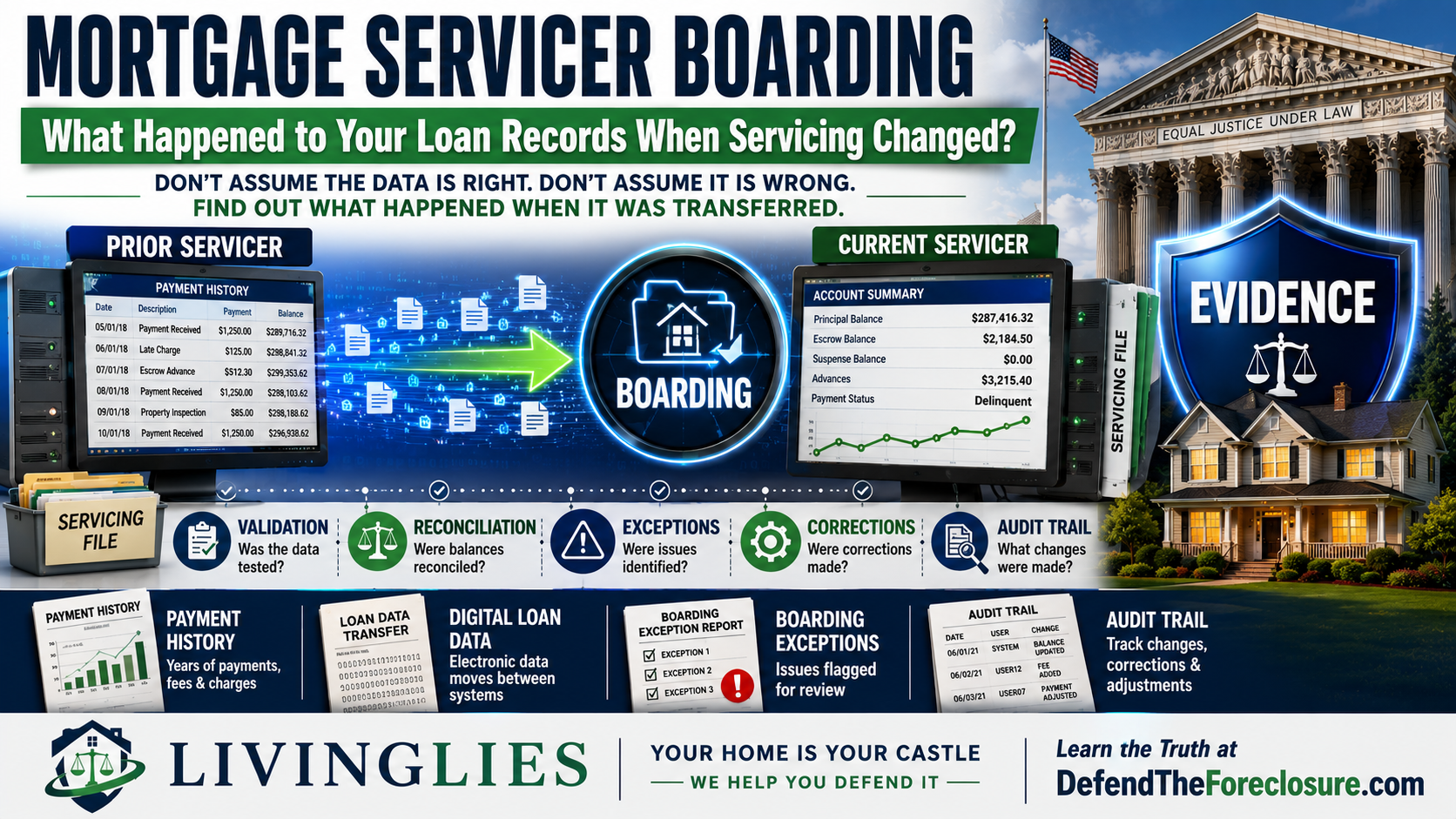
What Is Mortgage Servicer Boarding?
When servicing of a mortgage loan transfers from one company to another, the receiving servicer needs enough information to begin administering the account.
That can involve the transfer of substantial amounts of electronic data.
The process of loading that information into the receiving servicer’s system is commonly called boarding.
Depending upon the loan and the systems involved, transferred information may include:
- principal balance,
- interest information,
- payment history,
- escrow balances,
- tax information,
- insurance information,
- suspense balances,
- fees and charges,
- corporate or servicing advances,
- delinquency status,
- default information,
- loss mitigation history,
- bankruptcy information,
- foreclosure information,
- borrower communications,
- and account notes.
Some information may be transferred electronically from one system to another.
Other information may arrive through documents, images, reports, data files, or separate platforms.
The receiving servicer then uses that information to administer the loan.
Years later, those same records may become exhibits in a foreclosure case.
The Problem Is Not the Transfer. The Question Is What Happened During the Transfer.
A common mistake in foreclosure defense is to argue that a servicing transfer somehow makes all subsequent records invalid.
That argument is usually far too broad.
Servicing transfers occur routinely.
The more useful investigation asks what actually happened during the transfer.
For example:
- What information was received?
- Who supplied it?
- When was it received?
- How was it loaded into the new system?
- Were totals reconciled?
- Were data fields validated?
- Were exceptions generated?
- Were discrepancies identified?
- Who resolved those discrepancies?
- Were corrections made?
- Is there an audit trail?
Those questions move the defense away from speculation and toward evidence.
A Simple Example Shows Why Boarding Matters
Suppose a homeowner makes mortgage payments for ten years while the loan is serviced by Company A.
Company B then takes over servicing.
Company B receives electronic data from Company A and loads that information into its own servicing platform.
Three years later, Company C becomes the servicer.
Company C receives information from Company B.
A foreclosure lawsuit is eventually filed.
The witness appearing in court works for Company C.
Yet the payment history offered through that witness may contain entries dating back thirteen years.
Think about the layers involved.
Some information was created by Company A.
Some was created by Company B.
Some was created by Company C.
The current witness may have worked only for Company C.
That does not automatically prevent the records from being admitted.
But it makes the foundation worth investigating.
What Does the Current Witness Actually Know?
The servicer’s witness may say:
“I am familiar with our company’s recordkeeping practices.”
That statement may be relevant to the evidentiary foundation.
But it should usually be the beginning of the inquiry, not the end.
Consider asking:
- When did you begin working for the current servicer?
- Were you employed there when this loan was boarded?
- Did you personally participate in the boarding?
- Have you ever boarded any mortgage loan?
- What training have you received regarding boarding?
- Do you know which company supplied the incoming data?
- Do you know the format in which it was received?
- Can you identify the validation procedures used?
- Do you know whether exceptions were generated for this loan?
- Did you review any exception reports?
- Do you know whether corrections were made?
- What records show that?
The objective is not to demand that the witness personally observed every event in the history of the loan.
Business-record law generally does not impose such a universal requirement.
The objective is to determine what the witness actually knows and whether the foundation satisfies the law applicable to the evidence being offered.
What Is Data Validation?
The exact procedures vary among companies, platforms, contracts, and periods of time and they are not always sufficient for accuracy.
Validation can therefore become an important discovery subject.
For example, counsel may investigate whether the receiving servicer checked:
- principal balances,
- interest rates,
- payment amounts,
- escrow balances,
- delinquency status,
- fee balances,
- advance balances,
- and other critical data fields.
The question is not merely whether the company had a written policy.
The more useful question may be:
What procedure was actually applied to this loan?
Exception Reports May Be More Important Than the Final Payment History
This is an area homeowners rarely hear about.
Suppose incoming data does not pass a validation rule.
A servicing system or boarding process may identify an exception requiring review.
If that occurred, the final payment history might not reveal the entire story.
The important records could include:
- exception reports,
- boarding worksheets,
- reconciliation reports,
- data-validation reports,
- correction logs,
- audit trails,
- and communications concerning unresolved discrepancies.
If those records exist and are relevant to the issues in the case, they may provide information that cannot be seen merely by looking at the finished payment history.
This is exactly why targeted discovery is more useful than a generic request for “all documents relating to the loan.”
Ask for the Audit Trail
Computer systems frequently preserve information concerning changes made to account data.
Depending upon the platform and the records retained, an audit trail may show when information was entered or changed and sometimes identify the user, process, or event associated with that change.
That can raise important questions.
Was the beginning balance changed after boarding?
Was a payment reversed?
Was a fee added later?
Was the default date modified?
Was an escrow figure corrected?
Was a suspense balance moved?
If so:
When?
Why?
By whom or by what process?
The current payment history may show only the final result.
The audit trail may help explain how the system arrived there.
The Opening Balance Deserves Special Attention
One of the simplest but most important questions in a transferred servicing file is:
Where did the new servicer’s opening balance come from?
Imagine the receiving servicer begins with a principal balance of $287,416.32.
That figure did not materialize out of nowhere.
Some record, data field, reconciliation, or source supplied it.
Ask:
- What source established that number?
- Was it independently calculated?
- Was it merely imported?
- Was it reconciled against another record?
- Can the witness identify the source record?
- Is that source record available?
If the foreclosure case depends upon calculations beginning with an inherited balance, understanding the source of that balance can be important.
Boarding Can Affect More Than the Principal Balance
It would be a mistake to focus exclusively on principal.
A servicing transfer can involve numerous categories of financial information.
Consider escrow.
If the old servicer says the escrow account contains one amount and the receiving servicer begins with another, what happened?
Consider suspense funds.
If borrower money was being held in suspense when servicing transferred, how was that money accounted for?
Consider fees.
Were fees transferred as a single balance or as individual transactions?
Consider advances.
What categories were transferred, and how were they recorded?
Consider the alleged default date.
Did the new servicer independently determine that date or inherit it from the prior system?
Each answer can lead to another legitimate evidentiary question.
Boarding and the Alleged Default
Foreclosure ultimately depends upon an alleged default.
So ask a deceptively simple question:
How does the current servicer know when the homeowner actually defaulted?
If the alleged default occurred while another company serviced the loan, today’s servicer may be relying upon information received during boarding.
That does not necessarily make the default information incorrect.
But the source and reliability of that information can matter.
What records establish the last payment?
What records establish the first missed payment?
Were payments sitting in suspense?
Were payments reversed?
Were any corrections made after transfer?
Was the default date carried forward automatically?
Those are factual questions.
The Servicing Notes Can Tell a Different Part of the Story
The payment history is not necessarily the only electronic record worth examining.
Servicing notes may contain information about:
- borrower communications,
- payment disputes,
- servicing transfers,
- loss mitigation,
- bankruptcy,
- foreclosure referrals,
- account corrections,
- document requests,
- and internal servicing activity.
A comparison between the servicing notes and payment history can sometimes identify events that deserve additional investigation.
For example, a servicing note might refer to an account correction that is difficult to understand from the payment history alone.
Again, that does not prove misconduct.
It identifies a question.
And questions are what good discovery is designed to answer.
Why Generic Discovery Misses the Best Boarding Evidence
A generic foreclosure discovery request might say:
“Produce the complete servicing file.”
The servicer may object that the request is vague, overly broad, burdensome, or disproportionate.
Even if documents are produced, counsel may receive thousands of pages without knowing what matters.
A better strategy starts with specific factual issues.
For example, if the loan transferred from Servicer A to Servicer B on a known date, discovery might focus upon the records documenting that particular transfer.
The attorney can then investigate:
- incoming loan data,
- boarding records,
- reconciliation results,
- exception reports,
- correction logs,
- opening balances,
- and procedures applicable to that transfer.
That is targeted discovery.
And targeted discovery is much easier to explain to a judge when the servicer objects.
Loan-Level Data Can Help Identify the Transfer Timeline
This is another place where loan-level data may become useful.
External financial reporting may identify servicing changes, reporting periods, pool references, investor identifiers, or other events that help establish a chronology.
That chronology can then be compared against:
- servicer correspondence,
- payment histories,
- boarding records,
- county records,
- foreclosure documents,
- and other available evidence.
If those sources line up, they may help confirm the timeline.
If they materially differ, counsel has identified something worth investigating.
The purpose of loan-level data is not to manufacture a defense.
Its value is helping you discover what questions the financial evidence actually raises.
What Comes Next: Turn the Boarding Process Into Discovery
Once the servicing-transfer timeline has been identified, the next step is converting those factual questions into discovery that can produce usable evidence.
That means determining:
- which boarding documents to request,
- which interrogatories to serve,
- which Requests for Admission can narrow the dispute,
- how to identify the right corporate representative,
- how to structure the deposition,
- and how to use the answers at summary judgment or trial.
The Boarding Discovery Blueprint
Once you know that servicing transferred from one company to another, the investigation should become more specific.
Do not simply ask for “all documents relating to boarding.”
Identify the transfer.
Identify the date.
Identify the prior servicer.
Identify the receiving servicer.
Then determine what records should exist if the receiving servicer actually performed the boarding, validation, reconciliation, and correction procedures its witness describes.
Depending upon the facts of the case and applicable discovery rules, relevant categories may include:
- boarding reports for the subject loan,
- incoming data records,
- data-transfer records,
- boarding checklists,
- validation reports,
- reconciliation reports,
- exception reports,
- correction logs,
- audit trails,
- opening-balance records,
- servicing-transfer records,
- payment histories before and after transfer,
- account notes concerning the transfer,
- policies and procedures applicable when the loan was boarded,
- and records showing how identified exceptions were resolved.
The objective is not volume.
The objective is evidence.
Start With the Servicing Transfer Timeline
Before drafting discovery, build a timeline.
For example:
January 2007: Loan originated.
2007–2012: Servicer A.
2012: Servicing transferred to Servicer B.
2018: Servicing transferred to Servicer C.
2024: Foreclosure initiated.
Now the discovery becomes much easier to understand.
If the alleged default occurred in 2016, Servicer B’s records may be especially important.
If Servicer C is the current servicer and its employee is supplying the foreclosure testimony, counsel can focus on what Servicer C received from Servicer B and what Servicer C did with that information.
This is far more effective than treating twenty years of servicing history as one giant file.
Request the Records From the Actual Boarding Event
One of the most important distinctions in discovery is the difference between a general company policy and evidence concerning the particular loan.
A servicer may produce a policy manual describing how loans are supposed to be boarded.
That can be useful.
But the next question is:
What records show what actually happened when this loan was boarded?
A written policy might say exceptions are reviewed.
Was an exception generated for this loan?
A policy might say balances are reconciled.
Where is the reconciliation?
A policy might say incoming information is validated.
What record demonstrates validation of this account?
The difference between what should happen and what actually happened can become important.
Incoming Data Can Be Critical
If the receiving servicer began with information supplied by the prior servicer, counsel may want to identify the source data received at transfer.
That information can provide a comparison point against the records later generated by the receiving servicer.
For example:
- What principal balance was transmitted?
- What escrow balance was transmitted?
- What suspense balance was transmitted?
- What delinquency status was transmitted?
- What default date was transmitted?
- What advance balances were transmitted?
- What fee balances were transmitted?
Then compare those figures with the receiving servicer’s opening entries.
If they match, that tells you something.
If they do not, the next question is:
Why?
Exception Reports: Ask Whether Something Failed
One of the most useful discovery subjects may be whether the boarding process generated exceptions.
An exception does not necessarily mean the account was wrong.
It may simply mean that incoming information required additional review.
But if an exception existed, counsel should consider investigating:
- what triggered it,
- when it was identified,
- who reviewed it,
- what information was examined,
- how it was resolved,
- whether an account entry changed,
- and whether the resolution is documented.
If the witness testifies that boarding procedures ensure reliability, records showing exceptions and their resolution may help test that testimony.
Correction Logs and Audit Trails
The final payment history may not reveal every change made to the account.
That is why correction records and audit trails can matter.
Depending upon the servicing platform and retention practices, those records may reveal changes to:
- principal balances,
- escrow balances,
- suspense accounts,
- fees,
- advances,
- payment application,
- delinquency status,
- and other account information.
The important question is not merely whether something changed.
The important questions are:
What changed?
When did it change?
Why did it change?
What source information supported the change?
Interrogatories Can Identify the People and Systems
Document requests seek records.
Interrogatories can help identify the people, systems, and procedures behind those records.
Depending upon the case and local procedural rules, counsel might seek information identifying:
- the date the loan was boarded,
- the prior servicer,
- the receiving system,
- the servicing platform used,
- persons knowledgeable about the transfer,
- persons knowledgeable about boarding procedures,
- persons responsible for resolving exceptions,
- records supporting the opening balance,
- and witnesses expected to authenticate servicing records.
The answers may help counsel determine whom to depose and which documents require further investigation.
Requests for Admission Can Lock Down the Timeline
Requests for Admission can be particularly effective when directed toward simple facts that should not require lengthy explanation.
Depending upon the applicable procedural rules and facts, counsel may consider requests directed toward matters such as whether:
- the current servicer received the account from a named prior servicer,
- the transfer occurred on a particular date,
- the current servicer did not service the loan before that date,
- the current servicer imported prior-servicer information,
- identified records originated with the prior servicer,
- the current witness was not employed by the prior servicer,
- or particular records exist.
The purpose is not to trick the opposing party.
The purpose is to remove undisputed facts from the battlefield so everyone can focus on what is genuinely contested.
Depose the Right Corporate Representative
A major mistake is taking the deposition of a witness who knows little about the subject you actually need to investigate.
Federal Rule of Civil Procedure 30(b)(6), and state procedures that may provide analogous corporate-representative mechanisms, can permit counsel to identify deposition topics and require an organization to designate an appropriate witness, subject to the governing rules.
Where available and appropriate, boarding-related deposition topics might include:
- boarding of the subject loan,
- transfer of electronic servicing information,
- validation of incoming data,
- reconciliation procedures,
- exception handling,
- correction procedures,
- audit trails,
- payment-history creation,
- incorporation of prior-servicer records,
- and records supporting the alleged default and amount due.
State procedure varies significantly. Counsel should use the deposition mechanism authorized in the jurisdiction where the case is pending.
Questions for the Boarding Witness
Every deposition should be customized, but the following questions illustrate the type of factual inquiry that can test the boarding foundation:
- On what date did your company begin servicing this loan?
- Who serviced it immediately before your company?
- What information did your company receive from the prior servicer?
- In what format was the information received?
- Into what system was it loaded?
- Who performed or supervised the boarding?
- What validation procedures applied at that time?
- How do you know those procedures were applied to this loan?
- Were the incoming balances reconciled?
- What documents show that reconciliation?
- Were any exceptions generated?
- Have you reviewed the exception records?
- Were any corrections made?
- What records identify those corrections?
- What was the opening principal balance?
- What source established that balance?
- Was the opening balance independently calculated or imported?
- Was there an escrow balance at transfer?
- Was there money held in suspense?
- Were advance balances transferred?
- Was a default date supplied by the prior servicer?
- Did your company independently determine that default date?
- Did you personally participate in the boarding?
- What training do you have concerning boarding?
- Have you reviewed the boarding records for this particular loan?
The answers may confirm the servicer’s foundation.
Or they may reveal additional subjects requiring investigation.
Either result is useful.
Compare the Witness’s Testimony With the Documents
A deposition should not be treated as an isolated event.
Afterward, compare the testimony with:
- the payment history,
- servicing notes,
- boarding records,
- exception reports,
- audit trails,
- prior declarations or affidavits,
- interrogatory answers,
- Requests for Admission,
- and loan-level data.
Suppose the witness says all opening balances were reconciled.
Does the servicer have the reconciliation record?
Suppose the witness says there were no exceptions.
Does an exception report say otherwise?
Suppose the witness says the default date was independently verified.
What record demonstrates that verification?
This is how discovery becomes evidence.
Compare the Deposition With the Summary Judgment Declaration
This comparison can become especially important in judicial foreclosure.
A declaration might broadly state that the witness is familiar with the servicer’s records and that those records demonstrate a default and amount due.
The deposition may reveal a more limited picture.
Perhaps the witness:
- did not participate in boarding,
- did not review exception reports,
- cannot identify the source of an opening balance,
- does not know whether particular corrections occurred,
- or cannot explain an important payment-history entry.
Whether those facts affect admissibility or summary judgment depends upon the governing law and the complete evidentiary record.
But the litigant should know about them before responding to a dispositive motion.
The Prior-Servicer Business Records Issue
Our last post explained the importance of business-record foundations. Read it HERE
Boarding is where that issue becomes concrete.
The current servicer may be offering records containing information created by a prior servicer.
Courts may recognize circumstances in which a business can incorporate and rely upon records received from another business.
But the exact evidentiary requirements are governed by the law of the jurisdiction.
The defense should therefore avoid simplistic arguments such as:
“The witness didn’t work for the old servicer, so none of the records are admissible.”
That may not accurately state the law.
The stronger strategy is to develop the factual record necessary to apply the actual evidentiary rule.
Ask how the records were received.
Ask how they were incorporated.
Ask how they were relied upon.
Ask what validation occurred.
Ask what the witness knows.
Then apply the governing law to those facts.
Do Not Confuse Boarding With Ownership
This distinction is essential.
Boarding evidence primarily concerns servicing information.
It should not automatically be treated as proof of who owns the underlying obligation or who possesses whatever enforcement rights are required under applicable law.
Likewise, evidence concerning ownership does not automatically prove that a particular servicing balance is correct.
Keep the questions separate.
Who is entitled to enforce?
Who claims the economic interest?
Who services the account?
Who authorized foreclosure?
What records establish the alleged default and amount due?
Those questions may overlap, but they are not necessarily identical.
Important note: We know most of our homeowner clients are not going to be comfortable questioning a witness in a foreclosure case or trying a case themselves. The hard truth is that Pro se litigants are at a distinct disadvantage in front of a judge for a lot of reasons. This article goes into such detail here not so much to help prepare a Pro Se litigant for trial, but to equip them to get the case against them dismissed before it ever gets to a trial or a summary judgement. Yes, the attorney’s we consult with nationally on behalf of our clients use this material, and we also want to make it accessible to the average homeowner in foreclosure. The purpose here is to educate, to equip, and to help them to navigate the foreclosure process and save their home.
Florida: Develop the Boarding Foundation Before Trial
Florida judicial foreclosure cases can place significant emphasis on payment histories and other servicing records.
Where the current servicer relies upon prior-servicer information, counsel should investigate the applicable Florida evidence law governing business records and incorporated records.
Discovery can be used to identify the servicing-transfer history and test the factual foundation before trial.
New York: Boarding Can Matter at Summary Judgment
New York foreclosure litigation frequently involves affidavits submitted in support of summary judgment.
Where a witness relies upon records created by prior servicers, counsel should examine the controlling New York authorities governing the foundation for those records.
The affidavit should also be compared against discovery responses and deposition testimony where available.
New Jersey: Investigate the Source of the Records
New Jersey’s judicial foreclosure process likewise provides opportunities to investigate the factual basis of servicing evidence.
If a current servicer relies upon information inherited from another company, the source, incorporation, validation, and use of that information may become appropriate discovery subjects depending upon the disputed issues.
California: Investigate Before the Trustee’s Sale
California’s predominantly non-judicial foreclosure system changes the timing of the investigation.
A homeowner may not have an existing foreclosure lawsuit in which ordinary discovery can immediately be served.
If judicial relief is sought, including a Temporary Restraining Order or Preliminary Injunction, evidence concerning servicing history may need to be developed quickly.
That makes early investigation especially important.
Texas and Georgia: Time Can Be the Enemy
Texas and Georgia also commonly use non-judicial foreclosure procedures.
The opportunity to conduct ordinary civil discovery may arise only after litigation is filed and subject to the applicable procedural rules.
Homeowners should therefore avoid waiting until immediately before a scheduled sale to begin investigating the servicing history.
The LivingLies Expert Analysis
LivingLies assists homeowners and attorneys with the investigation and documentation of evidence used in foreclosure litigation.
Our work may include:
- loan-level data acquisition and analysis,
- real creditor investigation,
- investor-reporting analysis,
- customized discovery planning,
- Qualified Written Request drafting,
- Request for Information drafting,
- corporate representative deposition preparation support,
- expert reports,
- expert affidavits and declarations,
- expert witness services,
- summary judgment support,
- litigation consulting,
- and trial preparation consulting
The objective is not to invent a defect in every servicing transfer.
The objective is to determine what actually happened.
If the records support the servicer’s position, that fact matters.
If the records reveal a material inconsistency, missing foundation, unexplained correction, or other disputed fact, that matters too.
Follow the evidence.
Was Your Mortgage Transferred From One Servicer to Another?
Do not assume the information simply moved perfectly from one computer to another.
And do not assume it moved incorrectly.
Investigate it.
Your Home Is Your Castle.
We Help You Defend It.
Submit a Case Statement here for a free review by our team or call us at 866.216.4126
Related LivingLies Cornerstone Articles
- The Foreclosure Business Records Trap: How Servicers Try to Get Computer Records Into Evidence
- Foreclosure Discovery Secrets: How to Obtain the Records Banks and Servicers Avoid Producing
- How to Prove the Foreclosing Party Is Not the Real Creditor
- How Loan-Level Data Can Help Investigate a Foreclosure
Frequently Asked Questions About Mortgage Servicer Boarding
What does boarding a mortgage loan mean?
Boarding generally refers to the process through which a receiving mortgage servicer loads information from a prior servicer into its own servicing system. That information may include balances, payment history, escrow information, fees, advances, default information, and account notes.
Does a servicing transfer make the old servicer’s records inadmissible?
Not automatically. The admissibility of prior-servicer records depends upon the evidence rules and controlling law of the jurisdiction, together with the foundation actually established for the records.
Does the current servicer’s witness need to have worked for the prior servicer?
Not necessarily. Business-record rules generally do not impose a universal requirement that the sponsoring witness personally worked for the company that originally created every record. The important question is whether the required evidentiary foundation has been established.
What is a boarding exception?
An exception may occur when incoming information does not satisfy a validation or reconciliation rule and requires additional review. The meaning and handling of exceptions depend upon the servicer’s systems and procedures.
Why should I ask for boarding exception reports?
If exception reports exist for the subject loan, they may help show whether incoming information required review, whether discrepancies were identified, and how those issues were resolved.
What is a servicing audit trail?
An audit trail may record changes or activity within a servicing system. Depending upon the platform and records retained, it may help identify when account information changed and provide information concerning the change.
Can boarding records prove who owns my loan?
Not necessarily. Servicing records and ownership or enforcement rights involve different factual and legal questions. Each should be analyzed under the law governing the case.
Can loan-level data help investigate servicing transfers?
Yes. Loan-level data may provide additional information concerning servicing changes, reporting periods, pool references, or other events that can be compared with servicing records and used to identify subjects for further investigation.
Search Our Blog
Categories
Contact Our National Headquarters Phone: 844-583-5339
Connect with us


Contact Our National Headquarters
- 844-583-5339
- Available 24/7
-
200 S. Andrews Ave. Ste. 604
Ft. Lauderdale, FL 33301